
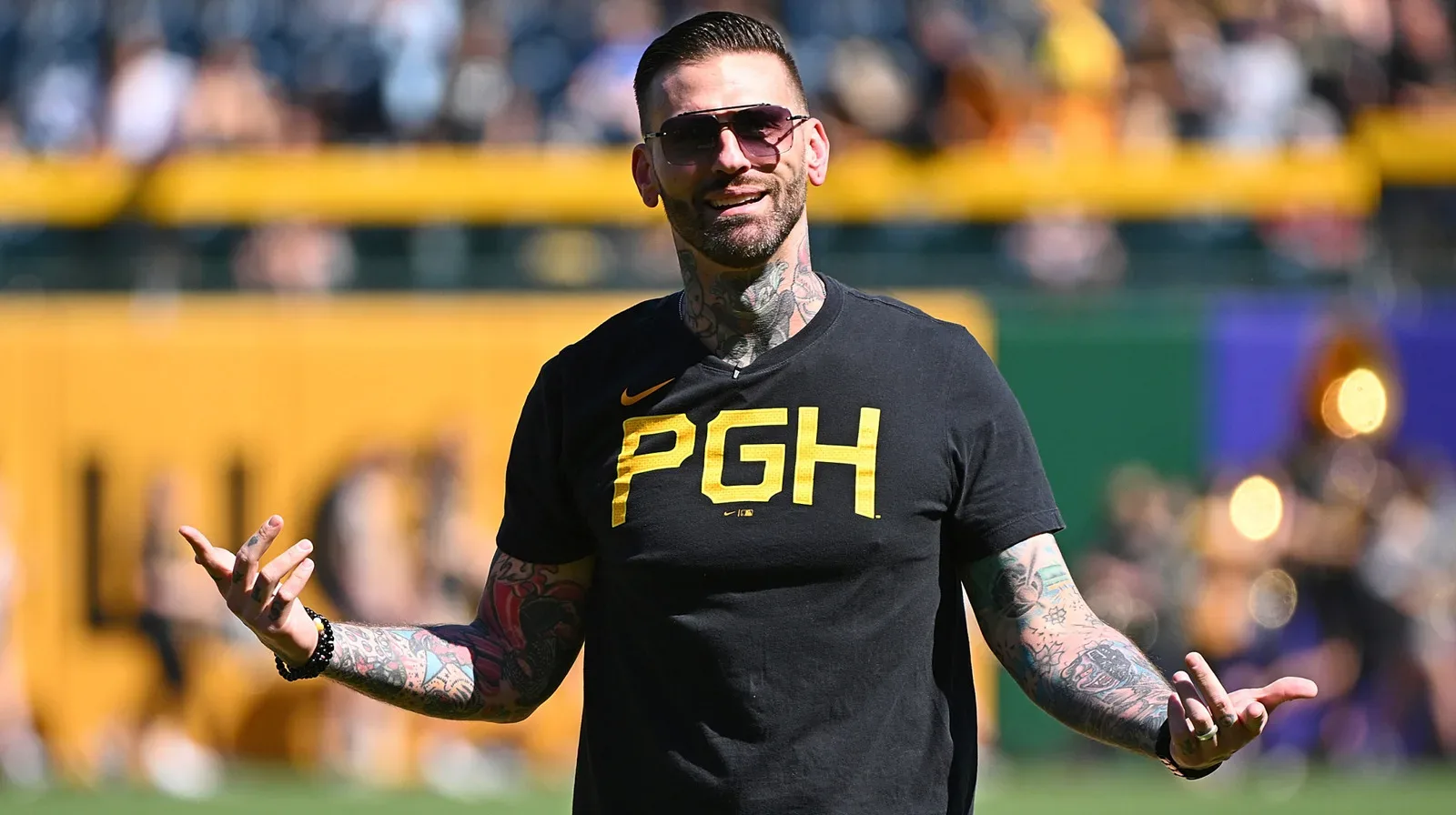
Corey Graves has offered a clear message to WWE talent: talk to the commentary team before heading through the curtain.
Speaking on Busted Open Radio, Graves explained that a commentator’s ability to strengthen a match depends heavily on understanding what the performers intend to communicate in the ring. While the announcers can react to the action as it happens and draw on established character history, Graves believes even a brief conversation before a bout can make a major difference in how effectively the television presentation serves the wrestlers.
Graves currently sits beside Michael Cole on WWE Raw as the show’s color commentator. He also works as the English-language play-by-play voice for AAA. Having spent years calling WWE programming across Raw, SmackDown, and NXT, Graves has seen how commentary can either clarify a match’s purpose for viewers or leave key motivations understated when the broadcast team has not been brought into the planned direction.
His point was not that every wrestler must reveal every move, surprise, or finish. Rather, Graves emphasized the value of knowing the central narrative: what a competitor wants to prove, which body part matters, whether a character is changing course, or what the audience should take away from a pivotal moment.
For more background on this topic, read Charlie’s Reported Post-WWE Plan Centered on New Japan Pro-Wrestling.
“I cannot overstate how important it is [to talk with] talent — hopefully some of them are listening to this right now,” Graves said on Busted Open Radio. “If you tell me what you want your story to be, I will tell it for you, and I will most likely enhance it for you. I will put my spin on things and maybe do it my own way, but I will make sure that what you want conveyed is conveyed.”
Commentary as part of the match’s storytelling structure
Modern WWE television asks commentators to do considerably more than identify holds and call near falls. The booth is responsible for providing context to casual viewers, reminding longtime fans of prior issues, reinforcing a wrestler’s motivations, and framing the consequences of a result. That responsibility becomes especially important when matches sit within larger stories that may have developed across several weeks of Raw, SmackDown, NXT, premium live events, digital programming, and social media.
A wrestler may enter a match with an obvious goal on paper, but the specific emotional thread can be harder to recognize in real time. One performer might be selling an injured knee to demonstrate resilience. Another may be wrestling more aggressively than usual to signal frustration. A villain could be attempting to escape rather than win cleanly because the character fears an opponent. Those details are more likely to register with the audience when commentary recognizes and articulates them.
Graves’ comments underline the collaborative nature of that process. The wrestlers control the in-ring performance, but the announcers guide the home audience through its meaning. When both sides are operating with the same broad objective, the presentation can feel more intentional. A commentator can reinforce a recurring strategy, call attention to a subtle shift in attitude, or prepare viewers to understand why an apparent surprise matters after the bell.
There is also an important distinction between helping tell a story and simply narrating every planned development. Wrestling depends on spontaneity, timing, and the ability to create believable reactions. Graves indicated that he would still apply his own voice and instincts to the call. His argument is that the talent should provide the destination, allowing the commentary team to help viewers follow the path there.
Graves says pre-match conversations remain uncommon
Despite the potential advantages, Graves said the number of performers who speak with him or other commentators before their matches is “remarkably low.” That observation points to a practical reality of television wrestling. On a live production day, talent are balancing meetings, rehearsals, travel, medical checks, wardrobe preparation, promotional responsibilities, agent discussions, and last-minute creative changes. With so many moving pieces, a conversation with the announce desk can be overlooked.
Still, Graves made the case that the time investment is worthwhile. A short pre-match exchange can provide information that is difficult to infer from a run sheet or from the early moments of a contest. It may tell the commentary team whether the intended emphasis is on a personal rivalry, a tactical injury, a looming character development, or a particular reaction the wrestler hopes to generate from the crowd.
That knowledge does not eliminate the need for commentators to adapt. In live wrestling, plans can change quickly. A crowd may respond differently than expected. Timing can be altered by events earlier in the show. A spot may not land as intended, or a performer may need to adjust the match on the fly. Graves views informed commentary as one of the safeguards that can help preserve the story when those unpredictable moments occur.
“It’s not rocket science — there likely isn’t something that’s going to be totally missed — but better safe than sorry,” Graves continued on Busted Open Radio. “We’re sort of that last line of defense. If something doesn’t go right, ... if I know where you’re trying to go or what your goal was, nine times out of 10, I can spin something to get the train back on the track.”
That “last line of defense” description captures a central function of an experienced broadcast team. If an angle appears unclear, commentary can explain the apparent motivation without exposing the mechanics of what happened. If a planned moment is interrupted, the announcers can focus viewers on the most meaningful remaining development. If a match’s closing sequence changes, the booth can keep the audience centered on the character implications rather than the disruption.
Cena, Styles and Reigns cited as examples
Graves pointed to John Cena, AJ Styles, and Roman Reigns as performers who would regularly discuss matches with him beforehand. The three names represent different styles, generations, and roles within WWE, but each has been associated with an ability to make the narrative of a match understandable to a broad audience.
Cena spent years as one of WWE’s defining figures and frequently worked in prominent main-event situations where the stakes had to be clearly established. Styles brought a reputation for detailed in-ring work while adapting that approach to WWE’s television format. Reigns has been positioned at the center of some of the company’s most significant long-form character stories, where every confrontation, match finish, and facial expression can carry consequences beyond a single segment.
Graves did not suggest that pre-match communication alone is what makes someone a top-level WWE performer. However, his examples support the broader point that elite talent often understand every part of presentation matters. The entrance, camera work, ring action, crowd response, commentary, and post-match fallout all contribute to whether a story connects.
For developing talent, that is an especially useful lesson. A wrestler may have an excellent match physically, but viewers still need to understand why the contest matters and what the result changes. Bringing the announcers into the loop can help ensure that a performer’s strongest ideas do not remain confined to the ring.
A perspective shaped by Graves’ WWE career
Graves’ perspective comes from someone who has experienced WWE from more than one position. His own in-ring career ended in 2014, leading him toward a long-term role behind the microphone. He went on to call NXT, SmackDown, and Raw, becoming one of WWE’s most recognizable modern commentators.
That background gives Graves an appreciation for the performers’ side of the equation. He knows the physical and creative demands placed on talent, while his broadcasting career has also taught him how quickly a match can be elevated when the commentary team understands the intended story. His present Raw partnership with Cole places him in one of WWE’s most visible weekly broadcast roles, where clarity and continuity are crucial across a three-hour live program.
The takeaway from Graves’ comments is straightforward: wrestlers do not need to script the booth’s every word, but they should make use of the people tasked with explaining their work to millions of viewers. A quick conversation can help the broadcast team stress the right details, protect a storyline when circumstances change, and add greater weight to a victory or defeat.
In an environment where WWE stories are designed to unfold across multiple shows and major events, that communication can be as valuable as any individual move. Graves wants talent to view commentary not as an outside element of the match, but as another tool available to make their intended story land.
In pictures

Darryl Polo
Darryl Polo is a passionate wrestling fan covering WWE, AEW, TNA and beyond. He loves great rivalries, breakout stars and the moments that keep fans talking long after the bell. How we work.