
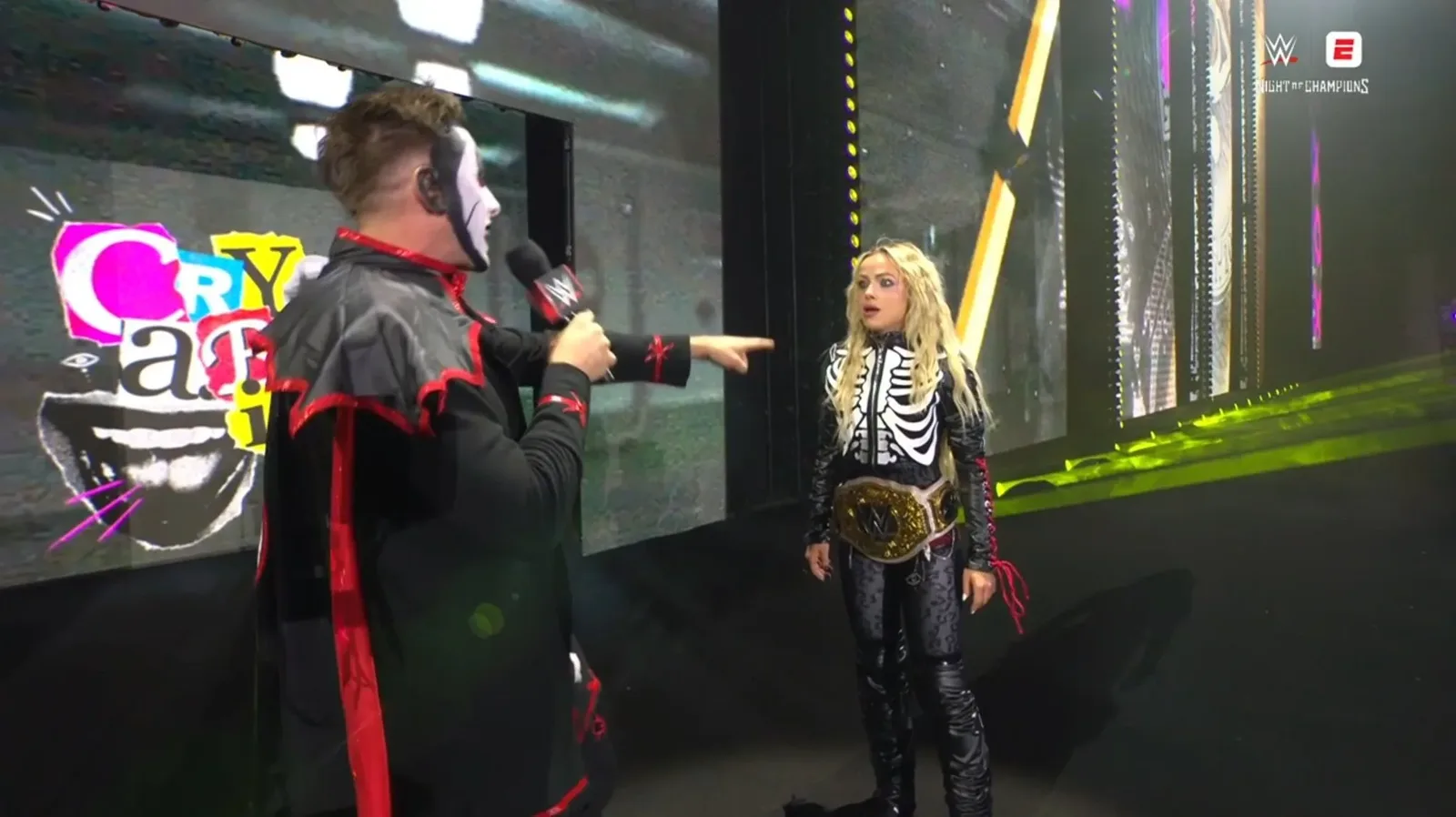
WWE history is full of storylines that remain memorable long after the original participants have moved on. Some were built around championship rivalries, while others were defined by a distinct presentation, a larger-than-life group dynamic, or an atmosphere that made the acts feel unlike anything else on the roster. Danhausen and Liv Morgan were recently asked to name the wrestling storylines they most wish they could have experienced firsthand, and their answers pointed to two sharply contrasting factions: The Undertaker's Ministry of Darkness and the controversial Right To Censor.
Danhausen selected the Ministry of Darkness, the sinister Undertaker-led stable that became one of the defining acts of WWE's Attitude Era. Morgan, meanwhile, named Right To Censor, saying that while she was choosing more of an overall concept than one particular plot, she would have been interested in doing anything connected to the group.
Danhausen sees a natural place in the Ministry of Darkness
When asked to identify the greatest wrestling story he wishes he could have been part of, Danhausen went immediately toward one of WWE's darkest presentations. The Ministry of Darkness was built around The Undertaker's ominous leader character and featured a collection of followers who carried out the group's hostile agenda across WWE television in 1999.
“Oh, the GOAT wrestling story that Danhausen wishes he could have been a part of, which is, oh, I think Danhausen would have been quite nice in the Ministry of Darkness, because I’m very evil.”
For more background on this topic, read Rey Mysterio’s Triplemanía 34 Gear Revives His 1997 Halloween Havoc Look.
The answer fits the character Danhausen has cultivated in professional wrestling. His persona has long leaned into macabre imagery, unusual threats, theatrical delivery, and a brand of villainy that can move between intimidating and deliberately absurd. That combination makes his interest in the Ministry understandable, even if the stable's tone was generally much more severe and supernatural than the offbeat sensibility associated with Danhausen.
The Ministry of Darkness remains a major point of reference whenever WWE revisits its most elaborate villain factions. The group emerged from The Undertaker's evolution following his late-1998 return, with the Deadman positioning himself as the leader of an ominous force. The stable's storylines centered on intimidation, recruitment, ritualistic imagery, and the sense that its members were operating under the authority of a figure who was bigger than a standard wrestling rival.
Its presentation gave The Undertaker a vehicle to surround himself with allies while maintaining an aura of control. The faction's membership included familiar names from that era, and its reach expanded when it became linked with The Corporation, creating the Corporate Ministry. That larger alliance placed The Undertaker at the center of a major power struggle on WWE programming and helped make the faction one of the most talked-about acts of its period.
For a performer such as Danhausen, the appeal likely goes beyond simply joining a famous stable. The Ministry allowed its members to use a unified visual identity while still supporting a clear central story. It was a world within WWE television: followers, symbols, rituals, authority figures, and an unmistakable leader. That kind of setting can give a character-driven wrestler room to add layers without needing to abandon what makes the character distinct.
Danhausen's comments did not suggest a literal desire to recreate the Ministry of Darkness in the present day, nor did he name a specific role he would have wanted within it. His answer instead reflected admiration for a landmark storyline and the type of supernatural, villainous atmosphere in which he believes his character could have fit.
Why the Ministry still stands apart
The Ministry of Darkness was created at a time when WWE programming often pursued provocative, high-concept, and highly serialized stories. Its angle work was designed to dominate television through spectacle as much as matches. The Undertaker's presence, distinctive entrance, and status as one of the promotion's most protected stars made him a particularly natural foundation for a faction that needed to feel menacing immediately.
Factions are often remembered either for their in-ring success or for the personalities involved. The Ministry is remembered for its mood. The imagery and tone made the act feel separate from more conventional heel groups, and that uniqueness is likely a major part of why it remains a frequent choice when wrestlers and fans discuss eras they would have liked to experience.
Danhausen identifying it as the “GOAT wrestling story” he would want to join also speaks to the wide range of WWE history that continues to influence current performers. A wrestler does not need to have been active during an angle's original run to recognize what made it work. In this case, the connection is clear: both the Ministry and Danhausen's own presentation place considerable value on character, visual language, and the feeling that the act brings something unconventional to wrestling television.
Liv Morgan's choice is Right To Censor
Morgan's answer came from a completely different corner of WWE history. Rather than identifying a single sprawling storyline, she pointed to Right To Censor as a faction she liked for its overall appeal. The stable was active during the early 2000s and positioned itself as a group objecting to the provocative and adult-oriented content that had become closely associated with WWE's Attitude Era.
“I don’t really know that it’s so much a story rather than just like the overall appeal. I really liked Right To Censor. I really like Right To Censor, and I think I would have liked to do anything with Right To Censor.”
Right To Censor was intentionally aggravating in its presentation. The group, led prominently by Steven Richards, used a moralizing message to challenge the behavior, language, and content around them. Its members were not framed as subtle antagonists. The act leaned into the frustration it created, from its messaging to its visual identity and the now-famous entrance presentation that immediately announced its arrival.
That directness is part of why the faction has endured in conversations about WWE's most unusual acts. Right To Censor was designed to generate a reaction by presenting itself as an opposing force to the environment around it. In an era built around rebellion, excess, and stars regularly defying authority, the group represented restriction and disapproval. The premise made it easy for audiences to understand why the act was meant to be disliked.
Morgan did not specify whether she would have wanted to be an on-screen member, an opponent, or a figure involved in a particular Right To Censor angle. Her emphasis was on the group's “overall appeal,” suggesting that she was drawn to the strength and clarity of the concept itself. Wrestling factions can be valuable not only because of the matches they create, but because they provide performers with a recognizable point of view. Right To Censor had one from the moment its music hit.
It is also notable that Morgan's pick was not simply one of WWE's most universally celebrated heroic stories. She chose a heel act with a polarizing gimmick, one remembered for committing fully to a specific idea. That reflects an appreciation for character work and presentation, qualities that have been central to Morgan's own evolution as an on-screen WWE personality.
Two faction choices, two different kinds of wrestling theater
Danhausen and Morgan's answers highlight how broad WWE's historical creative range can be. The Ministry of Darkness was built on supernatural menace and an all-consuming power structure led by The Undertaker. Right To Censor used satire, outrage, and a deliberately restrictive message to make itself an irritant to fans and fellow wrestlers alike. One was steeped in darkness and ritual; the other in censorship, judgment, and confrontation.
Yet the groups have an important similarity. Both were instantly identifiable. WWE's most enduring factions usually have that quality: a clear leader or central message, a presentation that separates them from the rest of the roster, and a purpose that affects more than one isolated match. The Ministry and Right To Censor succeeded in creating strong reactions because viewers understood exactly what each group represented.
Those qualities explain why performers can look back at factions from different decades and see possibilities for themselves. A stable can amplify a character, create fresh rivalries, and give an act a role in a story bigger than an individual championship pursuit. For Danhausen, the Ministry of Darkness represents a dark theatrical world suited to his self-described evil nature. For Morgan, Right To Censor represents an unapologetically specific act whose appeal came from its willingness to be unlike the rest of the show.
Morgan's championship change adds to a notable weekend
Morgan's comments arrived around a significant development in her WWE career. On Saturday evening, she lost the WWE Women's World Championship to Stephanie Vaquer at a WWE live event. The title change marked a major result for Vaquer and brought Morgan's reign to an end.
Championship changes at live events can carry a different energy from those staged on weekly television or premium live events. The audience in attendance gets an unexpected moment with immediate consequences, while the wider WWE audience learns of the result after it has happened. Regardless of venue, the WWE Women's World Championship remains one of the promotion's top prizes, and Vaquer's victory over Morgan is a defining result for both competitors.
As Morgan moves forward following the loss, her Right To Censor selection offers an interesting glimpse into the kind of wrestling presentation she enjoys. It is not necessarily a roadmap for her next character direction. Rather, it shows that her appreciation extends to sharply drawn concepts and factions that embraced a distinctive identity.
Danhausen's Ministry of Darkness choice and Morgan's Right To Censor choice are ultimately fantasy casting exercises, but they are revealing ones. Both WWE stars looked beyond title belts and individual dream matches to groups that made entire periods of WWE television feel different. Whether the hook was sinister spectacle or irritating moral authority, each act left a lasting enough impression to inspire performers years later.

Darryl Polo
Darryl Polo is a passionate wrestling fan covering WWE, AEW, TNA and beyond. He loves great rivalries, breakout stars and the moments that keep fans talking long after the bell. How we work.