
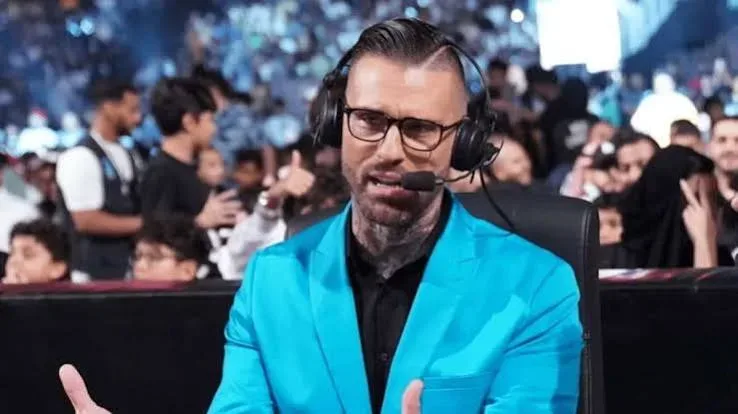
Corey Graves has explained how he was able to call AAA Noche de Los Grandes live from Italy, revealing that he worked the event remotely from Turin while already overseas for Clash in Italy.
AAA Noche de Los Grandes was built around a major lucha libre stipulation: a mask vs. mask match between the Original El Grande Americano and El Grande Americano. Graves handled commentary for the bout despite not being physically present in the building, a logistical reality that did not prevent him from becoming deeply invested in what unfolded.
Speaking with Mark Hoke on The Mark Hoke Show, Graves said his call began in the middle of the night in Italy. The unusual circumstances, he said, made his emotional response to the match all the more meaningful.
“I called that match live as it happened from Turin, Italy. We went live at 4 AM in Italy. In the middle of the night, I was in a conference room calling that match as it took place. That speaks volumes as to how magical it truly was because here I am on the other side of the globe, at four in the morning; I barely know which way is up, and I got so captivated and so caught up in that matchup.”
For more background on this topic, read Orange Crush Launches ORANGE CRUSH CRITERION Series With Free YouTube Premiere.
Graves praised both competitors for what they created in a setting where the stakes were centered on one of lucha libre’s most enduring traditions. Mask vs. mask matches have a singular level of pressure because the result is not merely a win or a loss. A wrestler’s identity, presentation and history are all placed on the line. The loser is required to unmask, making the stipulation one of the clearest examples of how deeply personal major lucha contests can become.
For Graves, the Original El Grande Americano and El Grande Americano successfully conveyed that gravity to someone calling the action from thousands of miles away.
“What those two did was absolute magic. I think it will live on as one of the greatest lucha matches in history, as well as one of the most important matches as it pertains to WWE’s partnership with AAA,” Graves said.
A Remote Call During a Major International Week
Graves was in Turin because he had already been booked for Clash in Italy. With AAA Noche de Los Grandes taking place during the same stretch, the question became whether he could still be part of the broadcast team while traveling internationally.
The answer depended on the production infrastructure available to WWE and AAA. Graves said the capability exists to call a show from virtually anywhere, provided the necessary technical setup is in place. Although he has a home setup that can be used for remote commentary assignments, he needed a solution while on the road in Italy.
“It’s tricky. For logistical purposes, we can call any show any place on Earth at any given time. I have a setup in my house. I was on the road, I was already booked for Clash in Italy. The mask vs. mask event is happening, and somebody said to me, ‘How do you plan on doing this?’ I made a few phone calls to our production team, which is world-class, and they got me all set up.”
The arrangement put Graves in a conference room at 4 AM rather than at ringside. That type of broadcast environment comes with obvious differences. A commentator working remotely must rely on video, audio, communication with production and their ability to read the atmosphere through the presentation. They do not have the same direct view of the ring, the immediate arena sound or the ability to absorb every reaction from the live crowd in person.
Still, remote calls have become an increasingly familiar part of the modern wrestling production landscape. Major companies can connect announcers, analysts, interviewers and production staff across continents when travel schedules or event timing make an in-person assignment impractical. Graves indicated that he has particular experience handling lucha events from a distance, which gave him a frame of reference for approaching the Noche de Los Grandes main event.
Graves Says He Did Not Have to Force the Emotion
Graves acknowledged that calling lucha remotely can require an announcer to consider the feeling inside the venue and translate it for viewers. In this case, however, he said the match itself eliminated any need to manufacture that perspective.
“I call a lot of these lucha events remotely so there is a lot of ‘how should this feel? How would it feel if I were in the arena?’ Kudos to both Americanos because what played out, I didn’t have to pretend, ‘What would I be feeling in this moment?’ I felt it.”
That distinction is central to Graves’ assessment of the contest. His comments were not simply about the technical success of a remote production. He emphasized that the performers communicated the stakes and drama strongly enough that he felt immersed despite the time difference, the distance from the venue and the early-morning setting.
In a mask vs. mask situation, the commentary team has an important responsibility beyond calling holds and near-falls. The announcers must provide the wider context of what a mask represents, why the competitors’ identities matter and how the result can alter the course of a wrestler’s career. Graves’ reaction suggests the match gave him ample material to convey that emotional weight as it happened.
His description of being “captivated” is especially notable given the conditions. At four in the morning, in a conference room and on the other side of the globe from the ring, it would have been easy for a commentator to focus primarily on the mechanics of the assignment. Instead, Graves said he became caught up in the story being told between the two Americanos.
The Significance for WWE and AAA
Graves also framed the match as a meaningful moment in the continuing relationship between WWE and AAA. The Noche de Los Grandes main event placed a classic lucha stipulation at the center of the show, while using a WWE commentator on the broadcast. That combination reflects the broader crossover opportunities created by the partnership.
AAA brings a deep lucha libre identity, including its emphasis on masks, rivalries and high-stakes apuestas matches. WWE’s production reach and broadcast personnel add another dimension to major presentations. In Graves’ view, the Original El Grande Americano vs. El Grande Americano encounter could stand as an important entry in the history of that collaboration.
His comments also underline the practical side of international wrestling partnerships. The relationship is not limited to talent appearing on a card or a logo appearing in promotional material. It requires coordinated production teams, flexible announcing arrangements and personnel who can adapt to schedules that cross multiple time zones. Graves’ call from Turin was a direct example of that process in action.
Rather than missing the event because of his Clash in Italy commitments, Graves was able to take part in the broadcast through the remote setup arranged by production. The situation allowed him to work two significant international wrestling assignments during the same trip, even as the timing demanded an overnight call from Italy.
TripleMania in Las Vegas Is Next for Graves
Graves’ involvement with AAA will continue quickly. He is set to be on commentary for AAA TripleMania in Las Vegas on Friday.
That assignment will follow his memorable experience at Noche de Los Grandes, where he says a match called remotely became one of the most absorbing broadcasts he has worked. Graves did not present the distance as an obstacle that diminished the main event. Instead, he viewed his own reaction as proof of how effective the match was.
For viewers, the commentary position is often part of the emotional bridge between a match and the audience at home. The announcer explains the stakes, registers the big moments and helps establish why a turning point matters. Graves’ account illustrates that this connection can still be created from a remote location when the performers and production team deliver at a high level.
In the case of AAA Noche de Los Grandes, the Original El Grande Americano and El Grande Americano gave Graves a match that he believes belongs in the conversation among the greatest lucha matches in history. Whether watching from inside the arena or listening from a conference room in Turin at 4 AM, Graves said the emotion was impossible to miss.
Darryl Polo
Darryl Polo is a passionate wrestling fan covering WWE, AEW, TNA and beyond. He loves great rivalries, breakout stars and the moments that keep fans talking long after the bell. How we work.