
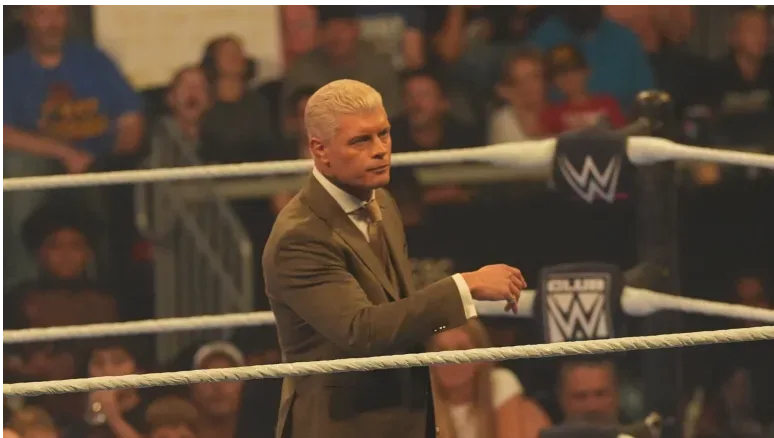
Cody Rhodes has offered one of his clearest looks yet at the timeline he envisions for the remainder of his in-ring career, estimating that he could have another six or seven years with WWE while making it clear that he does not intend to continue wrestling into his 50s.
The WWE star recently confirmed that he had signed what he considers to be his last wrestling contract. While he did not reveal the length of that agreement, Rhodes expanded on what “last” means to him during an appearance on Insight with Chris Van Vliet. Rather than framing the decision as an immediate countdown to retirement, Rhodes explained that the deal is expected to keep him involved with WWE for a substantial period and could coincide with growing opportunities away from the ring.
“I just signed my last contract,” Rhodes said. “I say last contract, but that’s going to go for a while.”
Rhodes discussed his interest in continuing to pursue acting work alongside wrestling. He indicated that he would like the current year to feature more than one film project, following his work as Guile in the upcoming Street Fighter movie. That role carries personal meaning for Rhodes, who grew up playing Capcom’s iconic fighting-game franchise.
For more background on this topic, read Cody Rhodes Says WrestleMania 42 Orbital Injury Slowed Him Down After Randy Orton Match.
When pressed for a more direct estimate on how much longer his WWE run could last, Rhodes put a number on it.
“My time with WWE could go—I mean, just to give you a real answer here, and not politic around you, probably seven years. Six, seven?”
The phrasing also prompted a lighthearted exchange, as Rhodes acknowledged the current “six-seven” reference that has circulated among younger fans. He said Carmelo Hayes had explained the reference to him, though he still did not fully understand it. The joke aside, Rhodes returned to the central point and reiterated that six or seven years feels like a realistic window.
“Yeah, six, seven years. I’d say so,” Rhodes said. “And I don’t want to say that in a final sense. I just know that I don’t want to overstay my welcome.”
Rhodes Draws a Line at Wrestling in His 50s
At 41 years old in 2026, a six- or seven-year estimate would place Rhodes’ potential in-ring departure in his late 40s. That distinction is important to him. Rhodes stressed that he has no criticism for wrestlers who remain active beyond that stage of life, but he does not see that path as the right one for his own career.
“Well, I definitely don’t want to wrestle into my 50s,” Rhodes said. “No shame to anyone who wrestles in their 50s. I don’t want to overstay my welcome in a sense of this, right?”
Professional wrestling has no single standard retirement age. Numerous legends have extended their careers well past 50, whether through full-time schedules, limited special-event matches, or occasional appearances. The demands of that choice vary dramatically depending on a performer’s health, style, schedule, recovery and role within a promotion.
Rhodes’ comments were not presented as a judgment on those wrestlers. Instead, he spoke about his own sense of how much he has already invested in the business, and how much the business has returned to him. For Rhodes, the calculation is not solely physical. It is also tied to gratitude, perspective and a desire to recognize when the right time has arrived to step back from being a regular in-ring performer.
“I have been given so much from wrestling,” Rhodes said. “You have to think about my career in its totality. The things that we don’t talk about, the things that I don’t get asked about anymore. You have to think about all that. I have shed so much of my skin for the industry, but I have also been given so, so, so much.”
Rhodes added that there can be a point where a wrestler needs to “stop taking” from an industry that has provided so much. He emphasized that he does not believe he is at that point now, but he sees it as a possibility within the timetable he outlined.
A Career Defined by Reinvention
The perspective reflects the unusual arc of Rhodes’ career. His WWE journey has included early success, a period in which he believed his upward path had reached a ceiling, a departure from the company, extensive work rebuilding his identity outside WWE, and a return that put him at the center of the promotion’s biggest stories.
Rhodes specifically looked back at the contrast between his earlier WWE position and where he stands today. He noted that his first conversation with Van Vliet came when he viewed himself as a mid-card talent in WWE, a role he was careful not to diminish. Rhodes said he had heard Triple H describe the value of the mid-card in a way that reshaped how he viewed that spot on a card.
Even so, Rhodes felt that his ceiling at the time was immediately above him. His later career changed that perception completely. His return to WWE, his championship-level positioning, and the scale of his mainstream profile have made him one of the defining figures of the current era.
That broader success has also given Rhodes possibilities he could not have anticipated during his earlier WWE tenure. Playing Guile in Street Fighter is one example. The role connects an established WWE name with one of the most recognizable characters in video-game history, and Rhodes described the experience as the kind of opportunity that forces him to appreciate how far his career has traveled.
“I’m talking to you today as someone who got to play Guile from Street Fighter, created by Capcom, a game that I played growing up as a little kid,” Rhodes said. “Again, be careful what you wish for, but also I don’t know how many moments like this I can take, and I can get hopefully more, hopefully a lot more.”
Balancing WWE and Outside Projects
Rhodes’ comments suggest he is looking toward a future in which WWE remains central to his professional life while acting and other projects become a greater part of the equation. He did not indicate that a move into film means he is preparing to leave wrestling soon. On the contrary, his six- to seven-year estimate indicates that he expects to keep competing for years.
Still, Rhodes openly acknowledged that the chance to explore different creative avenues factors into how he is approaching the latter stages of his active career. A packed wrestling schedule can be difficult to balance with feature-film commitments, media obligations and travel, especially for a performer positioned prominently on WWE programming. Rhodes appears to be considering how those worlds can coexist rather than treating them as mutually exclusive.
For WWE, retaining Rhodes on a long-term agreement provides stability around one of its most recognizable active stars. Rhodes has experience in nearly every role the industry can offer: developmental prospect, second-generation talent, tag team wrestler, singles champion, independent headliner, executive figure and WWE centerpiece. That range could give him substantial value to the company even after he eventually reduces or ends his in-ring workload.
However, Rhodes did not outline what his post-wrestling relationship with WWE might look like. His focus was on the present and on making the most of the time he believes he still has as an active wrestler.
Rhodes Addresses the Idea of “Cody Fatigue”
Rhodes also raised the subject of audience fatigue, using the phrase “Cody fatigue” while discussing the remarkable amount he has already received from wrestling. In an era of constant weekly television, premium live events, social-media discussion and expanded media commitments, top WWE performers are more visible than ever. Sustaining a major position over a long stretch naturally brings questions about overexposure.
“Cody fatigue is already pretty set in,” Rhodes said during the conversation.
When asked whether he truly felt that fatigue existed, Rhodes softened and clarified the statement rather than presenting it as a firm assessment of fan sentiment.
“Well, no, maybe. But I think you can only go so far, and you’re only supposed to go so far.”
The answer fits with the larger theme of his comments. Rhodes is not saying that he is ready to walk away. He is instead showing awareness that even the most successful careers have limits, and that a performer has to be honest about those limits before the audience makes the decision for them.
That self-awareness has been a recurring trait throughout Rhodes’ career. His willingness to change course when he felt creatively constrained helped shape his rise outside WWE and ultimately his return as a leading star. Now, with a new contract in place and opportunities beyond wrestling increasing, he is again speaking candidly about the next stage rather than pretending it will never arrive.
Rhodes also addressed how an orbital injury suffered at WrestleMania 42 has affected his work, though his broader remarks about his future were not framed as an immediate retirement concern. His stated plan remains to continue in WWE for several more years, make the most of the opportunities in front of him, and avoid extending his active wrestling career beyond the point he believes is right for him.
For now, Rhodes has placed the likely horizon at six or seven more years. That is a meaningful amount of time in WWE, particularly for a performer who remains deeply connected to the company’s biggest events and who continues to expand his profile beyond the ring. Yet his comments also make one thing unmistakable: Rhodes sees an eventual finish line, and he wants to reach it on his own terms rather than wrestle into his 50s.

Darryl Polo
Darryl Polo is a passionate wrestling fan covering WWE, AEW, TNA and beyond. He loves great rivalries, breakout stars and the moments that keep fans talking long after the bell. How we work.