
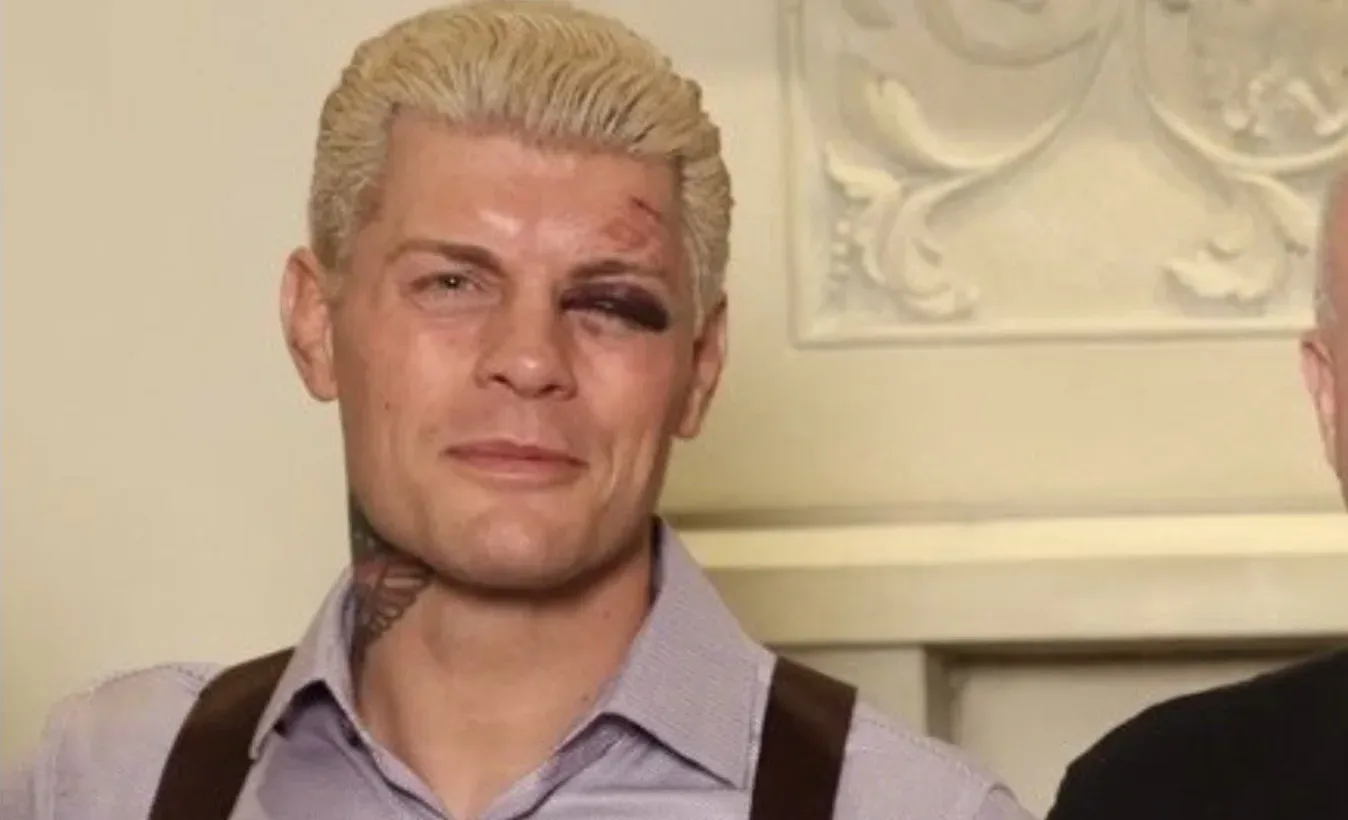
Cody Rhodes has opened up about the facial injury he suffered during his WrestleMania 42 match against Randy Orton, acknowledging that the issue affected his work after the event and briefly limited his peripheral vision.
Rhodes and Orton’s WrestleMania encounter left Rhodes with an eye swollen shut. Although he stepped away from active in-ring competition for a short period, he was back wrestling on SmackDown two weeks later. The return continued a familiar pattern for Rhodes, who has repeatedly pushed himself to perform through serious physical adversity during his WWE career.
In a new interview with Chris Van Vliet on Insight, Rhodes described the injury as a possible minor orbital fracture. He was careful not to place responsibility on Orton, instead saying that he blamed himself for the situation.
“I think we skated by with a little bit of an orbital fracture, and that’s not on anyone’s fault but my own. It was bad. I think we skated by a little bit of an orbital fracture, and I think I am mad at myself for doing so because it’s affected my work since, super slowed down.”
For more background on this topic, read WWE NXT Set For Wednesday, November 4 Showdown With AEW Blood & Guts.
The comments provide a more detailed look at the consequences of the WrestleMania 42 match. A swollen eye is an immediately visible injury, but Rhodes indicated the effects went beyond appearance. His assessment that the injury slowed him down suggests the issue remained a consideration even after he was cleared to return to WWE television and resume wrestling.
Rhodes says his peripheral vision was affected
When asked whether the injury had impacted his peripheral vision, Rhodes confirmed that it had, at least to some extent. For a performer working at the pace and physical intensity expected of a top WWE star, any limitation involving sight can become a major concern.
“Yeah, just to a degree, to a little bit, and I feel like that’s you can’t go out there QB 1 and saying you’re in your prime, and you’re the best you’ve ever been if you’re dealing with something that’s a bit of a hindrance like that, but at this point we’re out the woods. I got through it. I showed up the next night. I am toxic as can be when it comes to physical stuff. Toxic as can be. I can go. Tape it up. I can go.”
Rhodes framed the issue through the standards he sets for himself. He did not present the injury as an excuse, but he also did not minimize the reality that working with compromised vision can change what a wrestler is able to do in the ring. His “QB 1” comparison reflected the pressure he places on himself to operate like a leading player at all times rather than appearing while functioning below full capacity.
At the same time, Rhodes said he has now gotten “out the woods,” signaling that he believes the worst of the problem is behind him. That is an encouraging update considering the nature of an orbital injury and the specific visual difficulty he described. Rhodes did not offer further medical details, a formal diagnosis, or a timeline for when the issue fully improved.
A familiar mindset for WWE’s top star
Rhodes’ admission that he is “toxic” in his approach to physical pain was notable because it echoes one of the defining moments of his WWE return. At Hell in a Cell 2022, Rhodes wrestled Seth Rollins despite suffering a torn pectoral muscle. The injury became dramatically apparent before the match, yet Rhodes went through with the bout and later underwent surgery.
He has previously used similarly self-critical language when discussing that decision. The Hell in a Cell performance is remembered as a major display of toughness, but Rhodes’ comments over time have also made clear that he recognizes the potential danger in an attitude built around simply taping an injury up and continuing onward.
That context makes his WrestleMania 42 comments more revealing than a standard injury update. Rhodes is not merely saying that he was hurt. He is also identifying a personal instinct to keep going even when a physical problem could affect performance or create additional risk. In this case, he returned to compete on SmackDown two weeks after the WrestleMania match despite dealing with the aftermath of the orbital issue.
For Rhodes, that drive has been central to his identity. It has helped define his reputation as one of WWE’s most resilient performers, particularly across the long road that took him from his first WWE run through his time away from the company and then to his return as one of its foremost stars. But his own words suggest that resilience can come with a cost when the injury involves something as fundamental as vision.
The Randy Orton rivalry remains active
The injury came out of Rhodes’ WrestleMania 42 bout with Orton, and the rivalry between the two remains ongoing. Rhodes and Orton have a lengthy shared history, with their connection dating back to their time in Legacy alongside Ted DiBiase Jr. Their current conflict carries the weight of that history, making it more than a simple clash between two major WWE names.
Rhodes stated that Orton was not to blame for the orbital injury. That distinction matters in the context of an intense feud, where viewers may naturally connect a legitimate injury to the opponent involved in the match. Rhodes instead took personal responsibility while acknowledging that the result was serious enough to leave his eye swollen shut and affect his work in the weeks that followed.
The program has continued, with Rhodes now doing the punting as the situation between the former allies escalates. That development underlines how far the rivalry has progressed. Their history once positioned them on the same side as part of a younger generation trying to establish itself in WWE. Now, their conflict has become one of the company’s active personal issues, with Rhodes and Orton continuing to raise the stakes.
Rhodes says he has moved beyond the setback
While Rhodes was candid about the impact of the injury, his overall message was optimistic. He believes he made it through the difficult stretch and is no longer dealing with the same hindrance. His willingness to discuss the slowed pace and limited peripheral vision also adds perspective to his post-WrestleMania appearances, especially given how quickly he returned to competition.
There is a difference between being physically able to appear and being able to perform at the level a wrestler expects from himself. Rhodes made that difference clear. He was able to get back in the ring, but he did not feel entirely comfortable characterizing himself as fully at his best while the orbital issue still created a limitation.
That honesty is particularly significant for someone whose career has featured high-profile examples of enduring pain in pursuit of a match or a moment. Rhodes has built substantial goodwill through that toughness, but his remarks also serve as a reminder that performing through an injury is not always a straightforward measure of readiness.
For now, Rhodes says the orbital concern is behind him. With the feud against Orton still moving forward, he will have little time to dwell on the WrestleMania 42 aftermath. Still, the revelation explains why the period following the match was more difficult than it may have appeared from the outside.
Rhodes remains determined to keep moving, as his comments made abundantly clear. Yet his latest update also showed a more reflective side of that determination: the recognition that the urge to push through everything can affect the work itself, even for a wrestler who has made a career out of refusing to stay down.

Darryl Polo
Darryl Polo is a passionate wrestling fan covering WWE, AEW, TNA and beyond. He loves great rivalries, breakout stars and the moments that keep fans talking long after the bell. How we work.