
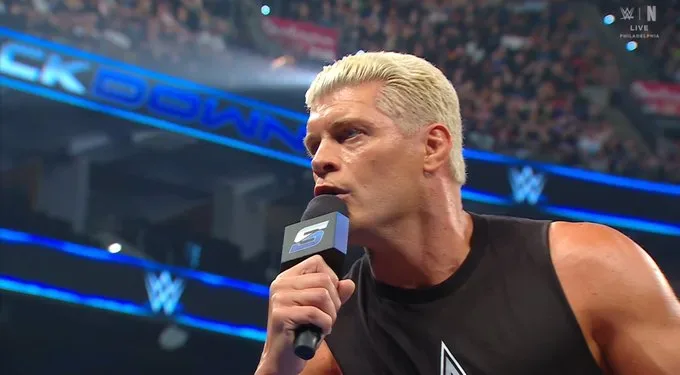
Cody Rhodes has offered a blunt take on one of professional wrestling’s longest-running language habits: referring to WWE as “The Fed.”
During a conversation with AJ Styles on What Do You Want To Talk About?, Rhodes addressed the wider debate over wrestling etiquette, paying dues and traditions that continue to be passed between generations. While he made clear that he respects wrestlers across the industry, Rhodes questioned whether some of the terminology and customs associated with an old-school mindset still have a useful place in the modern business.
For Rhodes, terms such as “The Fed” and “New York” are not just alternate names for WWE. They can signal an outlook he believes is disconnected from how the industry operates today.
“This has been a big discussion about etiquette and paying dues and that old-school mentality,” Rhodes said. “I don’t know where this really came from, but I’ve had a couple of really old guys make the joke, ‘Oh, now I know you’re stiff’ after a handshake, but I don’t know any wrestler that I’ve really respected—and I respect like every wrestler—but I can’t recall one that did that.”
For more background on this topic, read LA Knight Calls Logan Paul the Greatest Rival of His Career So Far.
The WWE star’s comments came in the context of a broader conversation about standards that are often treated as unwritten requirements for wrestlers entering a locker room or working independent events. In wrestling, the idea of “paying dues” can cover a wide range of expectations, from learning the practical work required around a show to showing deference to more experienced performers. The phrase has also become a flashpoint when veterans and younger talent disagree about whether a particular custom represents professionalism or simply an outdated test.
Rhodes did not dismiss respect for wrestling history. Instead, his point was that reverence for the past does not require everyone to preserve every piece of its vocabulary or every ritual associated with it. He specifically challenged the continued use of older shorthand for WWE.
“You know how people say, ‘New York’? ‘Oh, he went to New York.’ When I hear that, I know you don’t know anything about the modern world,” Rhodes said. “It feels like it’s this old thing that the indies kept and that’s no longer how we say things anymore, or ‘The Fed.’ If somebody hits me with ‘The Fed,’ I’m blanked out already. It feels passed down in the wrong way.”
“New York” and “The Fed” have both long been used as informal references to WWE. Their roots are tied to eras when the company was commonly identified with the World Wrestling Federation name and its New York business base. Even after the company’s branding evolved into WWE, the terms remained part of wrestling vernacular, particularly among fans and performers who came up around independent wrestling scenes.
Rhodes’ reaction illustrates the divide between language that may be intended as tradition and language that can sound frozen in a previous era. WWE is a global company with a modern corporate identity, and Rhodes’ view is that continuing to rely on those older labels says more about the speaker’s attachment to a past version of wrestling than it does about the current landscape.
Etiquette Remains a Major Wrestling Conversation
The subject of etiquette has never been far from wrestling discourse. Some practices are practical: arriving prepared, treating fellow wrestlers and production staff professionally, understanding one’s responsibilities at an event and being willing to help when help is needed. Others are more ceremonial, including expected greetings in a locker room or traditions that vary dramatically depending on the promotion, region and generation involved.
The difficulty is that wrestling has never had one universal rulebook for these social expectations. A behavior viewed as standard in one environment can be irrelevant in another. That has made “old-school” etiquette a complicated subject, especially as the industry has become more accessible, more visible online and more shaped by performers from different training backgrounds.
Rhodes’ comments did not argue against courtesy or accountability. Rather, he expressed skepticism that certain behaviors often presented as essential rites of passage were actually common among the respected wrestlers he has encountered. His recollection of older wrestlers joking about a handshake being stiff served as an example of a custom he has heard referenced but does not associate with the people he most values.
That distinction is important. There is a difference between respecting colleagues and accepting every inherited practice as a meaningful measure of respect. Rhodes framed some old expressions and mannerisms as habits that have been handed down without enough consideration of whether they still communicate anything useful.
Rhodes and Styles Bring Distinct Perspectives
The discussion carries added weight because Rhodes and Styles have each experienced major shifts in wrestling over the course of their careers. Both have worked in different environments and alongside performers from multiple generations. Their careers also make them useful voices in conversations about how traditions survive, change or disappear.
Rhodes has been associated with WWE at several defining points in his career, while also having extensive experience outside that environment. Styles built a reputation across a variety of prominent wrestling stages before arriving in WWE. Their conversation therefore reflects more than one narrow view of what a wrestler is supposed to do in order to earn acceptance.
Neither man’s perspective requires a rejection of wrestling culture as a whole. Instead, the exchange highlights the need to separate values from terminology. Professionalism, preparation and consideration for others can remain important regardless of whether a performer uses language that originated decades ago. Likewise, a new wrestler can appreciate the people who built the industry without treating every old phrase as mandatory.
Rhodes’ observation that he respects “like every wrestler” also gave his criticism a clear boundary. His issue was not with veteran performers as a group. It was with the reflexive recycling of phrases he believes are no longer representative of the world wrestlers currently inhabit.
The Conversation Also Touched on Independent Shows
Elsewhere in their conversation, Rhodes and Styles discussed Styles’ son Avery and whether he should have been setting up chairs at an independent wrestling event. That topic fits naturally within the larger subject of dues and expectations around live events. Helping with setup is frequently viewed as a straightforward way for people around a show to contribute, but the conversation around who should be expected to do what can quickly become wrapped up in broader ideas about hierarchy and tradition.
The mention of Avery underlines why etiquette debates remain personal in wrestling. These are not always abstract arguments about terminology. They can involve younger people entering wrestling spaces, families connected to performers and the expectations that established figures place on those around them.
At the same time, Rhodes’ comments suggest that the purpose behind an expectation matters more than the performance of tradition for its own sake. If a practice teaches responsibility, supports the event or demonstrates consideration for the people doing difficult work, it may have obvious value. If it mainly exists because someone heard it was important from a prior generation, the case for continuing it is less clear.
Modern Wrestling Does Not Stand Still
Wrestling is built on continuity. Its performers learn from people who learned from other performers, and stories about the way things used to be are a central part of the culture. But it is also an industry in constant motion. Promotions change, training changes, audiences change and the language used to describe the business changes with them.
Rhodes’ “blanked out” response to “The Fed” is a humorous line, but it also delivers a serious message. In his view, outdated terminology can prevent a meaningful conversation before it starts because it suggests the speaker is approaching a current reality through an old lens.
That will not end the use of “New York” or “The Fed.” Wrestling vocabulary has a long memory, and many fans and wrestlers use such terms casually rather than as a statement of philosophy. Still, Rhodes has made his own position clear: when the discussion is about modern WWE and modern wrestling, he would rather move beyond language he sees as inherited in the wrong way.
For Rhodes, the strongest version of wrestling etiquette is not blind adherence to a collection of old phrases and informal tests. It is respect that remains relevant, practical and sincere in the present.

Darryl Polo
Darryl Polo is a passionate wrestling fan covering WWE, AEW, TNA and beyond. He loves great rivalries, breakout stars and the moments that keep fans talking long after the bell. How we work.