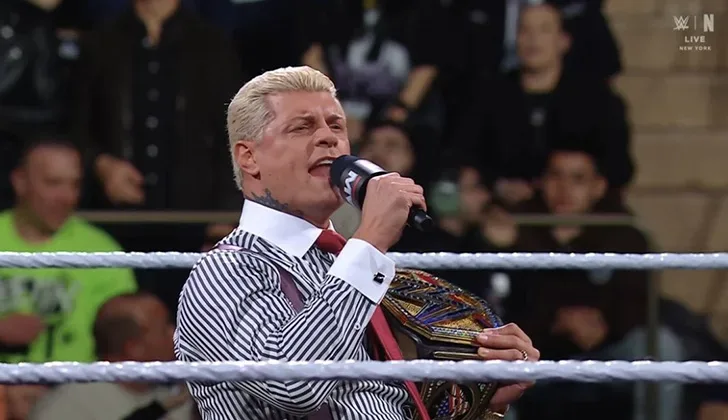
Cody Rhodes has shared a pair of revealing stories from very different stages of his WWE career: one involving an ill-fated prank engineered by Triple H, and another centered on the creative breakthrough he found through his memorable masked storyline opposite Rey Mysterio.
Rhodes, a former WWE Undisputed Champion, looked back on the incidents during a recent interview. His comments offered perspective on the sometimes unforgiving locker-room humor of his early years, while also underlining the importance of Mysterio’s belief in him at a pivotal point in his development as a singles performer.
For Rhodes, the two memories are connected by more than their place in his career history. Both came during a period when he was still defining who he could become in WWE. One was a lesson delivered through a painful and embarrassing rib. The other opened a door to a character direction that allowed him to show a more intense and unusual side of his personality.
Triple H’s DX prank left Cody Rhodes covered in paint
The prank took place during an overseas tour, although Rhodes was not certain whether the group was in Belfast or Dublin at the time. DX had been touring, and a white banner had been added to the pipe-and-drape entrance area. The letters “DX” had been spray-painted across it, with the display held in place by what Rhodes described as a single piece of lumber at the top.
For more background on this topic, read WWE Launches WWE Ahora, Its First Spanish-Language Podcast.
Triple H noticed the setup and encouraged Rhodes to pull the banner down. Rhodes was aligned with Randy Orton in Legacy at the time, and he recalled being told that tearing it down would anger the DX members. Looking back, Rhodes suspects the situation may have been more carefully arranged than it first appeared.
“That was a bad rib,” Rhodes said. “And I think he knew it was a bad rib.”
When Rhodes followed through and pulled the banner down, the board supporting it came forward and struck him in the back of the head. The impact left him shaken, but that was only part of the joke. The spray paint from the DX display scattered across his body, leaving him visibly speckled as he made his way to the ring.
Rhodes compared the experience to being slimed. As he entered the ring covered in paint, Triple H and Shawn Michaels pointed and laughed. It was not a flattering moment, and Rhodes plainly viewed it as an especially rough rib, but he also suggested that it was a learning experience from the environment he was working in.
“So now I’m jarred, and people are laughing at me,” Rhodes recalled. “But also the speckled spray paint covered my body.”
The story captures a familiar reality of WWE’s past locker-room culture, where practical jokes could be used as a form of initiation, entertainment, or hierarchy. Rhodes did not present the incident as harmless, calling it a bad rib, and the physical aftermath clearly made the stunt worse than a simple visual gag. Still, the fact that he can recount the moment years later also reflects the long professional history he shares with Triple H.
That relationship has evolved considerably since Rhodes’ early WWE run. At the time of the DX prank, Rhodes was a young performer working to establish himself alongside Orton and Ted DiBiase Jr. He would later leave WWE, help launch a new chapter in his career outside the company, and eventually return to become one of WWE’s leading stars. Triple H, meanwhile, has become a central creative executive within WWE. The old prank is a reminder of just how far Rhodes’ path has traveled.
The mask angle gave Rhodes room to explore
Rhodes also revisited his 2011 program with Rey Mysterio, a rivalry remembered for the facial injury angle that led to Rhodes wearing a protective mask. In storyline, Mysterio broke Rhodes’ nose, and the injury became the foundation for a dramatically different presentation of the younger Rhodes.
Rather than simply portraying the mask as a medical necessity, the story leaned into Rhodes’ fixation with his appearance and his belief that he had been disfigured. Rhodes described the direction as a deep place to explore early in his career, particularly because it examined the character’s distorted self-image even when he was not actually disfigured.
He credited the environment on SmackDown at the time with allowing him substantial latitude to develop the concept. Michael Hayes was serving as SmackDown’s head writer, and Rhodes said he was given room to create his own material within the angle. That freedom mattered because the storyline became more than an injury-based feud; it developed into a full character transformation.
“That was a moment in time where I was given a lot of freedom, a lot of latitude,” Rhodes said. “I was given a lot of latitude to create something on my own.”
Rhodes wore the mask as his character became increasingly vain, bitter, and theatrical. The angle also included his infamous paper bags, which he would place over the heads of fans as part of the act. He recalled that the bit occasionally created concern backstage because of whom he selected, but Rhodes said he avoided approaching people simply to force the gag upon them. In his view, the interaction worked best when fans in the crowd actively wanted to participate.
The mask era became an important example of Rhodes finding a distinctive voice. It gave him a visual identity, a clear emotional motivation, and a memorable way to make his reactions to Mysterio feel personal. It also showed that Rhodes could carry a character-driven story beyond the boundaries of a standard match rivalry.
Rhodes noted that wrestling is strongest when organic developments can lead performers into something new. A legitimately broken nose gave the company a starting point, but the creative response is what made the program endure. The mask did not merely cover Rhodes’ face; it became a symbol of the character’s insecurity and escalating obsession.
Why Rey Mysterio remains so important to Rhodes
More than a decade later, Rhodes still views Mysterio as essential to the trajectory of his career. He believes the WrestleMania match they had in Rhodes’ hometown of Atlanta served as a major launching point, and he does not think Mysterio or Mysterio’s son, Dominik, fully accept how strongly he feels about that influence.
“Nothing happens in my career without Rey Mysterio wanting to wrestle against me at WrestleMania in my hometown here in Atlanta,” Rhodes said. “Everything stems out of that moment.”
That statement is notable not only because it credits Mysterio’s in-ring work, but because it recognizes the value of a veteran choosing to work with an emerging talent in a significant setting. WrestleMania exposure in Atlanta gave Rhodes a major stage, and the resulting angle allowed him to display far more range than he had previously shown.
Rhodes’ appreciation for Mysterio extends beyond that particular program. He described Mysterio as a “timeless” character and said the WWE Hall of Famer has continued to appear in unexpected ways throughout his life. Even the watch Rhodes was wearing during the interview came through a jeweler Mysterio had recommended to him.
It is a small detail, but it reinforces Rhodes’ larger point: Mysterio has been present at meaningful points in both his professional and personal life. For Rhodes, the connection is not limited to a feud from an earlier era. It is part of the broader network of relationships and opportunities that helped shape his career.
Rhodes comes off a loss to Randy Orton
Rhodes was most recently in action at WWE Sunday Night’s Main Event last weekend, where Randy Orton defeated him in a singles match. The result adds another chapter to the lengthy history between the two former Legacy stablemates.
Orton and Rhodes once stood together as part of a group designed around WWE’s second- and third-generation talent. Their careers have since taken them through very different routes, including clashes as opponents at major points along the way. Rhodes’ recollection of the DX prank also places that period in sharper focus: he was a young Legacy member navigating a WWE locker room filled with established names, including Orton, Triple H, and Michaels.
Today, Rhodes has the experience to look back on those formative years with a fuller understanding of what they taught him. The Triple H rib remains a painful example of the hazing-style humor that could accompany life on the road. The Mysterio program, by contrast, stands as a creative turning point that gave Rhodes a greater sense of what he could offer as a performer.
Both stories ultimately illustrate the long road behind Rhodes: from a young wrestler absorbing difficult lessons to a star who recognizes the performers and moments that changed his direction.
Darryl Polo
Darryl Polo is a passionate wrestling fan covering WWE, AEW, TNA and beyond. He loves great rivalries, breakout stars and the moments that keep fans talking long after the bell. How we work.