
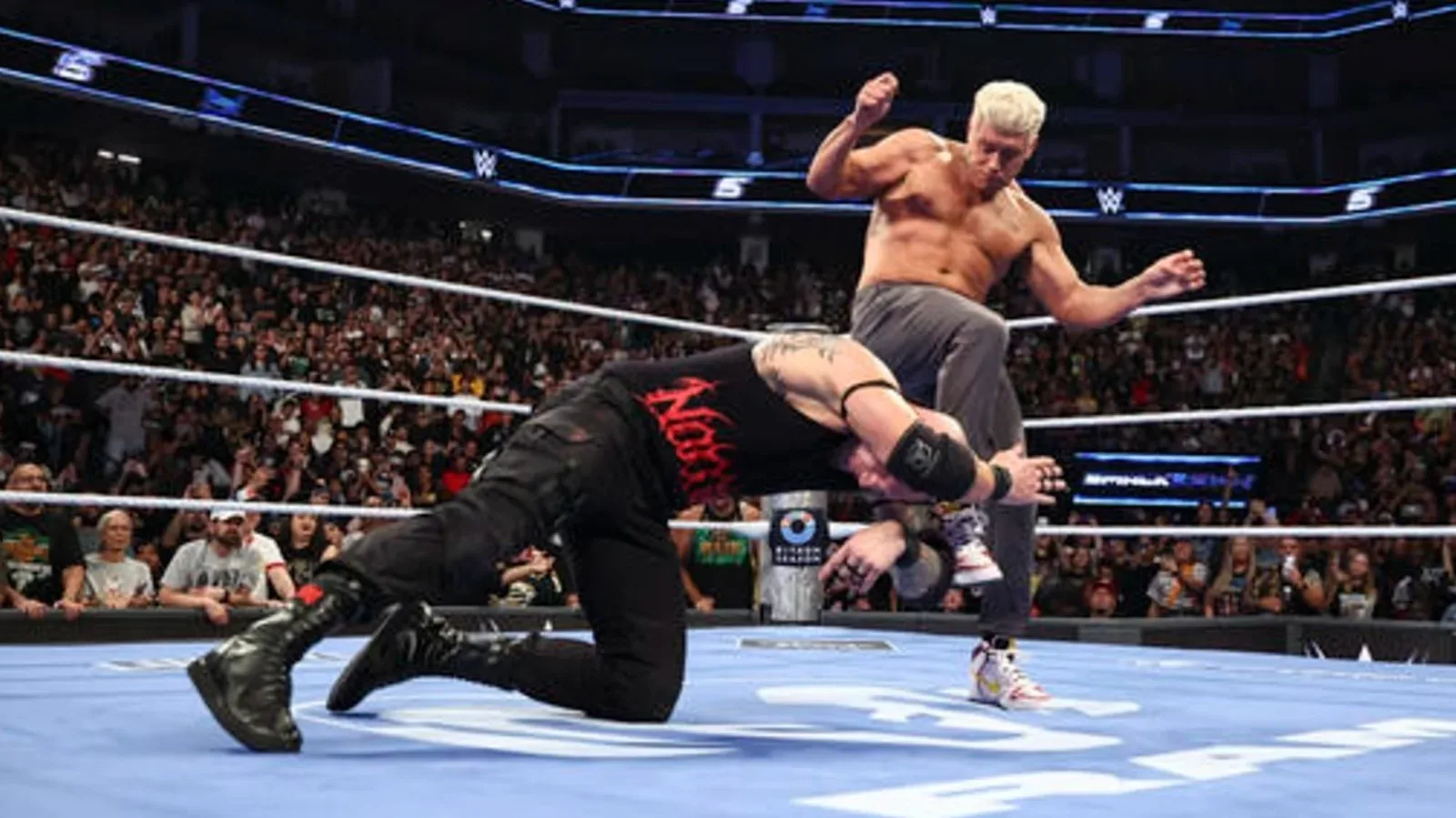
Cody Rhodes did not bring out the punt kick just to settle a score with Randy Orton. Speaking on 7PM in Brooklyn with Carmelo Anthony, Rhodes said he wants to keep the move in his WWE repertoire after the feud that gave him a reason to use it. Orton, the wrestler most closely associated with the punt and the man Rhodes borrowed it from, may not be the last person to take one from him.
It is a notable decision given what happened when Rhodes was on the other end of the move. He suffered an orbital bone fracture after Orton hit him with the punt, and the injury affected him for a long time. Rhodes said the visible damage around his eye helped persuade him that the punt should become part of his own offense. He also acknowledged that the move carries a real risk, one he knows from experience and one that has already prompted WWE to take it away before.
How the injury changed Rhodes’ thinking
Rhodes traced the decision back to the way his eye looked after Orton’s punt. He described the injury as an obviously unfortunate development that also left the feud with a striking image. Once that image was out there, Rhodes saw a reason to take the rivalry in a harsher direction. Using Orton’s move was a way to do that without having to explain why this particular feud had brought out a more vicious side of him.
Orton was a friend before he was a rival, and the fact that the punt belonged to him gave Rhodes’ use of it a meaning it would not have had against another wrestler. Rhodes was not simply adding a move with a reputation for ending confrontations. He was turning the move that injured him back on the man who delivered it. The injury gave that choice weight, while the history between the two men made it personal.
For more background on this topic, read Ken Anderson Explains How His WWE Days Prepared Him for Film Acting.
“I don't think Randy Orton will be the only person who is on the receiving end of a punt kick from me,” Rhodes said. “I think it's something to take forward, and you got it from the best at it, so got to keep it going.”
That last line was a direct acknowledgment of Orton. As much as the punt allowed Rhodes to get back at his former friend, he still credited Orton as the best at it. There is a difference, though, between using a rival’s move once and keeping it when the rivalry is over. The first is a pointed act of payback. The second means bringing a piece of that rivalry into whatever comes next.
Rhodes understands why WWE banned the punt
Rhodes did not play down the danger when discussing why he wants to keep the move. He made a distinction between injuries that can happen in wrestling and moves whose history of real injuries, in his view, goes beyond what is acceptable. The punt was his immediate example. In his explanation, WWE’s previous ban reflected the fact that even taking precautions did not remove the underlying risk.
“They banned it because there wasn't a way, even with the safest of safe,” Rhodes said. “It's just a very dangerous move, which is when wrestling is at its best. It's real.”
Those comments explain both the appeal Rhodes sees in the punt and the limits he expects to face. He believes it can raise the stakes because the audience understands what it can do. But he also spoke about the possibility of WWE banning it again and putting it away. That was Rhodes speculating about how long he might be able to keep using it, not announcing that WWE has made a new decision about the move.
His own injury makes it difficult to separate the punt’s reputation from its consequences. Fans do not have to take Rhodes’ word for it when he says the move is dangerous: the fractured orbital bone was part of what led him to use it in the first place. That makes his decision to hold on to the punt more complicated than a wrestler finding a new signature move. The same injury that helped establish why it mattered in the feud is evidence for why WWE has restricted it.
What the punt could mean beyond the Orton feud
Against Orton, the reason for the punt was clear before Rhodes ever used it. Against somebody else, the circumstances would have to do more of the explaining. A future rival would not carry the same history, and Rhodes could no longer rely on the immediate logic of returning the move to the man who injured him. What would carry over is the audience’s memory of how Rhodes came to use it and what he was willing to do once the rivalry reached that point.
The move could fit a future heel turn, but Rhodes did not announce one. He did not identify another opponent or say when he intends to use the punt again, either. His comments established that the move is available to him, not that a change in alignment is necessary to bring it back. A wrestler can show a more ruthless side in a bitter rivalry without turning heel, and Rhodes’ feud with Orton already gave him room to do that.
Frequency is another open question. Saying Orton will not necessarily be the only recipient is different from saying the punt will become a fixture in Rhodes’ matches. Keeping it in reserve would preserve the distinction between his usual offense and a move associated with a feud that turned especially personal. Using it more regularly would make it easier for fans to see it as Rhodes’ move, but it would also put more attention on the safety concerns he raised himself.
For now, Rhodes has made his intention clear without making any promises about the next use. Orton gave him the idea, and the injury gave him a reason to act on it. Rhodes wants the option to use the punt when the opponent is no longer Orton and payback is no longer the point. Whether WWE lets him keep that option is the question he left open.
In pictures

Darryl Polo
Darryl Polo is a passionate wrestling fan covering WWE, AEW, TNA and beyond. He loves great rivalries, breakout stars and the moments that keep fans talking long after the bell. How we work.