
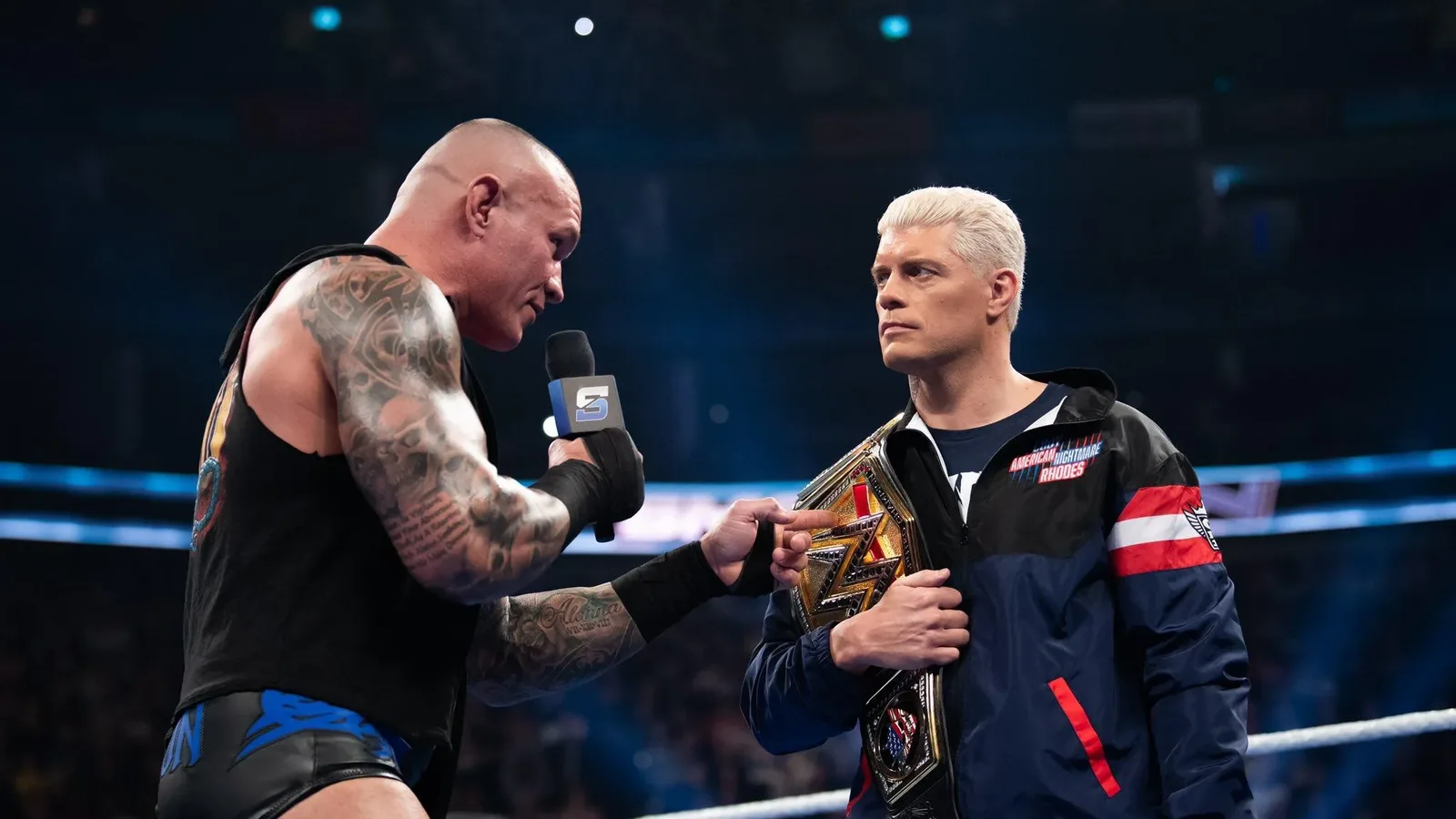
Cody Rhodes has shared a powerful assessment of Randy Orton’s standing in professional wrestling, placing his longtime WWE peer within what he calls a highly exclusive “golden circle” of all-time performers.
Rhodes and Orton have a history that stretches back to the formative stages of Rhodes’ WWE career. They were linked together in Legacy, the faction also featuring Ted DiBiase Jr., where the second-generation stars operated under Orton’s leadership. Their relationship has changed dramatically over time, however. The two have since met as rivals, with Orton’s attacks on Rhodes serving as some of the most personal moments in their shared WWE history.
That competitive and often hostile on-screen history has not diminished Rhodes’ respect for Orton as a wrestler. In a new interview, Rhodes explained that Orton occupies a very small tier of talent in his mind, using terminology he credits to WWE Hall of Famer Arn Anderson.
“Arn Anderson used to refer to it as this golden circle of wrestlers,” Rhodes said. “I always struggle when we talk about GOATs or talk about Mount Rushmore because there’s so many and there’s so many years of equity.”
For more background on this topic, read WWE Raw Misses Netflix Top 10 After August 31 Episode.
The idea of a single greatest wrestler, or even a fixed Mount Rushmore, is naturally difficult for Rhodes to embrace. WWE’s history spans generations, styles and eras that can be hard to compare directly. A performer who defined the national expansion period carries a different legacy from someone who excelled during the Attitude Era, the Ruthless Aggression era, or the modern global WWE landscape.
Rhodes’ point is not that such debates are unimportant. He made clear that he enjoys watching wrestling across its history, both classic and contemporary. But the “golden circle” is a different type of designation. It is not simply an argument about title totals, longevity, popularity or accolades. It is about the rare ability to enter a ring and deliver at the highest level when the moment demands it.
Orton’s Place Among WWE’s Most Dependable Big-Match Wrestlers
For Rhodes, Orton unquestionably meets that standard. The former WWE Champion pointed to John Cena as another example of the kind of performer he means: a wrestler with an extraordinary body of work, a major legacy, and the capacity to produce greatness on any given night.
“He’s in that golden circle, and that’s a count on one hand,” Rhodes said of Orton. “Maybe it’s just three.”
That is a significant statement considering Rhodes’ perspective. He grew up around the business as the son of Dusty Rhodes, trained and developed under the WWE system, broadened his experience across the independent scene, helped launch AEW, and ultimately returned to WWE to become one of its defining stars. He has shared rings and locker rooms with talent from several major wrestling generations.
Rhodes’ praise also reflects the unusual longevity of Orton’s WWE career. Orton became a major figure in the company at a remarkably young age, rose to world championship status early, and has remained a prominent presence through multiple creative eras. Along the way, his character has shifted between calculating villain, unstable aggressor, veteran leader, fan favorite and ruthless rival without losing the central qualities that make him immediately recognizable.
In-ring, Orton’s reputation has long been tied to timing, control and an ability to make major moments feel sudden. Rhodes specifically referred to the unpredictability built into Orton’s signature move.
“The RKO out of nowhere, that’s the whole bit,” Rhodes said.
The phrase has become synonymous with Orton because it captures more than a finishing maneuver. An RKO can alter the course of a match in an instant, whether Orton is absorbing punishment before a comeback, stopping an opponent’s momentum, or creating a highlight from an unexpected position. It is a feature of his presentation that has endured because it makes every opening feel dangerous.
Rhodes believes that same unpredictability applies to Orton’s overall performance level. He described the challenge of facing Orton as knowing that the veteran could be at his absolute best on any particular night.
“Any given night, he could be the best he ever was, and you just hope that you’re better than him,” Rhodes said.
That observation speaks to a core element of elite wrestling competition. A wrestler may enter a match with a strategy, a history with an opponent and confidence in their own preparation. Yet performers of Orton’s caliber bring a different kind of pressure. They are capable of changing the rhythm of a contest, connecting with the crowd at precisely the right time, and turning relatively small decisions into defining moments.
From Legacy to a Difficult Rivalry
Rhodes’ comments carry added weight because Orton is not just a respected contemporary from a distance. Their careers have been intertwined for years. Legacy positioned Rhodes alongside Orton at a crucial early point in his WWE run, placing Rhodes near an established main-event name and allowing him to learn within a high-profile environment.
That history has given their later confrontations an added emotional layer. When former allies become opponents, the story is not solely about who wins the next match. It is also about shared experiences, influence and the uncomfortable reality of competing against someone who helped shape a wrestler’s career.
Rhodes acknowledged that emotional complication directly. He said there is a difficult side to facing the wrestlers he admired, revered or learned from. The pressure is not merely professional; it comes from wanting to prove oneself against a figure whose work already carries deep personal meaning.
“The last thing you want to do is wrestle the guys who you loved and revered and taught you,” Rhodes said. “The last thing you want to do is be the one that’s, ‘Hey, it’s got to be me.’”
For Rhodes, though, that discomfort is part of what makes those matches meaningful. He said he appreciates the pressure that comes with being placed opposite a wrestler from that elite class. A contest with someone like Orton is not a routine assignment. It is a test against an opponent whose reputation has been built through years of major matches and memorable moments.
There is also an inherent contrast in their professional journeys. Orton was established as a top WWE star when Rhodes was still finding his footing on the main roster. Rhodes later left WWE, remade his identity outside the company, and returned with a singular goal of winning the championship that had eluded his family. Their rivalry therefore brings together two performers who have each evolved substantially since their original Legacy association.
Why the ‘Golden Circle’ Matters
Wrestling discussions are full of lists, rankings and debates over who belongs among the greatest ever. Rhodes does not reject those conversations. He simply suggests that the most meaningful category may be even narrower than a conventional Mount Rushmore.
The “golden circle” is defined by a combination of career achievement and present-tense capability. A wrestler can have historic accomplishments, but Rhodes’ standard also requires that they remain capable of creating something special when they step into the ring. In Orton’s case, Rhodes sees both components: an accomplished legacy and the ability to be exceptional at any moment.
It is telling that Rhodes framed the group as potentially containing only a handful of names. That does not diminish the many legends and outstanding wrestlers he recognizes. Instead, it underscores how difficult it is to reach the particular level he is describing. The distinction is reserved for performers whose presence changes expectations before a match even begins.
Orton’s career has produced the kind of confidence Rhodes is describing. Fans know the potential exists for an RKO at any time. Opponents know they are sharing the ring with a wrestler capable of making the most important sequence of the match feel effortless. And fellow performers, including Rhodes, recognize that the standard is elevated when Orton is involved.
Rhodes’ assessment ultimately goes beyond a former faction partner or a familiar rival. It is a statement of genuine professional admiration for one of WWE’s most enduring stars. Their past includes alliance, conflict and violence, but Rhodes sees Orton’s place in wrestling history with clarity.
In Rhodes’ view, Randy Orton is not merely a great wrestler with a celebrated resume. He is one of the exceptionally rare talents who belongs in the business’ most select company—and one who can still make any given night feel like a test of who is truly the best in the ring.
Darryl Polo
Darryl Polo is a passionate wrestling fan covering WWE, AEW, TNA and beyond. He loves great rivalries, breakout stars and the moments that keep fans talking long after the bell. How we work.