
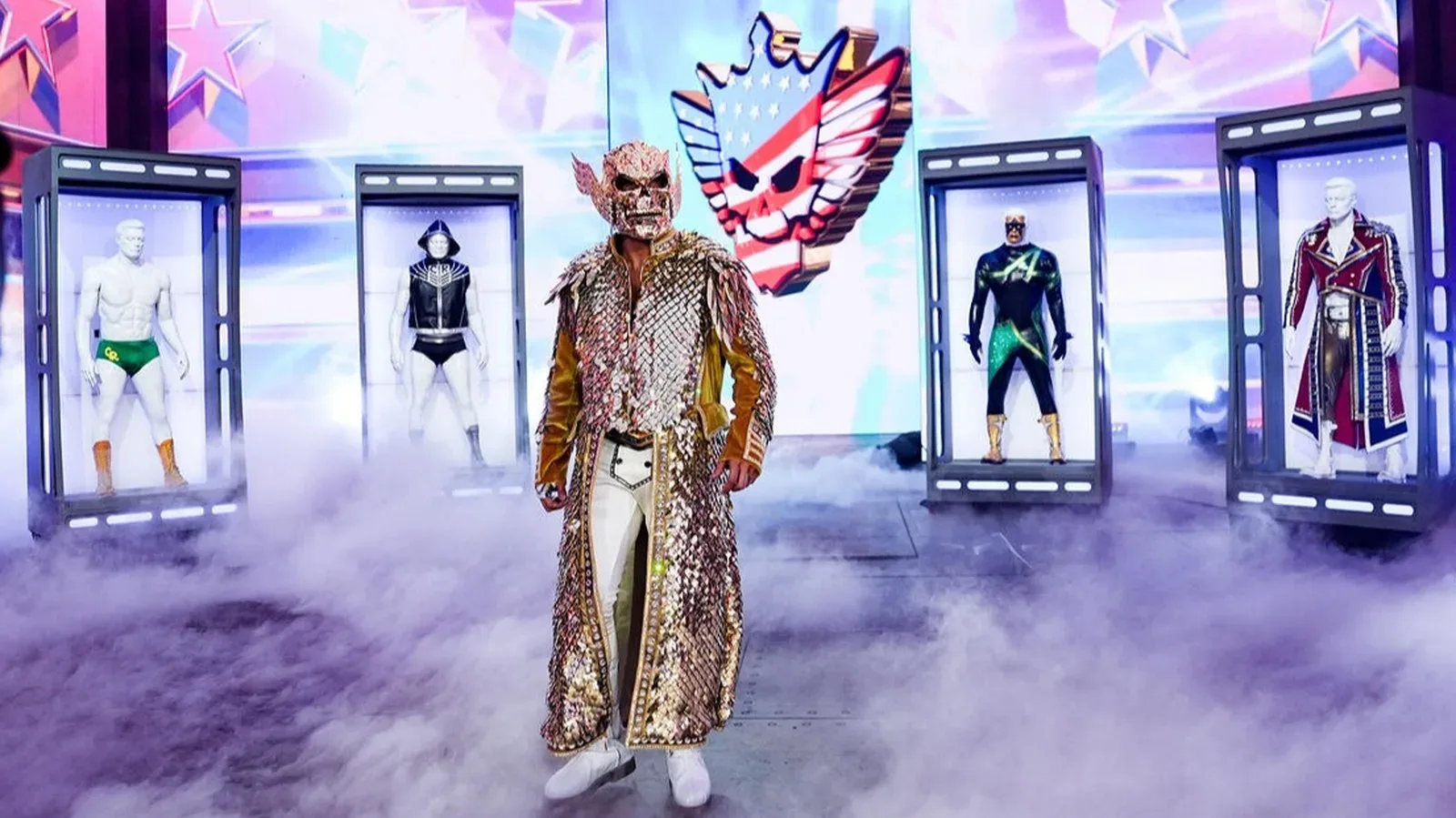
Cody Rhodes has offered a carefully measured response to speculation surrounding a potential future with Marvel Studios, confirming that he visited the company over the summer while declining to reveal anything further about the nature of the meeting.
Rhodes, one of WWE’s most recognizable stars and a performer whose larger-than-life presentation naturally invites superhero comparisons, has become a frequent subject of fan discussion whenever Hollywood opportunities arise. That conversation has only intensified following his work as Guile in Kitao Sakurai’s Street Fighter. Still, “The American Nightmare” made it clear that a photo from Marvel Studios should not be interpreted as confirmation of a role, a character, or a project.
Speaking on The Brandon Davis Show, Rhodes addressed the public curiosity while emphasizing his personal affection for Marvel’s characters and the importance of keeping potential professional matters confidential.
“There’s one guy [Andrew Schulz] in particular, who was sitting next to me on this couch pretty much all day, who is teasing things that aren’t real, and if they were real, I wouldn’t say anything, and guessing characters that are great, great characters, because I grew up... I learned every Marvel character you could from the trading cards, and then, of course, I had the animated series, and we have it again now. It’s been heavily discussed, but I never discuss it.”
For more background on this topic, read Wren Sinclair Explains Why She Was Ready to ‘Bite Back’ Ahead of NXT Women’s Title Opportunity.
Rhodes did not identify a character, a production, or a timetable. Instead, he framed the visit as an exciting experience for someone who has been connected to Marvel’s world since childhood. His comments leave the door open for continued fan speculation, but they do not establish that he has joined the Marvel Cinematic Universe or reached an agreement to appear in any upcoming movie or television series.
He further addressed the photo and the attention it generated, offering praise for the people he met without expanding on the meeting itself.
“That’s the beauty. I’ve said nothing other than that was just a photo at a wonderful office after a wonderful meeting with wonderful people.”
A wrestler built for crossover attention
The possibility of Rhodes pursuing more work outside the ring is unsurprising. WWE’s biggest names have long attracted interest from film, television, gaming, sports, and other entertainment fields, and Rhodes has developed a profile that reaches beyond weekly wrestling programming. His polished speaking style, distinctive look, extensive history in the industry, and status as one of WWE’s central attractions have made him an easy fit for crossover conversations.
Marvel speculation also carries an obvious appeal because Rhodes has openly described himself as a longtime fan. Rather than presenting that fandom as a recent talking point, he recalled collecting trading cards and following animated adaptations. That context explains why even a limited public acknowledgment of a Marvel Studios visit drew immediate attention.
At the same time, Rhodes’ approach in the interview was notably disciplined. He did not play along with character guesses, nor did he allow a discussion of hypothetical casting to become a public tease. For performers working in major film or television productions, secrecy can be a meaningful part of the process. Rhodes’ message was simple: fans can discuss possibilities, but he will not confirm something that has not been officially announced.
That stance should be especially familiar to wrestling audiences. Speculation is a constant feature of modern WWE coverage, whether the subject is an in-ring return, a surprise appearance, a contract situation, or a project outside the company. Social-media posts, photos, and brief public comments can quickly become the center of expansive theories. Rhodes acknowledged the enthusiasm while keeping the focus on what is actually known: he had a positive meeting at Marvel Studios, and he is not providing details beyond that.
Street Fighter adds to Rhodes’ expanding résumé
While there is no confirmed Marvel project to discuss, Rhodes’ involvement in Street Fighter provides a concrete example of his move into a major entertainment property. He has been associated with the role of Guile in Kitao Sakurai’s film, a character with enormous name recognition among video game fans and a look that has long been instantly identifiable.
The Guile role is a natural talking point for Rhodes because it places one of wrestling’s leading personalities inside another global pop-culture franchise. It also demonstrates that his potential outside WWE is not merely theoretical. Any future acting work would arrive after Rhodes has already taken on a high-profile character rather than as an untested first step into film.
For WWE, that visibility can be beneficial as long as Rhodes remains a central presence on television. Crossover work can introduce a wrestler to audiences who may not follow weekly wrestling, while the star’s WWE platform brings attention back to the film or series involved. Rhodes’ current position makes that relationship particularly significant. He is not a peripheral name looking for a new direction; he is one of the company’s defining figures.
Still, Rhodes’ immediate professional focus remains in WWE, where his personal conflict with Randy Orton has become increasingly volatile.
Randy Orton rivalry remains Rhodes’ immediate priority
Rhodes enters this latest stretch of WWE television following a painful defeat to his former friend turned rival, Randy Orton, at Sunday Night’s Main Event in September. The loss added another layer to a rivalry rooted in the collapse of a relationship that once carried genuine mutual respect.
Orton is one of the most dangerous opponents Rhodes can face, both because of his experience and because of the history between the two men. A loss to “The Viper” is damaging on its own. A loss to a former friend who has become a bitter nemesis carries a different emotional weight, and Rhodes has brought visible anger and resentment with him since that setback.
That frustration erupted again last week on WWE SmackDown. Rhodes and Orton came to blows during an impromptu confrontation, and Rhodes managed to get his hands on Orton by connecting with a Cody Cutter. The exchange did not have the opportunity to develop much further, however, as Baron Corbin interrupted the fight.
Corbin’s involvement halted an altercation that appeared capable of escalating quickly. Whether his interruption was simply an unwelcome intrusion or the beginning of a more direct issue remains to be seen. What is clear is that Rhodes did not get the sense of closure he was seeking from Orton. The Cody Cutter was a statement, but it did not settle the score following the September defeat.
The emotional edge of this program matters. Rhodes has built much of his WWE identity around perseverance, ambition, and the willingness to keep moving forward after setbacks. Orton, by contrast, represents a rival capable of turning familiarity into an advantage. Their shared history gives every confrontation an added level of tension, because each man understands the other’s instincts and vulnerabilities.
Two worlds of attention for The American Nightmare
Rhodes now finds himself at the intersection of two very different kinds of public interest. Outside the ring, fans are eager to know whether his Marvel Studios meeting will lead to a role in one of entertainment’s largest franchises. Inside the ring, his attention is fixed on an unsettled score with Orton and a disruption from Corbin that has complicated an already heated situation.
For now, the Marvel matter remains exactly where Rhodes has placed it: acknowledged, appreciated, and undisclosed. He has confirmed the meeting was a positive one and explained why Marvel has personal meaning to him, but he has not announced involvement in any film or series. Until that changes, any discussion of a potential MCU appearance remains speculation rather than fact.
WWE viewers, meanwhile, have far more immediate evidence of what Rhodes is dealing with. He was beaten by Orton at Sunday Night’s Main Event, he responded with a Cody Cutter on SmackDown, and he was denied the chance to take the confrontation further when Corbin intervened. Rhodes may be keeping Hollywood secrets close to the vest, but his rage toward Orton has been impossible to miss.
That contrast is fitting for “The American Nightmare.” The future beyond WWE may hold intriguing possibilities, but the present is defined by unfinished business in the ring.
In pictures

Darryl Polo
Darryl Polo is a passionate wrestling fan covering WWE, AEW, TNA and beyond. He loves great rivalries, breakout stars and the moments that keep fans talking long after the bell. How we work.