
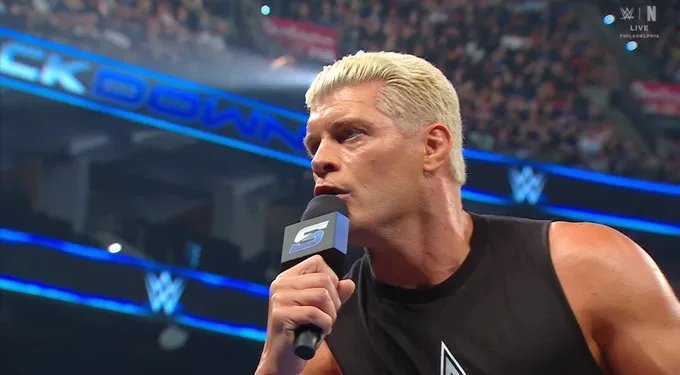
Cody Rhodes has responded to Randy Orton’s claim that he is “addicted” to winning the WWE Championship, framing the exchange as a calculated attempt to provoke him before their Sunday Night’s Main Event encounter.
The latest chapter in the relationship between Rhodes and Orton unfolded on the September 4 edition of WWE SmackDown, where the two met face-to-face ahead of their championship-related showdown. Orton attempted to draw an emotional reaction from his former protege, accusing Rhodes of being sick with a need to reclaim the WWE Championship and of placing that pursuit above everything else.
Rhodes did not take the bait on SmackDown, and he explained in a pre-Sunday Night’s Main Event interview that he recognized exactly what Orton was trying to accomplish. The key issue, Rhodes said, was the consequence either man would have faced had the confrontation turned physical before the match.
“He had said, ‘addicted to winning the championship’ and ‘sick’ and putting it in front of everything,” Rhodes said. “What’s the term kids use today? The rage bait, you know, or baiting me into … because if I had hit him, then I don’t get an opportunity for the WWE championship ever, and the same vice versa if he had hit me.”
For more background on this topic, read Paul Heyman Details Why Roman Reigns Could Not Remain WWE’s ‘Big Dog’.
That stipulation raised the stakes around an already personal confrontation. Rather than simply trying to gain a psychological edge, Orton was attempting to tempt Rhodes into forfeiting a path to the WWE Championship. Rhodes’ restraint therefore became as important as any verbal response in the segment, particularly given how much history the two men carry into this rivalry.
Rhodes Says Every Wrestler Wants The Top Prize
While Rhodes rejected Orton’s characterization of his own championship ambition, he also made clear that wanting the WWE Championship is not something he considers shameful. In Rhodes’ view, the pursuit of the top title is fundamental to professional wrestling. A performer who does not want to be champion is not demonstrating humility; to Rhodes, that attitude calls into question why that person is competing at all.
“I hate to put it in such terms, but at King of the Ring, I beat Randy Orton. At WrestleMania, I beat Randy Orton. I feel the desperation and the addiction. Every pro wrestler, to your point, you’re in this to win. You’re not trying to get second on the podium. I’ve never trusted a wrestler ever — hell, I’ve never liked a wrestler ever — who said he didn’t want to be champion.”
The comments offer a concise view of Rhodes’ competitive philosophy. The WWE Championship is not merely a prop or a symbol to him. It represents the objective of the work, and Rhodes sees no reason for a wrestler to apologize for wanting to stand at the top of the company.
At the same time, Rhodes separated that normal desire to become champion from what he believes is driving Orton. Rhodes pointed to their recent head-to-head record, noting victories over Orton at both King of the Ring and WrestleMania. Those defeats, Rhodes suggested, have put Orton in a position where his own urgency may be growing.
Randy Orton’s Historic Championship Chase
Rhodes also focused on Orton’s proximity to a major WWE championship milestone. Orton is closing in on 17 world title reigns, putting him near John Cena’s record. That pursuit gives the rivalry a layer beyond the immediate result at Sunday Night’s Main Event, as a championship victory would further strengthen Orton’s place in WWE history.
For Rhodes, that is where the “addiction” argument becomes more revealing. He believes Orton is the one feeling the weight of history, the pressure to reach another title reign, and the need to receive the recognition Rhodes feels he has long deserved.
“But I think that addiction and sickness is actually more on Randy’s end because Randy’s close to the record. He’s close to 17. He’s close to John. I think Randy also feels that he’s not been given the credit as one of the, you know, the GOATs of modern WWE, someone who’s going to go down in history as one of the greatest to ever do it. He should know he is going to go down in history as one of the greatest to ever do it, but he’s also going to go down in history as the guy who lost for a third time at Sunday Night’s Main Event to his protege, which is me.”
Rhodes’ statement was both respectful and sharply confrontational. He did not question Orton’s standing as one of WWE’s all-time greats. In fact, he explicitly said Orton should know that he will be remembered that way. But Rhodes also argued that greatness does not erase vulnerability, especially when a competitor is chasing a record and trying to reverse a losing streak against someone he once mentored.
By emphasizing the word “protege,” Rhodes underscored the unusual dynamics at the center of this matchup. Orton’s legacy includes his role as an established main-event talent and a figure who helped shape the environment in which Rhodes developed. Yet Rhodes is now speaking not as an understudy seeking acceptance, but as a rival confident that he has surpassed a pivotal influence in his career.
A Rivalry Built On Respect, Pressure And Restraint
The Orton-Rhodes conflict has featured respect on the surface, but the recent exchanges reveal how quickly that respect can become a weapon. Orton knows Rhodes is deeply motivated by the WWE Championship, and he used that ambition to try to paint Rhodes as consumed by a single goal. Rhodes, in turn, argued that Orton’s own pursuit of history has created the more desperate competitor.
Neither man is denying the importance of the title. The disagreement is over what that desire means. Orton’s argument is that Rhodes’ need to win has become unhealthy and all-encompassing. Rhodes’ counter is that championship ambition is supposed to be intense, and that anyone entering WWE should want to win rather than settle for less.
That distinction matters because Rhodes has spent much of his career defining success through persistence. His return to WWE placed a renewed focus on the championship pursuit, and he has repeatedly treated the title as the ultimate measure of completing his professional mission. Orton attempted to turn that familiar motivation into a weakness. Rhodes instead presented it as evidence of the mentality required of a top-level wrestler.
There is also a tactical component to Rhodes’ response. By publicly identifying Orton’s SmackDown remarks as “rage bait,” Rhodes signaled that he will not allow the veteran to dictate the emotional terms of the rivalry. Orton’s strategy depended on Rhodes acting impulsively and losing his championship opportunity before Sunday Night’s Main Event. Rhodes’ refusal to strike first denied Orton that outcome.
What Rhodes’ Comments Mean Going Forward
Rhodes entered Sunday Night’s Main Event convinced he had already proven he could beat Orton on major stages. His references to King of the Ring and WrestleMania were not incidental; they were central to his assertion that Orton is the one facing mounting pressure. A third victory would allow Rhodes to make that case even more forcefully, while Orton needed to change the narrative around his recent performances against his former protege.
The championship implications made every verbal jab more meaningful. Orton was not simply accusing Rhodes of being obsessed for the sake of personal insult. He was trying to exploit the very goal Rhodes values most. Rhodes answered by embracing the desire to be champion while insisting that Orton’s drive for a record-setting reign is the stronger source of desperation.
As a result, the debate between the two stars became a clash of perspectives on ambition itself. Rhodes sees the WWE Championship as the prize every wrestler should chase without hesitation. Orton sees Rhodes’ fixation as a possible flaw. Yet Rhodes believes Orton’s comments reveal a man who understands the same compulsion all too well, particularly as the chance to move closer to John Cena’s record remains in view.
Whatever comes next in their rivalry, Rhodes has made his position unmistakable: he will not be embarrassed for wanting to be WWE Champion. In his eyes, that hunger is not a sickness. It is the standard.
Darryl Polo
Darryl Polo is a passionate wrestling fan covering WWE, AEW, TNA and beyond. He loves great rivalries, breakout stars and the moments that keep fans talking long after the bell. How we work.