
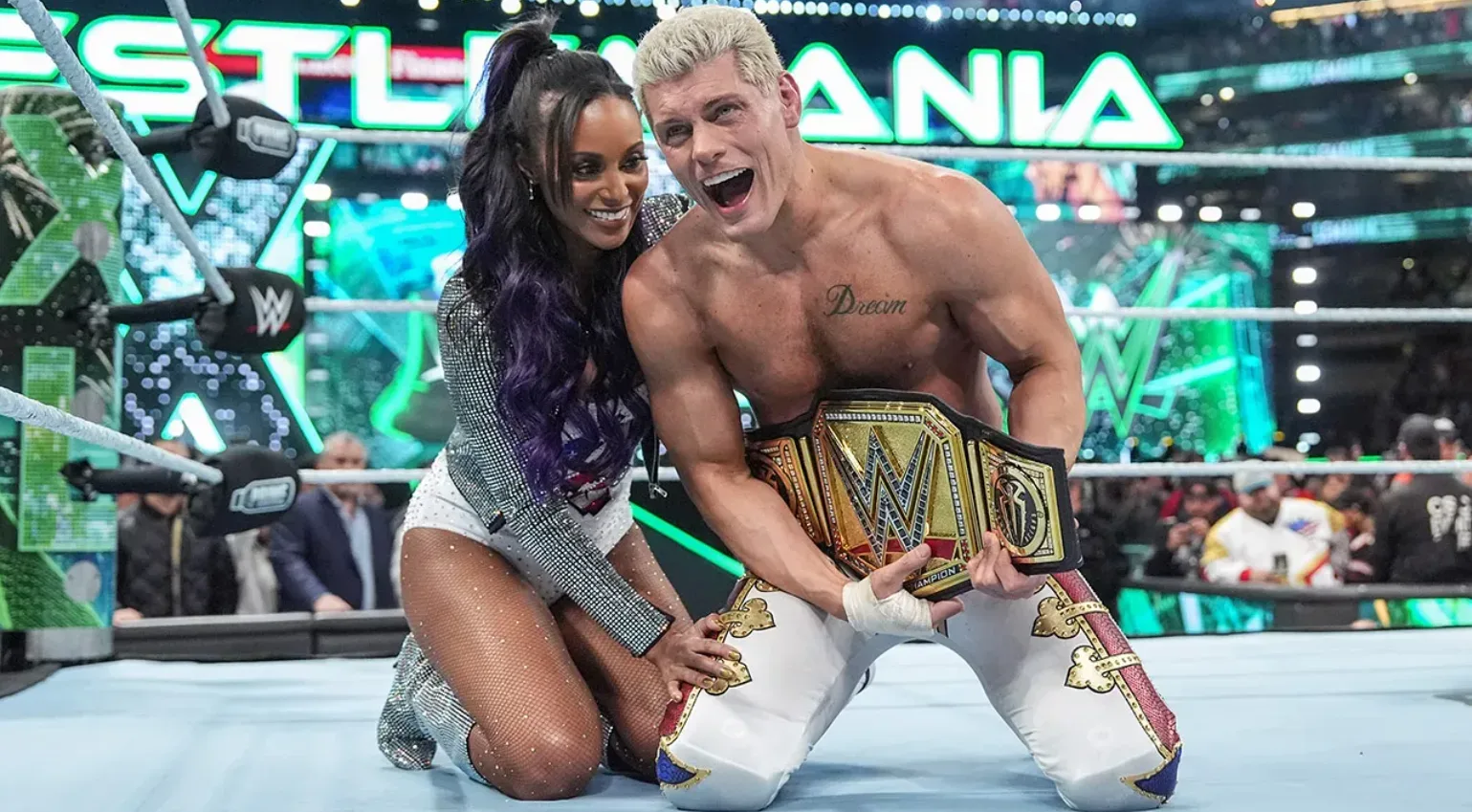
Cody Rhodes has made no secret of the value he places on the WWE Championship, and the three-time titleholder offered a clear explanation for why he considers it wrestling’s defining prize.
During an appearance on the Double Coverage Podcast, Rhodes was asked to name his favorite championship in professional wrestling. His answer was straightforward: the WWE Championship. He acknowledged that some listeners may see the choice as an obvious or overly corporate response, particularly coming from one of the company’s most visible active stars. But Rhodes’ reasoning centered on something more personal than presentation, branding, or even the physical appearance of the belt.
For Rhodes, the WWE Championship carries the weight of the performers who held it, the fans who watched those reigns unfold, and the generations of viewers who came to see that specific prize as the ultimate symbol of success.
“My number one, and this is going to be, everyone’s going to go, ‘Ah!,’ I think it’s such a corporate answer, it’s the one I won. It’s the WWE Championship.”
For more background on this topic, read Nunzio Reflects On Improvised Undertaker Moment That Became A Lasting WWE Memory.
Rhodes returned to WWE in 2022 and has since won the WWE Title three times. That history naturally gives his selection an added emotional element. Still, his comments were not solely about his own accomplishments. Instead, he argued that a championship’s place in wrestling culture is often determined by the people and memories attached to it over time.
Championship design is one of the wrestling industry’s most enduring subjects of debate. Fans routinely compare current belts with earlier versions, discussing which designs looked more prestigious, which ones felt more traditional, and which championships best reflected the identity of a promotion. Those conversations can become especially intense around the WWE Championship because it has changed appearances repeatedly across different eras while remaining the company’s central prize.
Rhodes understands why some fans may look at the modern title and view it primarily as a branding vehicle. The prominent WWE logo makes the championship immediately recognizable, and that corporate identity is a major part of its visual presentation. However, Rhodes sees that feature as only one part of what the belt represents.
He believes the championship’s connection to major names is what gives it lasting power. In discussing its importance, Rhodes pointed to John Cena, Roman Reigns, and himself as examples of performers whose stories are tied to the WWE Championship. The belt, in that sense, is not merely a prop or a logo displayed on television. It is a physical reminder of the wrestlers who competed for it, carried it, and helped define their respective periods in WWE.
“In 10 years, complain all you want, when these kids are talking about that’s my favorite title, it’s because it’s the one that they had. It’s the one they grew up with. You see these merch reports at the end of the night, people love those little, the old school little Velcro belts. It’s always the WWE title, always the big dub. People will say, ‘Oh, it’s a walking billboard.’ Yeah but it’s also connected to people. It’s connected to John Cena. It’s connected to Roman Reigns. It’s connected to me. I love that. I think time will tell that it’s a winner.”
That perspective places fan experience at the center of Rhodes’ argument. Every generation of wrestling fans tends to form attachments to the championship design and title lineage that was most prominent during its own viewing years. A belt that receives criticism when it first appears can later become a nostalgic favorite, simply because it was associated with a memorable time in a fan’s life.
Rhodes used the WWE spinner championship as the clearest example of that cycle. The design became strongly associated with Cena, whose era as a top WWE star made the spinner belt one of the most recognizable championship looks of its time. Yet the title was not universally embraced when it was active. Its nontraditional aesthetic drew plenty of criticism, particularly from viewers who preferred more conventional championship designs.
Years later, however, the response to the spinner belt has changed in many circles. What was once a frequent target of criticism has become a design remembered with considerable affection by fans who grew up watching Cena carry it. Rhodes recalled seeing that nostalgia firsthand during a major title presentation, when people were excited by the prospect of the spinner belt being included.
“The spinner is a great example. The spinner, at the time, I don’t know if you remember the spinner was heavily panned and it was criticized. Today when I did this big title presentation, I remember people, ‘Oh, thank gosh, he has the spinner.’ They should do it for the spinner. Where were you guys?”
His point was not that every belt design will eventually be embraced by every fan. Rather, Rhodes suggested that immediate reactions do not always determine how a title will be remembered. Time changes the context around an object. A championship becomes linked with entrances, rivalries, victories, losses, merchandise, family viewing traditions, and the larger atmosphere of a given era. Those associations can matter far more than the initial debate over whether a design was too modern, too commercial, too large, or too different from what came before it.
The WWE Championship has a unique role in that process because it has remained a central part of WWE through each of those changes. Its appearance has evolved, but its place in the promotion’s hierarchy has remained significant. For wrestlers, winning the title is a statement of standing. For fans, it is often the championship they saw their favorite stars chase. For younger viewers, it can be the belt they recognize before they know the full history behind it.
Rhodes’ comments also speak to the importance of championship merchandise. Replica and toy belts are a longstanding part of wrestling fandom, allowing fans to take a tangible piece of the presentation home with them. Rhodes specifically noted the continued popularity of the smaller Velcro versions, saying the WWE title remains a consistent favorite. That response reinforces his belief that the belt’s visibility and emotional familiarity are powerful assets rather than drawbacks.
There is an understandable split in the way fans judge championships. Some prioritize a belt’s artistry and its ability to look like a traditional sporting trophy. Others place greater importance on legacy, recognizability, and the stars who wore it. Rhodes is firmly emphasizing the latter qualities. He does not deny that fans can view the WWE Championship as a highly branded object. He simply believes that description misses the deeper relationship audiences have built with it.
In Rhodes’ view, the WWE Championship succeeds because it is both an institution and a personal symbol. It is associated with WWE itself, but it is also associated with individual journeys. Cena’s connection to the title evokes one set of memories. Reigns’ connection evokes another. Rhodes now has his own place in that lineage after returning in 2022 and becoming a three-time WWE Champion.
That is why Rhodes believes the final judgment on the current WWE Championship will not be made solely by today’s online design debates. It will be made years from now by fans looking back at the wrestlers, stories, and moments they experienced with the title at the center of the picture.
For Rhodes, the WWE Championship is his favorite because he won it. But his larger argument is that its significance reaches beyond any one champion. The title endures because each generation finds its own connection to it, and because the wrestlers attached to it turn a championship belt into something fans remember long after the debates over its appearance have faded.
In pictures

Darryl Polo
Darryl Polo is a passionate wrestling fan covering WWE, AEW, TNA and beyond. He loves great rivalries, breakout stars and the moments that keep fans talking long after the bell. How we work.