
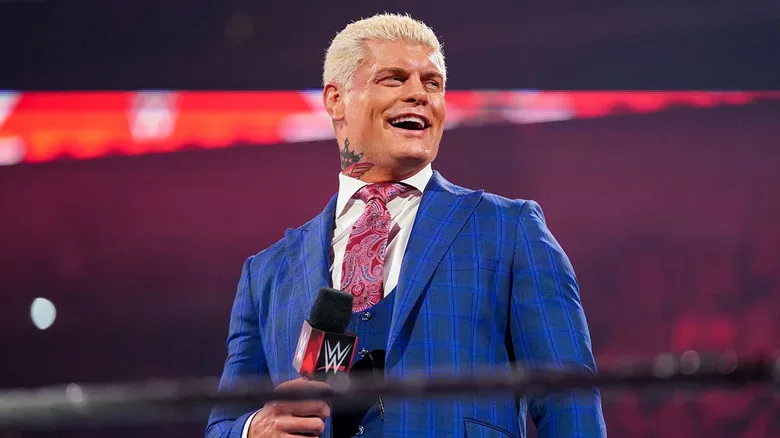
Cody Rhodes has made the suit a defining part of his modern WWE presentation, and he says the choice has grown beyond a television-ready fashion statement. For Rhodes, dressing sharply became a source of personal confidence during a pivotal stretch of his career, a reflection of the professional standard he wanted to set for himself, and an element influenced heavily by Ric Flair.
Rhodes discussed his wardrobe and the roots of his polished on-screen image during an appearance on the Double Coverage Podcast. The WWE star explained that even though he is the son of Dusty Rhodes, much of his own presentation has taken inspiration from Dusty’s legendary rival, “The Nature Boy” Ric Flair.
That influence is especially apparent whenever Rhodes appears on WWE programming outside the ring. Whether he is arriving at an arena, addressing the audience, or taking part in a major segment, he is usually dressed in a suit. Rhodes said that approach owes a great deal to Flair’s role as a trailblazer in how a top wrestling star could present himself to the public.
Ric Flair’s Influence on Cody Rhodes
Rhodes described Flair as a foundational figure in wrestling’s evolution into a larger sports-entertainment spectacle. In his view, Flair embodied the idea of a wrestler as a high-profile athlete whose success could be communicated through every detail of his appearance, from tailored clothing to the extravagant lifestyle that accompanied his character.
For more background on this topic, read Drew McIntyre Sees Major Upside in WWE Prospect Elijah Holyfield.
“A lot stolen from the Nature Boy, Ric Flair, as far as suited and booted and the whole concept of… he’s kind of wrestling’s, and this is going to sound strange, but the first pro athlete of wrestling in a sense of that big ’80s flashing the cash, the jets, the suits, the high lifestyle that came with it.”
Flair and Dusty Rhodes were among the defining opponents of the 1980s, but their personas were deliberately built on contrast. Dusty was the everyman: a blue-collar hero who spoke for working people and cultivated a connection with audiences through his charisma, resilience and relatability. Flair, meanwhile, was the elite champion who boasted of luxury, status and superiority.
Cody Rhodes acknowledged that the contrast remains striking given his family history. Yet he also made clear that he sees no conflict in borrowing from Flair’s template. While Dusty Rhodes remains an essential part of Cody’s identity and legacy, Flair’s presentation offers a different kind of aspiration—one centered on excellence, polish and unmistakable star power.
“It’s funny because he’s wrestling my dad, the majority of the 1980s, and Dusty’s running common man, man of the people, blue-collar. But so much of what I do is more stolen from Ric than Dusty, which is hats off to Ric. I mean, what pro wrestler doesn’t want to steal from the greatest of all time? Nature Boy is the best.”
Rhodes’ comments highlight the way wrestling personas frequently evolve through influence rather than imitation. He has never attempted to become Flair, nor has he abandoned the emotional weight of being Dusty Rhodes’ son. Instead, his current identity combines his own career experiences with ideas drawn from two icons who represented opposite ends of wrestling’s personality spectrum.
The result is a WWE character who can speak earnestly about family, perseverance and legacy while also carrying himself with the composure of a major attraction. The suits are only one component of that formula, but they have become a consistent visual marker of Rhodes’ place near the top of the company.
From Performance to Personal Routine
Rhodes said some of his peers initially viewed the suits as performative. That is understandable in a business where wardrobe is often inseparable from character work, particularly for someone positioned as prominently as “The American Nightmare.” Over time, however, Rhodes said the habit took on deeper meaning for him.
He compared the feeling to taking pride in a clean pair of sneakers: a small but meaningful part of how a person carries themselves. For Rhodes, dressing well became especially important while he was away from WWE. He viewed it as a way to reinforce the idea that he was moving forward and pursuing the position he wanted in the industry.
“I tell people, cause I think some of my peers for a long minute thought that the suits and stuff were real performative and maybe they were, but after a while it became this really great feeling. Felt professional.”
Rhodes continued by connecting the wardrobe choice to the familiar concept of dressing for the job one wants. It is a simple idea, but one that aligns closely with the broader story of his career. He has repeatedly pursued lofty goals, framing himself as someone determined to earn a leading role rather than wait for one to be handed to him.
That perspective gives the suits a purpose beyond aesthetics. They are part of a routine that helps Rhodes feel prepared, focused and professional. In an industry that depends on confidence and perception, he has found a presentation that matches the standard he expects from himself.
His conclusion was also characteristically direct: suits have become so ingrained in his lifestyle that they now account for much of what he owns. And after an unsuccessful attempt to introduce a more casual look, Rhodes suggested he may be even more committed to staying suited up.
The Polo Shirt That Did Not Land
Rhodes’ attempt to diversify his wardrobe did not receive much support from the people closest to him. He revealed that he recently bought polos and tried pairing them with jeans, only to be criticized for choosing what was apparently an overly fancy version of the casual shirt.
The people giving him grief were his wife, Brandi Rhodes, as well as Matt Cardona and WWE’s Chelsea Green. Rhodes did not specify exactly what made the polo too fancy, and he admitted he does not understand how a polo shirt can cross that line. Still, the reaction was enough for him to jokingly decide that casual dressing may simply not be for him.
“Now to the point where it’s all I have. I got shamed because I bought some polos. You can’t just wear suits all the time. So I wore jeans and some polos. Chelsea Green, Matt Cardona, and my wife shamed me for, I guess, it was too fancy of a polo. I don’t even know how you can go too fancy. But yeah, I’m just going to go all suits, all the time now at this point. I couldn’t get it right.”
The story is a lighthearted one, but it further illustrates how closely Rhodes is now associated with a refined, formal look. The suit is no longer merely an outfit reserved for television appearances. It has become a recognizable extension of his public identity, one that even a casual polo experiment could not easily replace.
For WWE audiences, that consistency matters. Wrestling stars are built through repeatable visual cues as much as through catchphrases, entrances and victories. A distinctive jacket, a particular hairstyle, a signature color palette or a style of clothing can communicate who a performer is before they say a word. Rhodes has established suits as one of those cues.
Rhodes Set for WWE NXT Appearance
Rhodes is currently scheduled to appear on the November 4 edition of WWE NXT. His appearance places one of WWE’s most recognizable stars on the brand’s lineup and continues the connection between the company’s top-level talent and NXT programming.
Whatever Rhodes has planned for the show, fans can likely expect the presentation that has become synonymous with him. When he is not competing, the American Nightmare has made it clear that he prefers to be “suited and booted”—and after the response to his polo shirts, he appears more convinced than ever that the look is here to stay.

Darryl Polo
Darryl Polo is a passionate wrestling fan covering WWE, AEW, TNA and beyond. He loves great rivalries, breakout stars and the moments that keep fans talking long after the bell. How we work.