
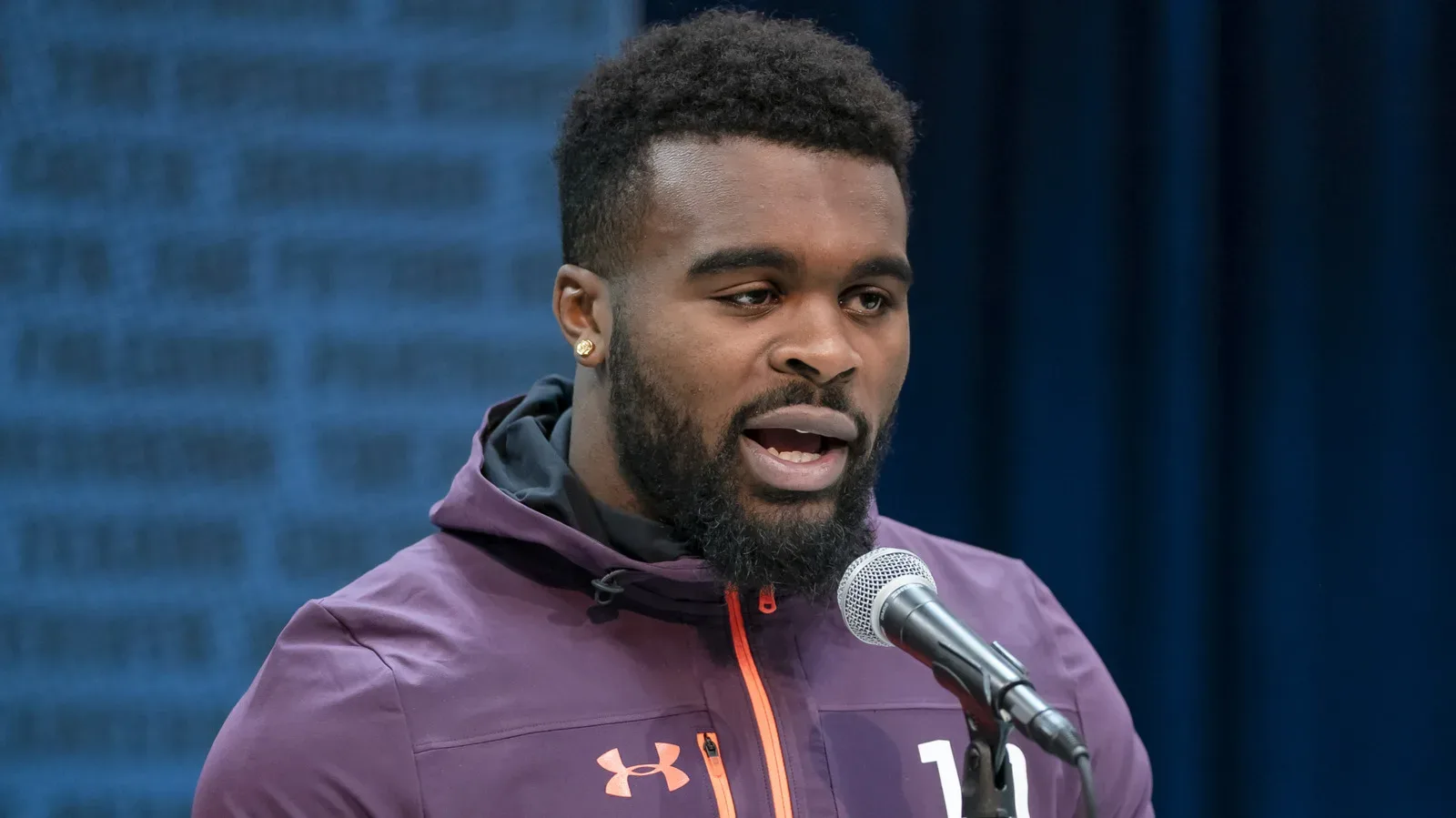
Drew McIntyre believes Elijah Holyfield has the physical presence and natural aura to become a significant name in WWE, provided the developing prospect can translate those qualities into the ring.
McIntyre recently worked alongside Holyfield on Agent of Shadows, WWE’s spy-themed micro-drama that debuted on ReelShort on October 23. The project brought together a mixture of established WWE personalities and newer talent, including McIntyre, Jacob Fatu, Booker T, Joe Hendry, and performers connected to WWE LFG: Legends & Future Greats. Holyfield, the son of boxing icon Evander Holyfield, was among the featured developmental names involved in the production.
Speaking on Insight with Chris Van Vliet, McIntyre discussed having several one-on-one sequences with Holyfield and came away impressed by what he saw away from a wrestling ring. The former WWE Champion emphasized Holyfield’s look, confidence, and effectiveness in their shared scenes, while also making clear that the central test for any prospective WWE star remains the ability to perform in matches.
“He looks great,” McIntyre said on Insight with Chris Van Vliet. “I’ve honestly never seen him work, like hopefully he can get it done in the ring, but his presence, he’s a great, great face. He’s got an aura about him. Solid. Built like a brick you-know-what and he was excellent in the stuff we did together, so I see big things in the future for him if he can put together a half decent match.”
For more background on this topic, read Tony D’Angelo Keeps Focus on NXT Championship Opportunity, Not All-Time Legacy.
A different kind of early endorsement
McIntyre’s comments are notable because they are not framed as a review of Holyfield’s in-ring body of work. Instead, they focus on several traits that can be difficult to teach: a memorable appearance, commanding presence, comfort in front of a camera, and the ability to project something distinctive before a performer has even delivered a promo or wrestled on television.
That is particularly relevant for Holyfield’s current place in WWE. He has not yet made his televised WWE NXT debut, meaning a large portion of the broader WWE audience has not had the chance to form an opinion on him through a conventional weekly television introduction. However, he has steadily added experience through other avenues, including NXT live events, appearances on WWE EVOLVE, and a recent NXT dark match against Kam Hendrix.
For a performer still building a public résumé, a project such as Agent of Shadows offers a useful additional platform. WWE has increasingly expanded its presentation beyond standard ring segments, and short-form scripted content can test a talent’s comfort level with close-up acting, reactions, timing, and character work. Those are not substitutes for wrestling fundamentals, but they are meaningful components of modern WWE presentation.
McIntyre’s assessment also reflects a reality of developmental wrestling. Physical credibility can create immediate interest, especially when it is paired with poise. Holyfield arrives with an athletic background, a recognizable surname, and an imposing build. The challenge is turning that first impression into a complete identity that works within the specific demands of WWE’s ring and television environment.
Holyfield’s road to WWE
Holyfield signed with WWE in 2024 after an athletic career that included college football at the University of Georgia and four seasons in the NFL. That background does not automatically guarantee success in professional wrestling, but it gives him experience in high-pressure team environments, physical preparation, and performance expectations at major levels of competition.
His football career also places him among a long list of WWE recruits who have entered the industry after competing in other sports. The transition can be demanding. Wrestling requires a different type of conditioning, an entirely separate technical vocabulary, and the ability to perform in a way that protects both oneself and an opponent while serving a story for a live audience and television cameras.
At the same time, former football players often arrive with assets that can be developed quickly: explosiveness, size, toughness, discipline, and familiarity with structured coaching. In Holyfield’s case, McIntyre’s praise suggests that his presence may be another important advantage. A strong visual presentation can help a new performer establish credibility before the audience knows much about his move set or character motivations.
The Holyfield name naturally brings attention as well. Evander Holyfield’s standing in boxing makes the surname immediately familiar to many sports fans, but WWE success will ultimately depend on Elijah Holyfield creating his own identity. The developmental process gives him time to do exactly that, away from the expectation that he must be fully formed from his first televised appearance.
Learning under The Undertaker on WWE LFG
Holyfield appeared during the first season of WWE LFG as part of The Undertaker’s team. The series placed developmental talent in a highly visible training and evaluation setting, giving viewers a closer look at the pressure facing wrestlers trying to earn their place in WWE.
Being aligned with The Undertaker’s group was a meaningful opportunity for a prospect at such an early stage. The Undertaker’s WWE career was built not only on longevity and character work, but also on an understanding of presentation, match pacing, and how to make an audience believe in a performer’s importance. Those are the same areas that could be especially valuable for someone like Holyfield, whose physical tools have already drawn attention.
Reality-based developmental programming can expose a wrestler’s strengths and weaknesses quickly. It asks participants to absorb feedback, adjust under pressure, and demonstrate the progress needed to move from potential to reliability. Holyfield’s continued work on live events and WWE EVOLVE indicates that his development has extended beyond the show’s format and into the regular repetition that shapes a wrestling career.
There is a substantial difference between looking like a WWE prospect and becoming one capable of delivering consistently in front of the company’s largest audiences. McIntyre addressed that distinction directly. His praise was significant, but it was also conditional: the in-ring side must come together. That is not a dismissal of Holyfield; it is a clear description of the next standard he has to meet.
The importance of NXT live events and WWE EVOLVE
Holyfield’s appearances at NXT live events are an important part of his path. Live-event settings provide valuable repetitions in front of wrestling crowds without the same pressure and permanence of nationally televised segments. Wrestlers can learn how audiences react to entrances, mannerisms, offense, pacing, and match finishes, while coaches can assess how a prospect responds when plans need adjustment in real time.
His work on WWE EVOLVE adds another opportunity to be seen and evaluated. Wednesday appearances give Holyfield a regular platform as he develops his ring style and presentation. For viewers following WWE’s emerging talent, those appearances provide a chance to watch his progression before a potential larger NXT introduction.
The dark match against Kam Hendrix also fits into that process. Dark matches are often used to evaluate performers, give talent ring time, and test how they handle the rhythm of a WWE event environment. While such bouts do not carry the same visibility as televised contests, they can still be valuable checkpoints for wrestlers preparing for expanded roles.
Holyfield does not need to rush past these steps. WWE has the infrastructure to let prospects develop through live events, training, dark matches, and supplementary programming before asking them to carry the expectations of weekly NXT television. The most productive route is often the one that allows a performer to become comfortable enough that their eventual debut feels like an arrival rather than an introduction made too soon.
What comes next
McIntyre’s comments add an encouraging outside perspective to Holyfield’s early WWE run. As a top-level performer with experience across the company’s biggest stages, McIntyre understands the value of presentation as well as the requirement for in-ring substance. His view is that Holyfield has already made a strong impression in the former area.
The remaining work will determine how far that upside can go. Holyfield will need to continue refining his match skills, finding the character elements that separate him from other powerful athletes, and building the confidence required to perform under the brightest lights. His television debut on NXT has not happened yet, so there is still no indication of when WWE plans to introduce him to that audience.
For now, the outlook is one of potential rather than certainty. Holyfield has an accomplished athletic background, ongoing developmental experience, and a notable endorsement from McIntyre after their work together on Agent of Shadows. If his in-ring development catches up to the presence McIntyre saw on camera, WWE may have a prospect with a compelling foundation for a much larger role.
In pictures

Darryl Polo
Darryl Polo is a passionate wrestling fan covering WWE, AEW, TNA and beyond. He loves great rivalries, breakout stars and the moments that keep fans talking long after the bell. How we work.