
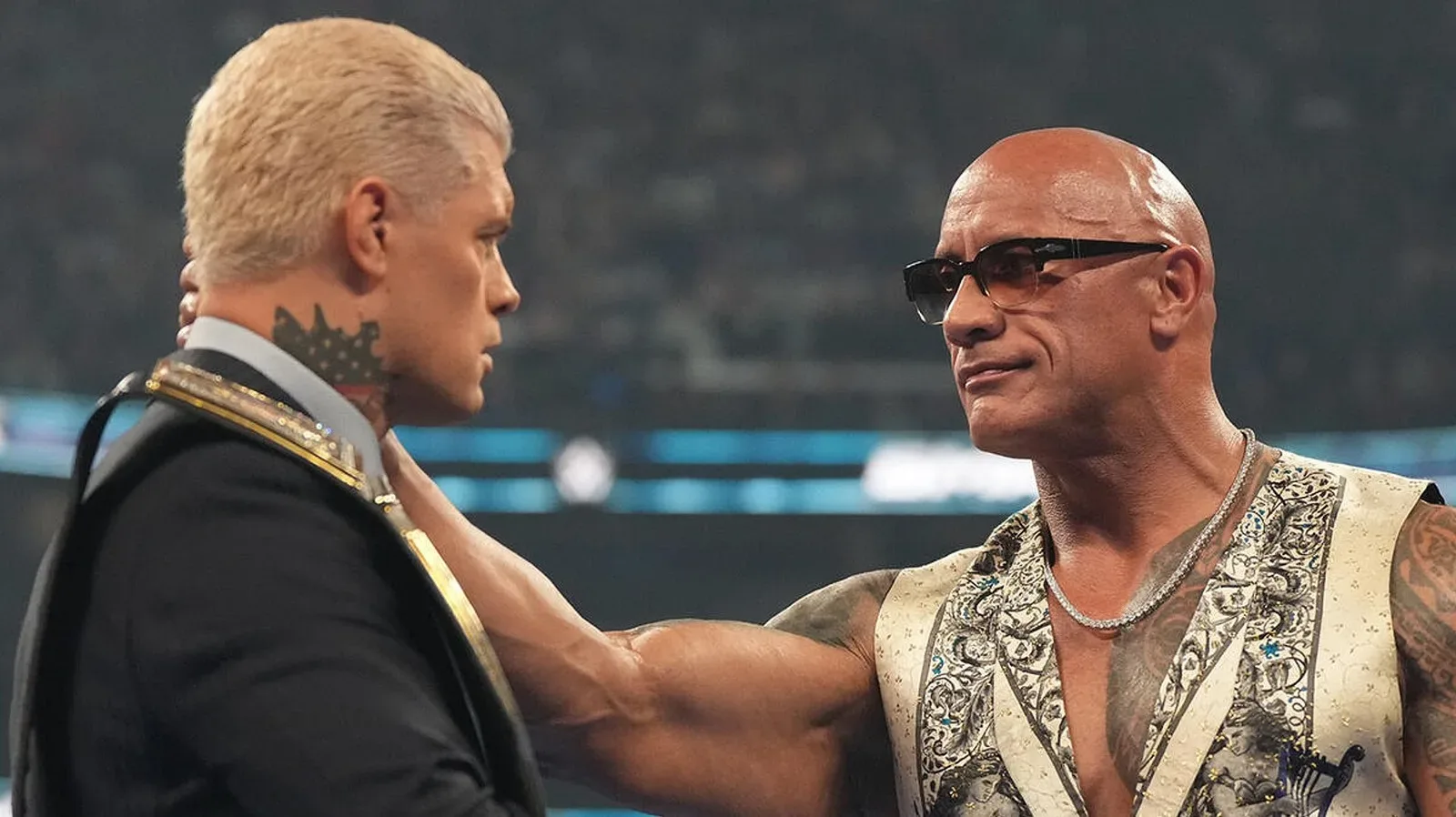
Cody Rhodes has shared an important piece of advice he received from Dwayne “The Rock” Johnson about the relationship between professional wrestling and Hollywood, describing a lesson that has shaped the way he presents his own ambitions outside the ring.
Speaking on INSIGHT with Chris Van Vliet, Rhodes recalled Johnson’s frustration with a particular response sometimes heard from wrestlers when the subject of acting comes up. Rather than framing a commitment to wrestling as a rejection of Hollywood, Johnson encouraged performers to view both fields through the same creative lens.
“One time, Rock told me he doesn't like when wrestlers would say, ‘Oh, I don't want to be an actor, I always want to be a wrestler,’” Rhodes said on INSIGHT with Chris Van Vliet. “And he had good reasons; he said, ‘Of course you love wrestling.’ ... But also, wrestling is storytelling. And that's what he said: ‘What I wish people would say is that they just want to grow as a storyteller.’”
The observation speaks to a subject Johnson knows well. Before establishing himself as one of Hollywood’s most recognizable stars, he faced considerable skepticism over his pursuit of a film career. That reaction was incorporated directly into his WWE presentation in 2003, when he embraced the “Hollywood Rock” persona. The character turned resentment over his movie ambitions into an essential part of his villainous act, allowing Johnson to use the criticism as fuel for some of his most memorable work.
For more background on this topic, read Chelsea Green Retains WWE Women’s Title Over Nikki Bella as Crown Jewel Chaos Erupts.
More than two decades later, Rhodes’ recollection shows that Johnson’s perspective goes beyond a simple choice between two professions. Wrestling and acting have distinct demands, schedules and formats, but both require performers to connect with an audience, understand character, communicate emotion and make viewers invest in a larger story. For Rhodes, the wording mattered. The goal was not to treat wrestling as a stepping stone away from the industry, nor to suggest acting is somehow opposed to the work of a wrestler. It was to grow as a storyteller.
The shared language of wrestling and film
Professional wrestling has always depended on storytelling, whether that story unfolds through a championship pursuit, a personal grudge, a rivalry between former allies or a character’s evolution over years of television. The in-ring action is a central part of that process, but it is not the only part. Promos, facial expressions, entrances, backstage segments and major decisions all help establish the stakes around a match.
Rhodes has long been associated with that broader side of wrestling. His career has included dramatic changes in identity and presentation, as well as deeply personal narratives that have resonated with WWE audiences. The advice from Johnson provides a clear explanation for why Hollywood work can fit within that framework rather than stand apart from it.
Rhodes said he later used Johnson’s exact logic in a general meeting with studio executives in Los Angeles. Instead of presenting his interest in acting as a departure from his background, Rhodes leaned into the skills that wrestling has already demanded of him.
“The lesson for me was: I want to grow as a storyteller,” Rhodes said on INSIGHT with Chris Van Vliet. “That's what it is, and I think coming from wrestling it's perfect, because that's what we do.”
That answer reflects a practical understanding of what wrestlers bring to screen work. Wrestling performers operate in a visual medium where timing, reaction and emotional clarity are crucial. They are asked to establish character quickly, work in front of large live crowds and deliver moments that can register equally with an arena audience and television viewers. Those abilities do not erase the differences between wrestling and film, but Rhodes’ point is that they are rooted in a related pursuit: making an audience feel something.
Johnson’s own path remains one of the most prominent examples of that crossover. His Hollywood success did not end his association with WWE, and his career has repeatedly demonstrated that wrestling’s character-driven foundation can translate across entertainment platforms. The former WWE Champion built a movie career while continuing to remain a major presence in wrestling’s broader cultural conversation.
Rhodes moves further into Hollywood
The conversation arrives as Rhodes takes a larger step into film himself. He recently appeared as Guile in the Street Fighter film adaptation, a role that places him within a globally recognizable fighting-game property. It is a significant addition to Rhodes’ work beyond WWE, but his comments make clear that he does not view such opportunities as separate from the creative work that has defined his wrestling career.
Guile is a character with a longstanding history in the Street Fighter franchise, meaning the role comes with audience expectations and established traits. That kind of assignment aligns naturally with Rhodes’ emphasis on storytelling. A performer entering an existing fictional world must help make a familiar character feel convincing to longtime fans while still serving the needs of the film around them.
Rhodes did not present his move deeper into Hollywood as an abandonment of wrestling. Instead, he described it through Johnson’s language of development. The distinction is meaningful in an industry where wrestlers’ outside projects are often measured against their commitment to the ring. Rhodes’ answer rejects the premise that an entertainer must diminish one craft in order to explore another.
It also recognizes that wrestling itself offers an unusually demanding creative environment. A wrestler can play a character in front of a live audience, adjust to crowd reactions in real time and then continue that story through weekly television. The performer must balance athletic execution with character consistency, all while helping an audience understand why a match matters. Rhodes’ belief that wrestling is “perfect” preparation for storytelling follows directly from those responsibilities.
A notable message from a complicated rival
The advice carries additional weight because Rhodes and Johnson have recently shared a highly charged on-screen history. Rhodes previously addressed his complicated relationship with Johnson following their heated rivalry on the road to WWE WrestleMania 42. Their rivalry created intense conflict in WWE’s biggest setting, while Rhodes’ latest comments show that the relationship has also included a valuable professional exchange away from that confrontation.
That contrast is familiar in wrestling. The strongest rivalries often work because the individuals involved understand the importance of the story, the audience and the emotional stakes. Rhodes’ recollection of Johnson’s guidance suggests an appreciation for the latter’s experience not merely as a superstar, but as someone who has navigated the expectations attached to a wrestling career and a Hollywood career at the same time.
Johnson’s 2003 “Hollywood Rock” run remains relevant because it directly confronted a criticism that has never entirely disappeared. Some fans and wrestlers have viewed acting aspirations with suspicion, particularly when a major name becomes less available to a wrestling promotion. Johnson took that response and made it part of his character, turning perceived distance from the audience into a source of antagonism. The work succeeded because it used a real tension and transformed it into compelling wrestling television.
Rhodes’ takeaway is less about copying that persona than understanding the broader principle behind it. Being a wrestler can be a source of strength in another storytelling medium. The experience of wrestling does not have to be framed defensively, and a performer does not have to apologize for wanting to develop new skills. In Rhodes’ account, Johnson’s message was to articulate the ambition in a way that respects wrestling’s own creative depth.
Storytelling remains the through line
For Rhodes, the phrase “grow as a storyteller” appears to be the central point. It gives a clear through line between his WWE work and his activity in film. Both require a performer to make choices that support character, build investment and give an audience a reason to follow what happens next.
That perspective may also offer a more useful way to discuss crossovers between wrestling and Hollywood in general. The question is not necessarily whether a wrestler wants to become an actor or whether acting will pull that wrestler away from the ring. The more important question is how a performer intends to use new opportunities, and whether the work expands the person’s ability to communicate stories across different platforms.
Rhodes has now taken Johnson’s advice from a private conversation into his own conversations with studio executives. His role in Street Fighter represents a concrete move in that direction, while his words underline the foundation he believes wrestling has already provided. For a performer whose WWE career has been defined by major narrative stakes, the transition is not presented as a change in identity. It is an extension of the same goal.
Johnson’s lesson, as Rhodes relayed it, is simple but substantial: loving wrestling and pursuing acting are not opposing statements. At their core, both are opportunities to tell stories. Rhodes has embraced that idea as he continues to build a career that reaches from WWE rings to the screen.
In pictures

Darryl Polo
Darryl Polo is a passionate wrestling fan covering WWE, AEW, TNA and beyond. He loves great rivalries, breakout stars and the moments that keep fans talking long after the bell. How we work.