
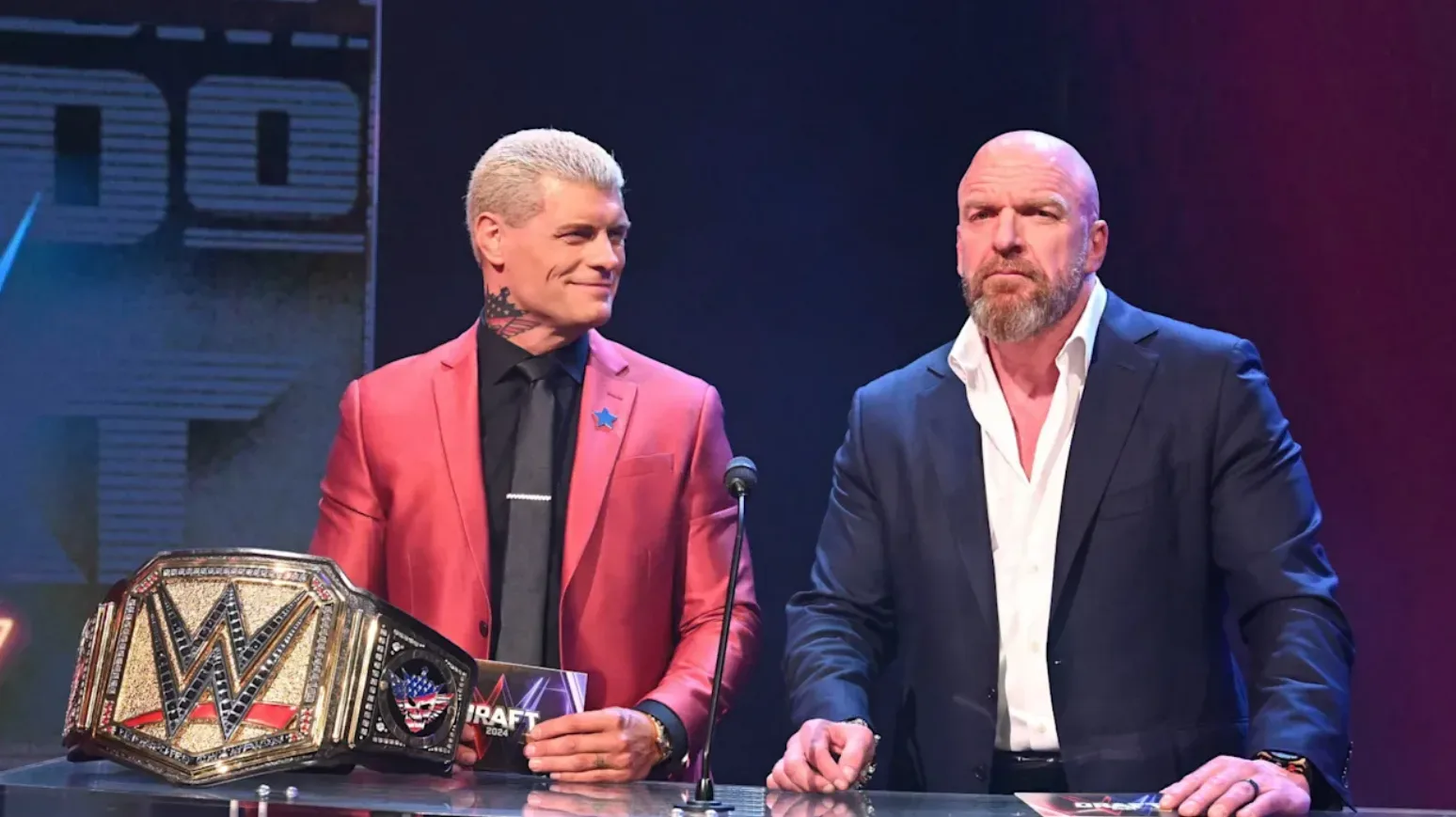
Cody Rhodes has opened up about the uneasy conversation he expected to have with Triple H before leaving WWE to film Street Fighter, explaining why the decision carried added weight while he was holding the WWE Championship.
Rhodes portrayed Guile in the Street Fighter film, which arrived in theaters on October 16. During an appearance on the Double Coverage Podcast, Rhodes said he was genuinely nervous about raising the subject with WWE’s Chief Content Officer, not because wrestling had become less important to him, but because he understood the responsibility attached to the company’s top championship and its weekly programming.
“I don’t think I’ve ever shared this before, but I was nervous to ask Triple H,” Rhodes said. “That’s really my coach and my guide in the wrestling world.”
For Rhodes, the anxiety was rooted in the reality that a WWE Champion’s availability is not a small creative matter. The title is positioned as one of WWE’s central attractions, and any absence can affect television plans, premium live event direction, live event promotion, and the ongoing stories surrounding the champion. Rhodes noted that Triple H’s focus is on making WWE’s broad slate of programming work for as many viewers as possible, from longtime followers to newer and younger fans.
For more background on this topic, read Drew McIntyre Hails CM Punk Hell in a Cell Clash as ‘Wrestling at Its Best’.
Rhodes described Triple H as someone whose business priority is keeping audiences invested in WWE across SmackDown, Raw, premium live events, and NXT. With that in mind, Rhodes knew he was effectively asking whether the company’s biggest championship could be taken off television for a period while he fulfilled his movie commitments.
“So to say, ‘Hey, the biggest title we have, the WWE title, is going to go away,’ I was nervous,” Rhodes said.
A conversation centered on planning rather than punishment
Rather than receiving the difficult response he had prepared himself for, Rhodes said the meeting became one of the most pleasant surprises of the entire experience. The discussion, as he recalled it, focused on working out the filming dates and finding a creative path that would make sense when he returned.
That distinction mattered to Rhodes. Wrestling has a long history of writing performers out of storylines through dramatic attacks or decisive losses when they need time away. Those angles can be effective, but Rhodes said Triple H did not immediately default to the familiar approach of removing a wrestler through a destructive on-screen beat.
“We’ll get the dates, and we’re going to work it out,” Rhodes recalled of the response. “But I think you could do this, then when you come back to have some ideas about how it could all flow.”
Rhodes specifically contrasted that outlook with the more traditional method of booking somebody out on the way to a hiatus. He summarized the extreme version with a memorable image: “let’s set them on fire and throw them off the ‘Tron.” The point was not that WWE could never use a physical angle to explain an absence, but that Triple H was willing to consider a broader creative solution because the circumstances were already public.
The cast’s involvement in the Street Fighter production was known, Rhodes said, meaning there was no need to pretend that viewers were unaware of why he would be away. That opened the door to a more practical conversation about timing, presentation, and how Rhodes could re-enter WWE storylines without relying on a standard exit device.
Rhodes did not lay out every detail of the scheduling process or specify every creative decision connected to his time filming. His comments instead offered a look at the philosophy behind the conversation: WWE could protect its ongoing priorities while also allowing a top star to pursue a major opportunity outside the ring.
Rhodes stresses that WWE remained the priority
Rhodes was clear that he understood WWE’s perspective. In his view, wrestling had to remain the company’s number-one concern, and, while he was champion, it also had to remain his own. The opportunity to play Guile in a theatrical film did not change the significance of being WWE Champion or the obligation that comes with representing the title.
“Wrestling is number one for WWE,” Rhodes said. “At the time, you’re WWE champion. It needs to be number one for you too. It was.”
That framing is important because Rhodes was not presenting the situation as a choice between WWE and film. He instead described a process of making both commitments work through communication and advance planning. The challenge was especially substantial because of his place at the top of WWE, but the response he received convinced him that the company could take a more expansive view of a performer’s career without losing sight of its own needs.
The comments also underline the changing visibility of WWE talent beyond the company’s traditional programming. Major outside projects can create promotional possibilities, but they also create logistical questions when the performer involved is a champion or a key fixture of weekly television. Rhodes’ experience suggests that such discussions are handled case by case, with the timing of the project and the needs of WWE’s stories both playing a role.
There is no indication in Rhodes’ remarks that the process was effortless. In fact, his nervousness illustrates just how seriously he took the request. He knew that Triple H’s responsibility extends beyond any one talent, even one holding WWE’s premier championship. The concern was not simply whether he would be allowed to take the role; it was how WWE would maintain momentum while one of its most visible stars was needed elsewhere.
Triple H’s leadership leaves an impression on Rhodes
Beyond the movie and championship logistics, Rhodes used the story to offer a strong assessment of Triple H’s leadership. He said Triple H has a larger perspective that comes with experience, and he believes that perspective makes him uniquely suited to lead WWE in its current era.
Rhodes said younger members of the roster may gain a similar understanding as they spend more time working with Triple H and learn how he approaches conversations that involve business, creative, and the individual aspirations of WWE talent. In Rhodes’ view, the key is that Triple H can evaluate opportunities without losing sight of the larger picture.
“He just has a larger worldview, which you only get with experience,” Rhodes said.
Rhodes went further, calling Triple H “the perfect person and the only person who could lead WWE.” It was a notable endorsement from a performer whose career has included several major chapters inside and outside the company. Rhodes framed Triple H as both a professional guide and a decision-maker who can balance WWE’s immediate creative demands with the reality that performers may have significant opportunities beyond wrestling.
That does not mean WWE’s priorities suddenly become secondary when an outside project arises. Rhodes repeatedly emphasized the opposite. What stood out to him was that the conversation began with WWE’s responsibility to its audience and then moved toward a workable solution, rather than treating an outside commitment as something that required an automatic, formulaic punishment in storyline.
What the Street Fighter experience represents
Playing Guile places Rhodes in one of gaming’s most recognizable franchises, and the October 16 theatrical release marked a major crossover moment for the WWE star. Guile is a character with a long history in the Street Fighter series, making the casting a high-profile assignment for Rhodes. But when discussing the project, Rhodes’ focus was less on the role itself than on the professional trust needed to step away from WWE while champion.
His account offers an unusually candid window into a conversation fans do not always get to hear about: the moment when a top champion must explain an outside commitment to the person responsible for WWE creative. Rhodes entered that discussion apprehensive. He left it encouraged by a response that made room for the film while accounting for the championship, the audience, and the story still waiting when he came back.
For Rhodes, the most meaningful outcome may have been the proof that an honest conversation could produce something more thoughtful than a routine television exit. As he put it, if discussions of that kind continue to go as well as this one did, that would be “the greatest gift ever.”

Darryl Polo
Darryl Polo is a passionate wrestling fan covering WWE, AEW, TNA and beyond. He loves great rivalries, breakout stars and the moments that keep fans talking long after the bell. How we work.