
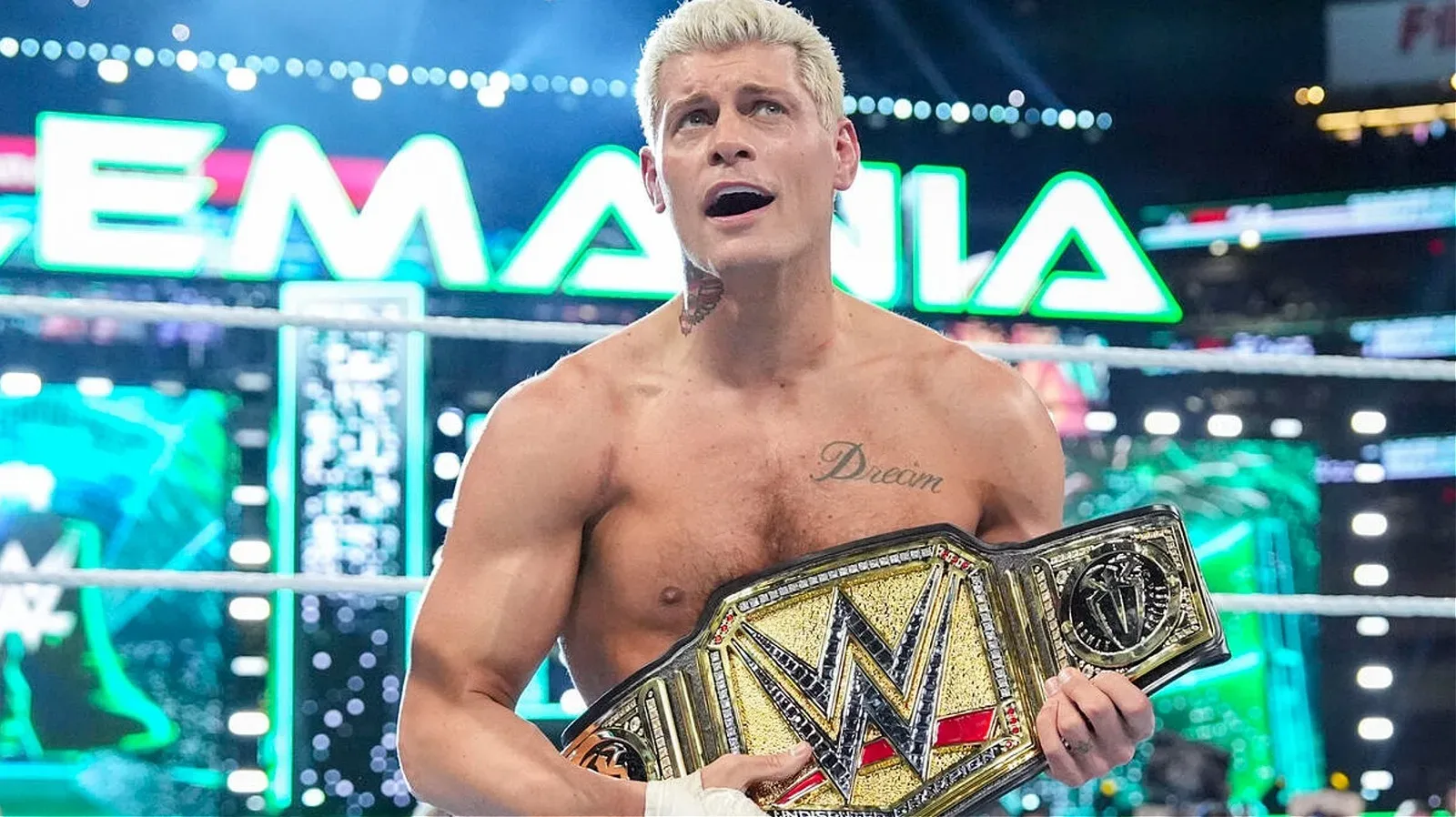
Cody Rhodes finally achieved the WWE Championship victory that had defined his return to the company at WrestleMania XL, defeating Roman Reigns in one of the most memorable main events in recent WWE history. Yet Rhodes does not view the night simply as the conclusion of his own long-running “finish the story” pursuit.
Speaking on Flagrant, Rhodes instead put the focus squarely on Reigns and the magnitude of what the former Undisputed WWE Universal Champion had built during his historic title reign. Rhodes said Reigns was the central figure in making WrestleMania XL feel like a major turning point for WWE, even though it was Rhodes who left the event with the championship.
“Roman, on that night, changed our industry,” Rhodes said. “So it had nothing to do with me.”
It is a striking assessment from the man whose WrestleMania XL win was framed as the emotional payoff to a story that had been developing across multiple years. Rhodes’ return to WWE in 2022 immediately established his stated objective: win the championship his father, Dusty Rhodes, never held. That mission brought him to Roman Reigns at WrestleMania 39, where Reigns retained after interference from Solo Sikoa. Rather than ending the chase, that loss made Rhodes’ eventual redemption a larger part of WWE’s overall direction.
For more background on this topic, read Jasper Troy Reflects on NXT Frustrations, Missed Reps and His WWE Departure.
One year later, Rhodes earned another opportunity at Reigns. The WrestleMania XL build became particularly layered after the involvement of The Rock, who aligned with Reigns and The Bloodline in a major shift for the company’s biggest storyline. Rhodes and Seth Rollins lost the first night’s tag team main event to Reigns and Rock, creating the “Bloodline Rules” stipulation for Rhodes’ championship challenge on Night Two.
The following evening, Rhodes defeated Reigns after a chaotic and heavily anticipated main event that featured a series of appearances connected to the long story surrounding The Bloodline, Reigns’ title run, and Rhodes’ road back to the top. The victory ended Reigns’ championship reign and gave Rhodes the career-defining result he had pursued since returning to WWE.
For many viewers, the finish was naturally inseparable from Rhodes. He was the challenger who overcame his WrestleMania 39 loss, endured the obstacles placed in front of him, and ultimately accomplished the goal that became synonymous with his WWE comeback. But Rhodes believes the wider meaning of the event cannot be reduced to his own championship achievement.
He explained that the period surrounding WrestleMania XL involved substantial changes within WWE, including shifts in management and broader business considerations. In Rhodes’ view, those developments, coupled with Reigns’ presence at the top of the company, helped make the event important beyond the outcome of one title match.
“That moment, I would say, is not about me,” Rhodes said on Flagrant.
Rhodes’ comments reflect the respect he has consistently shown Reigns as both an opponent and a defining WWE figure. Their rivalry was built on an obvious contrast: Rhodes presented himself as the challenger seeking to honor a family legacy and complete an unfinished personal journey, while Reigns entered the feud as the dominant “Tribal Chief,” a champion who had reshaped WWE television around The Bloodline.
Reigns’ run as champion became the foundation for much of WWE’s most prominent storytelling over several years. His title defenses, shifting alliances, and family conflict with members of The Bloodline created a sustained narrative that elevated the stakes of any challenger who stepped into his path. Rhodes was the ultimate challenger in that framework, but he believes Reigns’ role as the established attraction was essential to the scale of the WrestleMania XL match.
Rhodes also said he was grateful simply to have been part of the occasion. Rather than presenting himself as the individual responsible for the night’s success, he characterized his participation as an opportunity to contribute to something bigger. It is a notably modest perspective from a champion whose story was central to the promotion of WrestleMania XL and whose victory created one of the event’s lasting images.
There was one exception Rhodes acknowledged. If he had been playing a villainous character, he said he likely would have embraced the chance to boast about the event and claim it as his own. In that hypothetical version of the story, Rhodes said he would call WrestleMania XL the greatest night in wrestling history. As a babyface, however, he was unwilling to make that argument for himself.
“That moment is 110% Roman Reigns,” Rhodes said.
The distinction Rhodes is making is not that his victory lacked importance. It plainly changed the direction of WWE programming, ended Reigns’ reign, and established Rhodes as the company’s leading champion. Instead, Rhodes is emphasizing the difference between being the winner of a major match and being the central force who helped make that match a major attraction in the first place.
Rhodes illustrated that view by recalling a familiar piece of wrestling wisdom about the financial role of a card’s biggest bouts. He noted that one of his favorite wrestlers used to say, “There’s a couple matches on here that are paying for everybody’s flights.” The phrase speaks to the traditional understanding that a promotion’s top attractions are responsible for bringing in the audience that supports the entire event.
In applying that idea to WrestleMania XL, Rhodes suggested he sees Reigns as the established top draw whose presence carried particular weight. Rhodes may have been the protagonist of the championship chase, but he viewed himself as working alongside a performer whose run had helped define WWE’s modern era.
That outlook also underlines why the Rhodes-Reigns match resonated as strongly as it did. WrestleMania main events are often at their most effective when they combine distinct but equally significant narratives. Rhodes brought the deeply personal objective of finishing a story linked to his family. Reigns brought the aura of an almost unbeatable champion, the history of The Bloodline, and the pressure of a reign that had become one of WWE’s defining achievements.
The result required both sides of that equation. Without Rhodes’ perseverance following the WrestleMania 39 defeat, the rematch would not have carried the same emotional release. Without Reigns’ dominant position and the larger world built around him, Rhodes’ win would not have felt like such a monumental mountain to climb.
Rhodes’ remarks make clear that he regards Reigns as deserving of special recognition for that dynamic. It is an assessment that may surprise fans who associate WrestleMania XL most immediately with Rhodes holding the WWE Championship aloft, but it also acknowledges the collaborative nature of professional wrestling’s biggest stories.
WrestleMania XL gave Rhodes the result he had been chasing. It concluded one of WWE’s most prominent modern redemption arcs and placed him at the forefront of the company as champion. Still, Rhodes believes the defining impact of the night rests with Reigns, whose championship reign and stature made the destination feel as consequential as it did.
For Rhodes, being part of that moment was enough. Even with the title win representing a landmark achievement in his career, he has chosen to frame WrestleMania XL not as a personal triumph to claim alone, but as a night shaped most decisively by the rival he finally defeated.
In pictures

Darryl Polo
Darryl Polo is a passionate wrestling fan covering WWE, AEW, TNA and beyond. He loves great rivalries, breakout stars and the moments that keep fans talking long after the bell. How we work.