
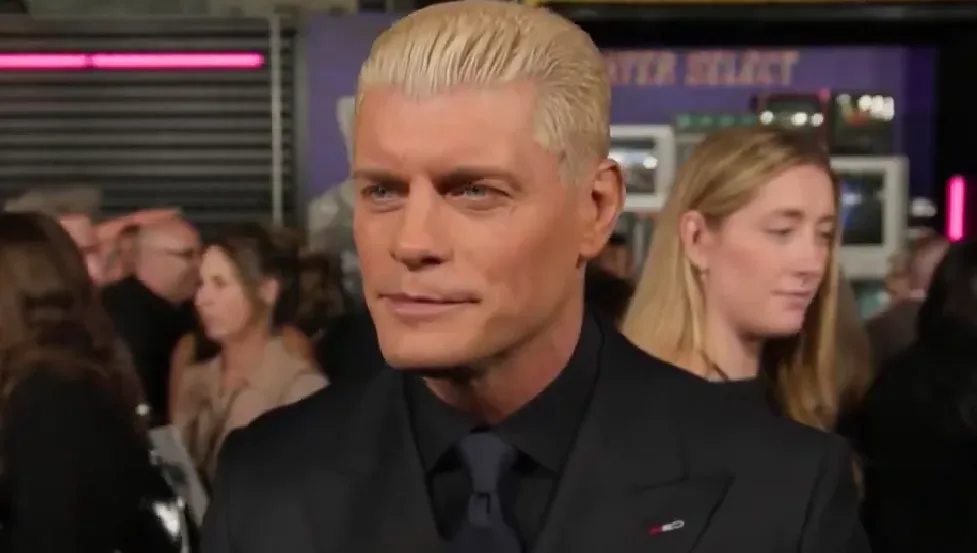
Cody Rhodes has addressed one of the most persistent jokes attached to his public comments, explaining that Bryan Danielson’s claim that Rhodes “loves to lie” was never intended to suggest that he fabricates serious information.
The line has followed Rhodes for years, particularly whenever a wrestling fan questions an interview answer, a career prediction, or a statement involving his future. During an appearance on The Nikki & Brie Show with Nikki Bella and Brie Bella, the WWE star said the quote has been stripped of its actual context and is now used in a way he considers misleading.
Rhodes was referring to comments Danielson made in February 2022. At the time, Danielson described his longtime friendship with Rhodes, dating back to their days traveling together in WWE. Danielson said he had learned how entertaining it could be to tell an absurd story with a straight face, crediting Rhodes with helping him appreciate that particular kind of ribbing.
That admission quickly became a running gag in wrestling circles. Since then, “Cody Rhodes loves to lie” has regularly appeared online whenever Rhodes makes a claim that is later debated by fans. Rhodes now feels the joke has come to stand for something much different than Danielson meant.
For more background on this topic, read Mara Sadè Says Ideas Have Been Discussed for a Tag Team With Kevin Knight.
“He put that quote out there, ‘Cody loves to lie. He taught me how to lie.’ It’s so poorly utilized,” Rhodes said. “I know what he’s saying. We didn’t make up stories. We’re not talking about, ‘They had a death in the family.’ No, these are just fun stories.”
Rhodes says the stories were harmless locker-room fun
Rhodes drew a clear line between playful exaggerations among colleagues and dishonesty regarding matters that could genuinely affect someone. His explanation presented the habit as the sort of harmless, deliberately ridiculous story wrestlers may tell one another while traveling or spending long hours backstage.
To illustrate what he meant, Rhodes offered an example involving an invented rumor about someone wearing a hairpiece.
“You tell the boys, ‘This guy has a hairpiece. Did you know that? He puts it on at 10 AM every morning.’ That’s a fun story. The guy doesn’t actually have a hairpiece. We’re not revealing anything.”
The distinction is important to Rhodes because the modern use of Danielson’s quote often arrives when fans are discussing real-world subjects. Wrestlers are interviewed constantly across television, podcasts, social media, press events, and promotional appearances. Their comments can concern current creative directions, professional ambitions, business decisions, major matches, and personal memories. A short answer can be separated from its original setting and turned into a larger argument within minutes.
For Rhodes, Danielson’s story was about harmless locker-room mischief rather than a description of his character or his reliability in public. The joke, in other words, was supposed to be about selling an outlandish tale for a laugh—not concealing major news, misleading people about serious circumstances, or spreading damaging claims.
A quote that became a fan shorthand
Danielson’s original remark has had unusual staying power because it was memorable, blunt, and easy to repeat. The phrase also came from someone with a lengthy personal history with Rhodes. Danielson said the two had ridden together during their WWE tenure and had been friends for a long time, giving his recollection the feel of an anecdote from behind the scenes rather than a criticism.
Still, the internet version of a wrestling quote does not always preserve every bit of nuance. A one-line label can become shorthand, especially when it can be applied to any prediction or assertion that sparks doubt. Rhodes acknowledged that frequent interviews make it inevitable that he will occasionally make a comment that people seize upon.
“It’s one of the worst quotes ever. Any time I say something dumb, which we’re interviewed all the time, you’re bound to say something: ‘Cody Rhodes loves to lie,’” Rhodes said.
His wording was not a rejection of the friendship or of Danielson’s sense of humor. Rather, Rhodes argued that the phrase has been used too broadly. Danielson’s account centered on tall tales meant to amuse friends, while the contemporary meme can imply that Rhodes is intentionally untrustworthy whenever he discusses a professional subject.
That difference has become especially notable as Rhodes has spent years as one of wrestling’s most visible personalities. His career has included prominent roles in WWE, a founding position in AEW, and a return to WWE that placed him back in the company’s top storylines. With that level of visibility comes constant scrutiny of every interview, including comments made casually or in response to hypothetical questions.
The broader challenge of wrestler interviews
Professional wrestling has always encouraged a complicated relationship between performance and reality. Wrestlers promote matches, protect surprises, speak within storylines, and discuss real career matters in the same media landscape. Fans have become highly attentive to wording, often looking for indications of future booking plans or major business developments.
That environment can make an old joke particularly durable. When a wrestler says something surprising, an audience may wonder whether it is a tease, a misdirection, a hope rather than a certainty, or a straightforward answer. Rhodes’ response does not eliminate that broader uncertainty, but it does clarify that Danielson’s specific “lying” story was about a different kind of behavior entirely.
The example Rhodes used was intentionally trivial: an obviously invented claim about a hairpiece. It was not an allegation designed to harm someone or expose private information. It was a piece of silliness offered with enough confidence that friends might briefly wonder whether it was true. In Rhodes’ telling, that is the entire spirit of the story Danielson had shared.
Rhodes also appeared to recognize why the line has endured. It is a catchy quote from another respected wrestler, and it provides fans an easy response whenever they disagree with him. But he made clear that the label can become frustrating when it is attached to comments that have nothing to do with the playful stories he and Danielson were discussing.
Danielson and Rhodes share a long history
The quote’s longevity is also rooted in the relationship behind it. Danielson and Rhodes were colleagues during an earlier WWE era, long before Danielson’s 2022 comments made the anecdote widely known. Danielson framed the story warmly, speaking about their friendship and the time they spent riding together. His account was less a warning about Rhodes than a recollection of the kind of nonsense that can entertain wrestlers during the repetitive rhythm of life on the road.
Rhodes’ latest explanation keeps that original relationship at the center of the discussion. He did not dispute that he and Danielson enjoyed making up ridiculous stories. Instead, he pushed back on the implication that the habit should be treated as proof that every public statement he makes is suspect.
That is a meaningful clarification in a business where a throwaway line can become part of a performer’s online identity. Fans may continue using the phrase as a joke, but Rhodes has now offered the context he believes should accompany it: the “lies” were fictional, harmless bits shared among friends, not serious deceptions.
Elsewhere in the same conversation, Rhodes discussed how The Rock knew about the outcome of Rhodes’ meeting for Street Fighter before Rhodes himself did. But the Danielson anecdote remains the portion most likely to resonate with longtime wrestling followers, largely because it addresses a meme that has outlived the moment that created it.
Rhodes’ message was simple. Bryan Danielson’s remark was based on real friendship and playful road stories. The problem, in Rhodes’ view, is not that Danielson told the story—it is that a joke about absurd locker-room tales has been repurposed as a blanket response to anything Rhodes says.

Darryl Polo
Darryl Polo is a passionate wrestling fan covering WWE, AEW, TNA and beyond. He loves great rivalries, breakout stars and the moments that keep fans talking long after the bell. How we work.