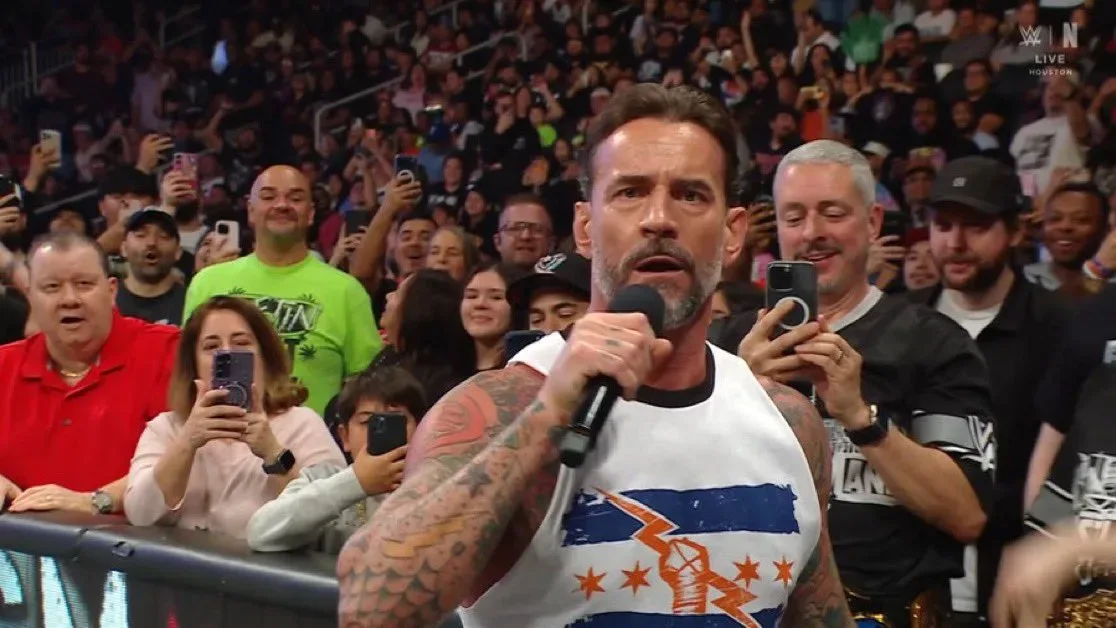
CM Punk has revealed that the effects of a serious injury from early in his career have never completely gone away.
The former WWE Champion said he still deals with occasional bouts of vertigo stemming from the skull fracture he suffered in 2002 during a match against Reckless Youth for Jersey Championship Wrestling. The injury sidelined Punk for roughly two and a half months at the time, but its impact has extended far beyond that initial absence.
Speaking on Hot Ones: Extra Heat, Punk described how the fracture led to significant equilibrium issues and explained that the condition can return without much warning. He said it has affected him during matches that fans may have viewed simply as demanding in-ring performances.
“I fractured my skull once. This is the one that reoccurs every once in a while because after I fractured my skull, I developed vertigo really bad,” Punk said.
For more background on this topic, read Cruz Montana And EK Prosper Set To Face The Vanity Project On WWE NXT.
Punk noted that he has not always discussed the issue openly. In the high-pressure environment of professional wrestling, a performer speaking publicly about balance problems and dizziness can invite difficult questions about medical clearance and future participation. Punk acknowledged that concern while offering a detailed explanation of what he believes is happening physically.
“Also one I haven’t talked about too much because you talk about that and people kind of look at you. The doctors, they’ll be like, ‘Hmm.’”
A Lasting Effect From an Early-Career Injury
The 2002 injury occurred long before Punk became one of the defining names of the independent wrestling scene, Ring of Honor, AEW, and WWE. At that stage, he was building his reputation on smaller cards and taking the risks that frequently came with trying to establish himself in a competitive independent circuit.
A fractured skull is among the more alarming injuries a wrestler can suffer, especially when it affects areas connected to balance and orientation. Punk explained that the issue involved small bones in the inner ear, which play a vital role in maintaining equilibrium. His description illustrated why vertigo remains an unpredictable obstacle more than two decades later.
“What happened was I fractured my skull and there was some bones in your inner ear that help with equilibrium,” Punk said. “Those basically were like dice inside a cup and got rattled around and thrown around. Sometimes, those still get knocked loose.”
Vertigo is more than ordinary dizziness. It can make a person feel as if either they or the world around them is moving or spinning, creating an especially difficult situation for an athlete expected to execute precise physical movements in front of a live audience. For a wrestler, that can mean attempting strikes, running the ropes, taking falls, navigating the ring apron, and coordinating with an opponent while dealing with disorientation.
Punk shared one particular circumstance that can trigger the problem for him: lying down and looking directly upward.
“If I lay down and look straight up, the world spins,” Punk said.
That admission puts another perspective on the physical demands involved in a modern WWE match. Wrestlers routinely spend time on their backs, rise quickly after being knocked down, and work through sequences where they must shift their body position in seconds. A sudden bout of vertigo can complicate any of those movements, particularly in a championship-level bout where timing and communication are critical.
Punk Says Fans Have Seen Him Work Through Vertigo
Punk did not identify specific matches in which his vertigo was at its worst, but he stated that there have been numerous occasions where viewers were impressed by his performance without realizing he was actively trying to manage a bout of the condition.
“So, there’s been a lot of matches that you see that a lot of people are impressed with where I’m full on going through a bout of vertigo and I don’t know what’s going on,” Punk said.
It is a striking look behind the curtain from a wrestler whose career has been defined as much by resilience as by his outspoken personality. Punk has returned from major setbacks at different points in his career, and he has frequently competed under the demanding spotlight that comes with being positioned near the top of a national promotion.
His comments do not establish that vertigo has caused a specific mistake, altered a particular result, or led to a medical absence in WWE. However, they do confirm that the condition remains a recurring part of his life and can affect him while he is performing.
That distinction is important. Punk was not presenting vertigo as an explanation for every difficult moment of his career or as an excuse for losing a match. Instead, he discussed it as a persistent physical consequence of an old injury—one that can emerge in the middle of a performance despite the preparation involved in working at WWE’s level.
The Moonsault Discussion Returns
Punk also addressed one of the more heavily scrutinized moments from his recent WWE matches: the appearance of his moonsault against Cody Rhodes at WWE SummerSlam. Some fans criticized the move for looking crooked, prompting widespread discussion online about its execution.
With his characteristic sense of humor, Punk connected the criticism to the vertigo he experiences.
“I will also now blame the crookedness of my moonsault on my vertigo,” Punk said.
The remark was delivered jokingly, but it also followed a serious account of how dramatically the condition can affect his sense of balance. A moonsault requires a wrestler to launch backward, rotate through the air, and land safely on an opponent, all while accounting for positioning, distance, and the ring environment. Even under ideal circumstances, it is a high-degree-of-difficulty maneuver. Any disruption to a wrestler’s equilibrium adds another potential challenge.
Punk has never been defined primarily by aerial offense. His style has traditionally centered on timing, storytelling, strikes, submissions, and an ability to make high-stakes moments feel personal. Still, the moonsault has become part of his WWE repertoire, and it naturally receives attention whenever he uses it on a major show.
The SummerSlam attempt against Rhodes generated criticism from a segment of the audience, but Punk’s comments offer context for why balance is not always a simple matter for him. They do not change what happened in the ring, nor did Punk claim the move’s execution was solely caused by vertigo. He instead made light of the reaction while acknowledging a legitimate medical issue that has followed him since 2002.
A New Chapter After the WWE Title Change
Punk’s health comments arrive during a significant stretch in his WWE story. On the September 11 episode of SmackDown, Punk lost the WWE Championship to Sami Zayn. The title change shifted the landscape at the top of the brand and ended Punk’s reign as champion.
The loss to Zayn gives Punk an immediate competitive issue to address while his long-term physical reality remains part of the conversation. WWE audiences have watched Punk operate in high-profile matches and championship situations since his return, and his disclosure underscores that what takes place between the ropes can involve challenges viewers do not see.
There is no indication in Punk’s comments that he plans to step away from competition because of vertigo. He spoke about the condition as something that reappears from time to time, not as a newly discovered problem or a stated reason to halt his career. Still, the candor is notable given the seriousness of balance-related symptoms for any active wrestler.
For Punk, the issue traces back to a night in 2002 that changed more than his short-term schedule. The skull fracture cost him time during his independent wrestling rise, but the inner-ear consequences have occasionally stayed with him through every chapter that followed. More than 20 years later, he says the world can still spin when he looks upward—and he has continued to wrestle through moments when that spinning feeling arrives at the worst possible time.
As Punk moves forward after losing the WWE Championship to Sami Zayn, his remarks serve as a reminder of the accumulated physical toll behind a career spent performing at a high level. The crooked moonsault may have become a topic for fans to debate, but Punk’s larger message was considerably more serious: an injury from the earliest days of his career remains something he has to manage while competing on WWE’s biggest stages.
Darryl Polo
Darryl Polo is a passionate wrestling fan covering WWE, AEW, TNA and beyond. He loves great rivalries, breakout stars and the moments that keep fans talking long after the bell. How we work.