
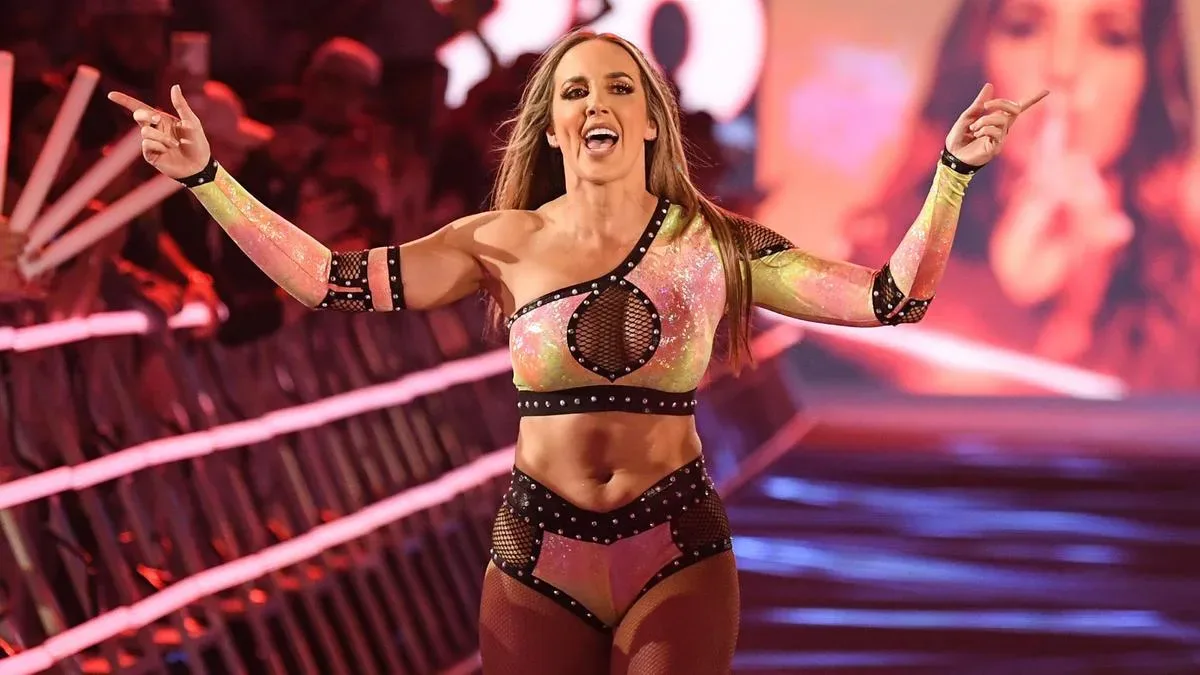
Chelsea Green’s WWE return at the 2023 Royal Rumble lasted only five seconds, but that was precisely the point.
Green entered the Women’s Royal Rumble match only to be thrown out almost immediately by Rhea Ripley. What could have been viewed as a fleeting gag instead became one of the defining early moments of Green’s latest WWE run. Green has now explained that the rapid elimination was not simply a creative decision handed to her. She actively pushed for it.
Speaking with Brad Gilmore and The Collection, Green recalled being told that she would be part of the Royal Rumble match for a considerably longer stretch. The original plan, as she understood it, would have kept her in the bout for roughly the time it took six additional entrants to arrive. Rather than looking for more minutes in the ring during her high-profile return, Green asked for a much shorter appearance.
“That was step one, you know, like coming back and them saying, ‘Hey, you’re going to be in the Rumble,’ and at first being in it for about, I believe I was in it, you know, for about six numbers before I was going to be eliminated, and I, begged them to let me be in it for a short amount of time,” Green said.
For more background on this topic, read Damian Priest Says AAA Return Is Paused as WWE SmackDown Schedule Creates Travel Hurdle.
The decision resulted in one of the match’s most memorable quick eliminations. Green entered, hurried across the ring toward Ripley, and was dispatched over the ropes before she could establish any sustained offense. Ripley, who ultimately won the 2023 Women’s Royal Rumble, was presented as an immediate threat, while Green’s return instantly gave viewers a clear sense of her comedic timing and character instincts.
Green Wanted the Shortest Possible Moment
Green said she spoke directly with Ripley just before the former NXT Women’s Champion made her entrance. Her instructions were straightforward: move quickly and make sure the elimination happened with enough speed to potentially challenge the record for the shortest time spent in a Royal Rumble match.
“I’ll never forget standing in front of Rhea right before she goes out, and I said to her, ‘if we don’t beat the record for shortest amount of time in the Rumble, I’m going to be so mad at you because I’ll run, I’ll run right across the ring, but you know, you got to toss my ass out of there,’” Green said.
The sequence lasted five seconds, a remarkably short amount of time for someone making a return on one of WWE’s biggest annual events. Yet Green viewed the choice as an opportunity rather than a sacrifice. Instead of trying to blend into the lengthy multi-person contest, she created a moment that stood apart from the rest of the match.
Royal Rumble matches are built around a difficult balance. The format provides dozens of wrestlers with an opportunity to appear on a major stage, but not every entrant can receive a lengthy showcase. Some wrestlers are given extended runs, dramatic eliminations, confrontation spots, or a position near the finish. Others need to make a sharp impression in seconds. Green’s approach was to embrace that latter role completely.
Her five-second exit was also effective because it fit the visual story of the match. Ripley entered the Rumble as one of its central figures and went on to survive from the No. 1 position to win. Tossing Green aside immediately reinforced Ripley’s physical dominance at the outset of her historic performance. At the same time, Green’s eagerness and instant downfall supplied an unforgettable beat without taking away from Ripley’s larger trajectory.
A Return Designed to Establish a Character
Green’s comments underline how much thought can go into a segment that lasts only a few moments. Wrestlers often speak about the importance of maximizing television time, but Green’s Royal Rumble example shows that a smaller role can have significant value when the performer understands how to make it distinct.
For Green, the quick elimination was not an attempt to diminish her comeback. It was a way to define it. She later said that she now sees the moment as important in setting the tone for the years that followed.
“Now I’m like, man, that was really critical to setting the tone really for the next few years,” Green said.
That assessment reflects the persona Green has cultivated in WWE: loud, dramatic, highly expressive, and capable of turning setbacks into material for the character. A conventional return featuring several minutes of exchanges may have shown that Green could compete in the match, but a sudden elimination gave her a cleaner comedic hook. It communicated frustration, chaos, and a willingness to lean into embarrassment in a way that was immediately recognizable.
In wrestling, a performer’s ability to control the crowd’s emotional reaction is often more important than simply accumulating ring time. Green’s reaction to being eliminated—and her later ability to frame the elimination as a deliberate character choice—demonstrates an understanding of that principle. The audience was given a concise visual: a returning wrestler arrives with urgency, runs directly into a dominant opponent, and is gone before she can settle in. It was simple, memorable, and easy to revisit.
The moment also illustrates why the Royal Rumble remains such a useful storytelling environment. The match can introduce returns, reunions, surprises, rivalries, dominant performances, and comic relief within the same structure. Every entrant does not need to be positioned as a prospective winner. A well-timed appearance can still help establish a direction, particularly when it plays to a wrestler’s strengths.
Rhea Ripley’s Role in the Moment
Ripley’s participation was essential to making Green’s idea work. Green needed an opponent who could credibly eliminate her in a flash, and Ripley’s presentation made that possible. By that point in the match, Ripley was already undertaking the demanding task of beginning from the first entry position. Her dominance over Green became an early punctuation mark in what developed into a marathon performance.
Ripley’s 2023 Royal Rumble victory was one of the major stories of the event. Winning from No. 1 required her to outlast the entire field, and the immediate disposal of Green contributed to the broader message that Ripley was operating at a different level. Green’s willingness to be thrown out instantly therefore aided both sides of the presentation: Ripley gained a dominant elimination, while Green gained a return moment people would remember.
Green’s recollection of telling Ripley to get her out quickly also speaks to the collaborative nature of a Royal Rumble match. The broad structure may be laid out in advance, but performers must execute rapid interactions safely, visibly, and with the intended impact. In this case, Green knew exactly what she wanted from the spot, communicated it to Ripley, and made the sprint across the ring part of the joke.
Why the Five Seconds Still Matter
There is a tendency to measure a Royal Rumble appearance by survival time. That statistic can certainly matter, especially for wrestlers involved in the final stretch or a record-setting performance. But Green’s reflection offers a different perspective. Five seconds can be meaningful if those five seconds establish a character, support a larger story, and give fans a reason to remember the moment long after the event ends.
Green was not describing the elimination as an unfortunate accident or a missed opportunity. She was describing it as a calculated decision that helped shape her WWE identity. That distinction matters. By asking for a short exit, she turned what might ordinarily be considered a negative result into a deliberate part of her presentation.
The 2023 Women’s Royal Rumble remains best known for Ripley’s victory and her endurance from the opening position. Green’s five-second cameo occupies a very different place in that history, but it has endured because of its clarity. It was a tiny piece of the larger match, executed with a specific purpose and an understanding of what would resonate.
For Green, the lesson is clear: a wrestler does not always need a long showcase to make an impact. Sometimes the right five seconds can set the tone for everything that comes next.

Darryl Polo
Darryl Polo is a passionate wrestling fan covering WWE, AEW, TNA and beyond. He loves great rivalries, breakout stars and the moments that keep fans talking long after the bell. How we work.