
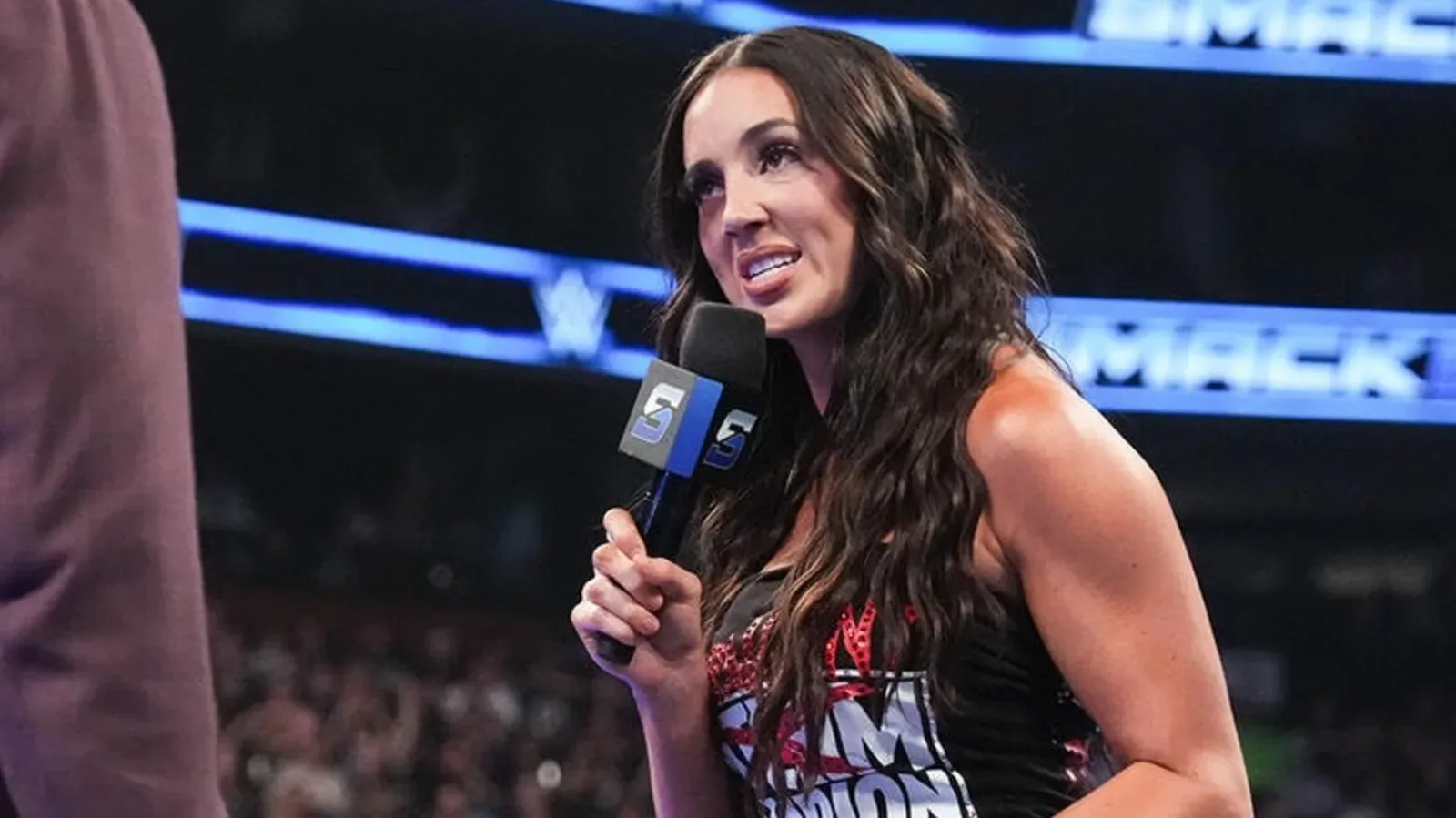
Chelsea Green believes an orbital bone injury that initially threatened to derail her WWE Women’s Championship reign ultimately became one of the most important breaks of her career.
Green won the WWE Women’s Championship at SummerSlam, only to suffer the orbital injury one week later. The timing created immediate uncertainty around the new champion’s ability to continue, and it led to an on-screen confrontation with WWE SmackDown General Manager Nick Aldis regarding the possibility that she could be forced to vacate the title.
Rather than viewing that situation solely as a setback, Green now sees it as the event that helped her recover from a creative stretch she felt was not connecting. Speaking on Notsam Wrestling, Green admitted that a promo in the week following SummerSlam had not landed the way she wanted and that the material around it had not yet found its rhythm.
“It was definitely bigger than whatever was going to come,” Green said. “I think we all felt where it was going that week after SummerSlam, where I had a very lame promo. And it kind of led into a couple of, like, lame moments, but then that broken orbital bone, like, it was the best thing that could have ever happened to me because of that promo.”
For more background on this topic, read Kofi Kingston and Austin Creed Reflect on Finding Opportunities Beyond Wrestling After WWE Departure.
A sudden shift after SummerSlam
Winning a championship is usually meant to establish momentum, especially when a performer is entering a new phase of their presentation. Green’s first week after SummerSlam, however, did not go as planned in her own estimation. Her comments make clear that she felt the initial direction of the title reign needed more than small adjustments.
The injury changed the stakes immediately. Instead of simply moving ahead with the expected follow-up to the SummerSlam victory, Green had to address whether she would remain champion at all. That uncertainty gave the SmackDown story a more urgent emotional foundation, with Aldis positioned as the authority figure who could potentially remove the title from her.
For Green, the pivotal element was not just the injury itself, but the way it allowed WWE to tell a more layered story. The possibility of a forced vacancy gave her an opportunity to play emotions beyond the usual celebratory champion material. It also introduced doubt for viewers: would Green’s championship reign be cut short almost as soon as it started?
That question, Green explained, was central to building the promo’s effectiveness. The audience needed to be taken through changing expectations, believing for a moment that the title might actually be taken away before the segment arrived at its intended destination.
Nick Aldis helped shape the key promos
Green credited Nick Aldis for helping her construct both the promo connected to the injury situation and a follow-up segment several weeks later. Her remarks offered a glimpse into the process behind developing the on-screen material, including a focus on tone, pacing, and the desired audience reaction at each stage.
“I’m very, very thankful for Nick Aldis because he helped me write that one, and he helped me write the follow-up a couple weeks later, and it hit because we were able to go through the emotions and, like, the change of pace and, what’s the ride that we want to take them on?” Green said.
That collaboration mattered because the story was built around a potential loss rather than a conventional title defense. In Green’s view, the important task was to make the audience invest in the possibility that she would lose the championship through circumstances beyond her control.
“What’s the end goal, but how do we get there, making them think that this is, you know, we’re going to take it off me because I think that’s the crucial moment in that promo,” Green said.
The approach reflects the difference between delivering lines and guiding an audience through a segment’s intended emotional arc. Green’s discussion of a “change of pace” suggests the promo was designed to move through multiple beats instead of staying at a single emotional level. The injury angle required concern and vulnerability, but Green’s established personality also demands a distinctive edge. Finding the balance between those elements was evidently part of the work she and Aldis undertook.
Green sees adversity as part of her path
Green placed the SmackDown promo and the injury-related storyline within a larger pattern from her career. She said she has experienced numerous “make or break” situations, and this was another moment when she felt pressure to turn a difficult circumstance into something useful.
Her assessment was blunt: she does not believe advancement has ever simply been handed to her. That mindset shaped the way she interpreted the injury. While an orbital bone injury so soon after a championship win could have been viewed purely as an obstacle, Green instead recognized a chance to make the character’s circumstances more compelling and to reset a direction she felt had begun weakly.
“When has anything ever just, like, been handed to me and I’m able to [take it to the next level] –never,” Green said.
That outlook is consistent with the broader theme of her comments. Green was not presenting the injury as something she wanted or something that made the situation easy. Instead, she argued that the creative consequences of the injury opened the door to a stronger story than the one that had initially been taking shape following SummerSlam.
In wrestling, momentum can change quickly, particularly after a major event. A championship win can create anticipation, but the weeks that follow determine whether that anticipation develops into a memorable reign. Green’s remarks show that she was highly aware of the early response to her material and unwilling to pretend that every segment had worked.
By openly labeling the initial promo “lame,” Green also demonstrated a willingness to critically assess her own performance. The point was not to dismiss the title victory, but to acknowledge that the presentation around it had to improve. Once the injury introduced a new layer to the story, she and Aldis were able to refocus the segment around something more immediate and emotionally engaging.
Moving away from the traditional wrestling promo
Green also explained that she has never been especially drawn to the standard style of professional wrestling promos. She wants her speaking segments to feel less predictable and more grounded, with the goal of creating a presentation that comes across as real rather than simply following familiar wrestling rhythms.
That preference helps explain why the injury storyline resonated with her creatively. A potential championship vacancy naturally carries real consequences within WWE’s on-screen world. It gave Green an opportunity to react to a threat that was more personal than an ordinary verbal exchange with an upcoming challenger.
Traditional wrestling promos often rely on direct declarations: a wrestler promises victory, insults an opponent, or demands a match. Those elements remain part of the format, but Green’s comments indicate that she is looking for something with more movement inside it. She wants the crowd to question where the story is headed, to feel the character’s changing emotions, and to reach the conclusion after being led through uncertainty.
In the case of the post-SummerSlam material, the crucial uncertainty was whether the WWE Women’s Championship would be removed from Green. The injury made that possibility believable enough to create tension, and the subsequent promo work gave the angle a structure that Green felt the earlier material had lacked.
A championship reign reshaped by an unexpected obstacle
Green’s reflection is a reminder that the most effective wrestling stories are not always the ones originally planned. Her injury came at a precarious time, just one week after winning the WWE Women’s Championship. Yet she believes it forced a necessary creative recalibration.
The result, from Green’s perspective, was a pair of promos that better communicated the stakes of the moment and brought the audience through a more deliberate emotional journey. Aldis’ involvement was particularly meaningful to her, as she credited him with helping identify the intended end point and map out how to make viewers believe the title could be taken away.
Green’s willingness to discuss the earlier SmackDown promo critically also adds context to why the injury angle mattered so much. She did not see it as a simple interruption of an already successful plan. She saw it as a moment that gave her the chance to rebound after a start she felt was underwhelming.
For the WWE Women’s Champion, the injury was an unwelcome physical setback, but its place in the story created an opening. Green used that opening to push for material with greater emotional variation, higher apparent stakes, and a more natural feel than the conventional promo structure she has long sought to avoid.
In pictures

Darryl Polo
Darryl Polo is a passionate wrestling fan covering WWE, AEW, TNA and beyond. He loves great rivalries, breakout stars and the moments that keep fans talking long after the bell. How we work.