
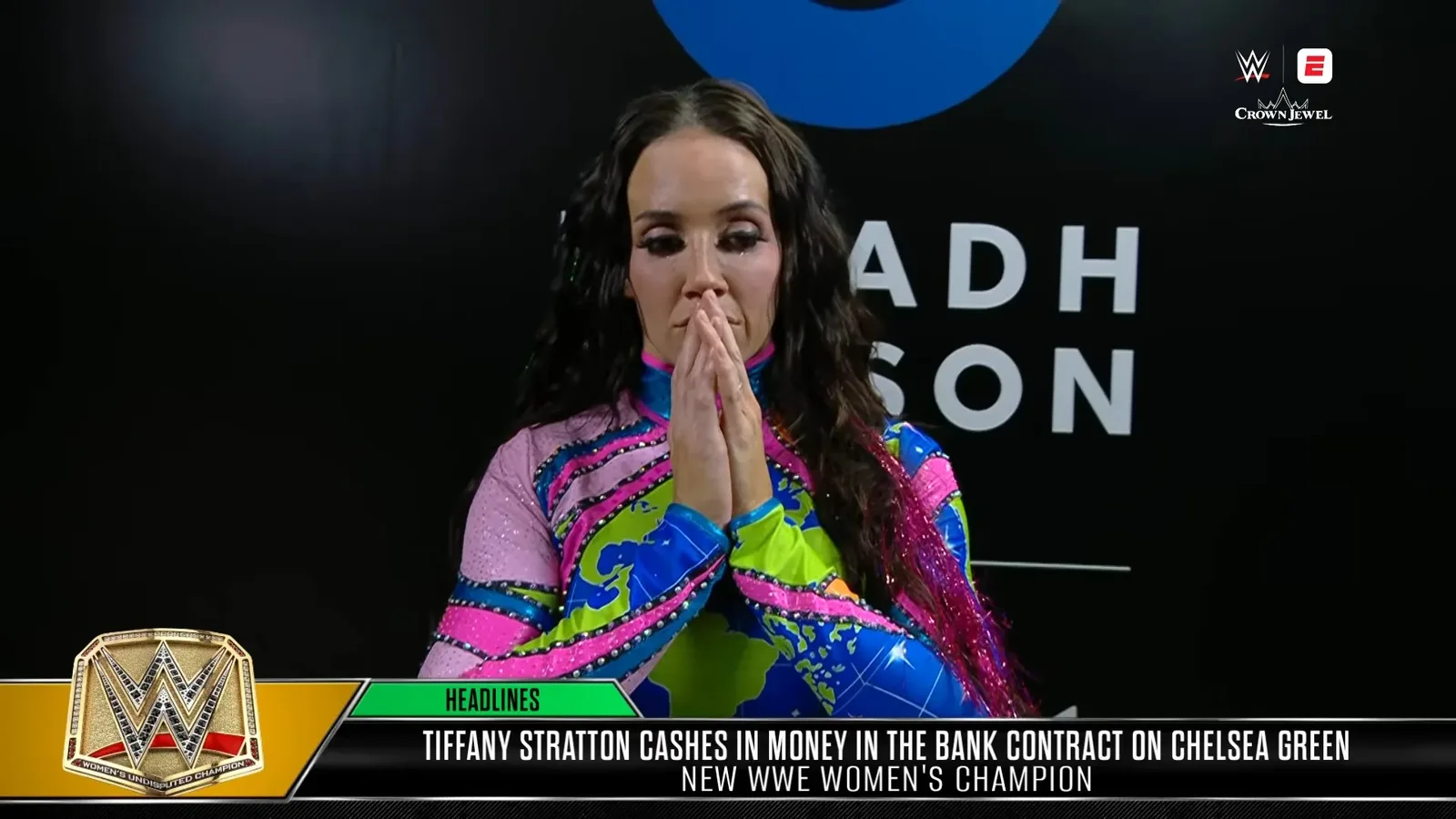
Chelsea Green has enjoyed no shortage of major moments during her WWE return, but the reigning WWE Women’s Champion believes her defining match in the company is still ahead of her.
Green, who captured the WWE Women’s Championship in a ladder match at WWE SummerSlam, discussed her in-ring expectations during an appearance on What Do You Want To Talk About? with Cody Rhodes. When Rhodes asked her to name a favorite match from her career, Green gave an especially candid answer about the difference between her perspective on WWE matches and the bouts that stand out from previous stages of her 13-year career.
“Since I came back to WWE, none of those will ever be my favorite wrestling matches. I thought it would be the opposite. I thought I would be having all my best and most beloved wrestling matches in WWE, but I’m actually so much harder on myself in WWE. My standard has risen, and I haven’t met my standard yet.”
It is a revealing assessment from a performer whose career has included memorable work across several environments. Green has competed in WWE, TNA, Lucha Underground and on the independent scene, building a resume that has demanded adaptability from her at every stop. She has also appeared on major independent events, including All In, and has consistently brought a distinctive character-driven approach to her work.
For more background on this topic, read Damian Priest Confirms AAA Run Is on Hold Due to WWE Scheduling.
Yet Green’s comments make clear that reaching WWE has not led her to relax her expectations or simply view the biggest platform as the automatic peak of her career. Instead, it has made her more exacting about what she wants a match to accomplish. For Green, the goal is not only to participate in a high-profile contest, win a championship, or create an isolated memorable moment. She is still looking for the complete match that feels personally definitive.
Green is still waiting for “the one” in WWE
Green did not identify a WWE match as her favorite, but she remains optimistic that she will ultimately have one that occupies that place in her mind. Her answer was framed less as a dismissal of her WWE work and more as an acknowledgment of a standard she has set for herself.
“Hopefully, I will. Hopefully the next time we talk I can say, ‘That’s the one.’”
That distinction is important. Green’s WWE return has already supplied landmark achievements, and her SummerSlam ladder-match championship victory stands among the clearest highlights. A ladder match is also a setting that carries unusual pressure: performers must balance athletic execution, timing, storytelling and the risks associated with the stipulation while performing in front of an enormous audience. Winning the WWE Women’s Championship in that environment ensured Green’s place in a significant chapter of WWE history.
But a championship accomplishment and a personally cherished match are not necessarily the same thing. Wrestlers often speak about favorite contests in terms of a particular chemistry with an opponent, a crowd reaction, the narrative built around a match, or simply the feeling that everything came together in the ring. Green’s comments suggest she evaluates her work through that broader lens.
Her emphasis on being “harder” on herself in WWE also speaks to the intensity of the environment. WWE presents performers with a global stage, heightened scrutiny and a deep roster of established and emerging talent. Being featured in that setting can raise the stakes for every outing, especially for a champion. Green is not presenting that pressure as an excuse; she is using it as motivation to keep reaching for a match she can view as her best.
Independent memories remain central to her career
Although Green could not point to a single favorite WWE bout, she said some of her strongest and most beloved matches took place away from WWE. In particular, she spoke fondly of independent wrestling experiences where the details of the location have faded, but the opponent and emotional response remain vivid.
“Some of the best matches I ever had were out there on the indies. I don’t even know what town. I just remember the opponent and the feelings.”
Green referenced matches in Pittsburgh, Milwaukee and Texas, though she did not specify the opponents or identify the exact events. The lack of a specific title, venue or date did not diminish the point she was making. Rather, it reinforced it. The memories that have endured for her are attached to the people across the ring and to how those matches felt in the moment.
That is a familiar reality for wrestlers who have spent meaningful time on the independent circuit. Not every career-defining match happens under the brightest lights or in a setting that is revisited constantly through video packages and historical retrospectives. Sometimes the most important bouts are those built in smaller rooms, in unfamiliar cities, or in front of crowds that were there for a singular connection between two wrestlers.
Green’s career has been long enough and varied enough to give her that kind of perspective. Thirteen years in the industry means navigating different locker rooms, television formats, promotions and styles of competition. It also means that an individual’s benchmark evolves. A match that felt like a breakthrough earlier in a career can remain emotionally important even after a wrestler advances to a far larger platform.
For Green, those earlier independent performances evidently still carry considerable weight. They helped form the standard she now brings to WWE, even if the company’s scale and the importance of her current role have made that standard more difficult to satisfy.
The Penta match remains a standout Lucha Underground memory
Among the matches Green did name, her Lucha Underground bout with Penta stood out. Lucha Underground gave Green an opportunity to work in a promotion with its own distinct presentation, blending wrestling action with a dramatic, character-heavy world. Penta, meanwhile, has long been recognized for his unique presence and physical in-ring style.
Green’s decision to mention that match underscores the breadth of her experience. Her favorite-match conversation was not limited to conventional singles bouts from one promotion or one chapter of her career. The Penta match represents a different setting and a different creative atmosphere from WWE, TNA or an independent event, but it has remained memorable to Green.
That range is valuable context for her current ambition. Green is not searching for a WWE match that merely exceeds her past work on paper. She is measuring future performances against a collection of varied experiences: independent bouts remembered for their emotion, major-event appearances, work in TNA, and the singular environment of Lucha Underground.
In that sense, the standard she described is not a simple number of minutes, a particular stipulation or a championship requirement. It is the difficult-to-define combination of opponent, story, execution and feeling that turns a match into one a wrestler carries for years.
A champion’s expectation for what comes next
Green’s comments arrive while she holds the WWE Women’s Championship, a position that naturally creates new possibilities for the match she is seeking. Champions are placed at the center of title programs and are regularly asked to deliver in bouts with greater stakes. The role can provide the time, the opponent and the story necessary to create an enduring performance.
There is no guarantee that a title match will become someone’s favorite match, of course. Green’s own remarks show that she understands the distinction. Still, she is positioned to continue pursuing exactly that opportunity. Her SummerSlam ladder-match win already demonstrated that she can thrive in a major, demanding WWE setting. The next challenge is finding the performance that matches her own elevated expectations.
Green’s openness also offers a useful reminder that performers can take pride in their accomplishments while continuing to demand more from themselves. She did not minimize the scale of becoming WWE Women’s Champion. Nor did she erase the importance of the matches that helped bring her to this point. Instead, she acknowledged that the personal bar has moved.
For now, Green’s most treasured match memories remain spread across the independent scene and her past work in promotions such as Lucha Underground. But she is not treating that as a final judgment on her WWE career. She sees it as unfinished business.
With the WWE Women’s Championship around her waist and a self-imposed challenge driving her forward, Green has made her objective clear: the WWE match she considers “the one” has not happened yet. She hopes the next conversation about her favorite bout will produce a different answer.

Darryl Polo
Darryl Polo is a passionate wrestling fan covering WWE, AEW, TNA and beyond. He loves great rivalries, breakout stars and the moments that keep fans talking long after the bell. How we work.