
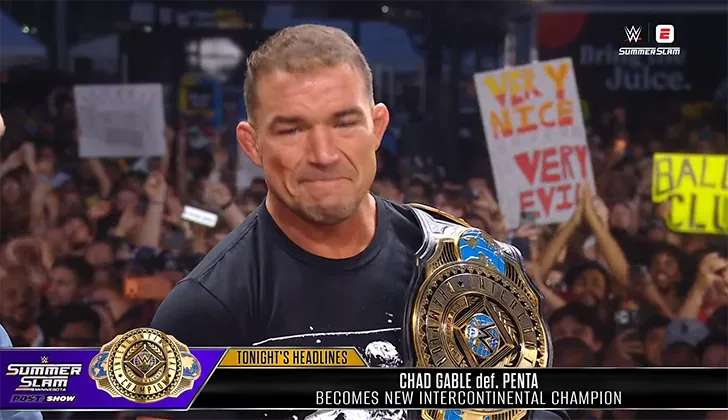
Chad Gable has opened up about the changes behind the noticeably improved physique and conditioning he has displayed since returning from injury, explaining that his results arrived when he stopped treating training as an endless test of work ethic.
For much of his athletic life, Gable’s mindset was shaped by amateur wrestling. That background helped build the relentless discipline that has been evident throughout his WWE career, but he now recognizes that the approach which worked in a competitive wrestling room was not automatically the best fit for fitness, recovery and nutrition.
Speaking with Complex Graps, Gable said the breakthrough came when he learned to apply the information he had accumulated over the years rather than simply insisting on doing things the way he always had.
“I think I had to finally turn some of my knowledge into wisdom,” Gable said. “And what I mean by that is, I had been reading and researching stuff forever and had all these smart people telling me like what works. But I always wanted to do things my way. And my way was very hard-headed and driven from amateur wrestling.”
For more background on this topic, read Rey Mysterio Looks Back on the Physical Trust Behind His WWE Rivalry With Batista.
Gable explained that amateur wrestling had reinforced a simple belief: greater effort would deliver greater results. In that environment, pushing harder could be a direct advantage. But the demands of building a pro wrestling physique, managing a full-time WWE schedule and maintaining long-term health require a more individualized approach.
“Just like the harder you work, then the more results you will see,” Gable continued. “It always paid off that way with amateur wrestling. But as far as like fitness, nutrition, all that stuff, it doesn’t really work like that. You know, like a physiology is different. There’s a science to it.”
Working Less, Eating More and Seeing Better Results
The key adjustment for Gable was counterintuitive. Rather than adding more training volume and restricting his intake in an effort to force physical changes, he found success by backing off and giving his body more fuel.
That does not mean Gable has moved away from discipline. His reputation as one of WWE’s most technically accomplished and intensely driven performers remains intact. Instead, he has redirected that effort into a plan that places a higher value on recovery, proper nutrition and sustainable training.
“So I was just running myself into the ground at times, I found,” Gable said. “And when I backed off is actually when I started seeing all these crazy changes.”
Gable credited trainer Jay Fujia with helping him understand that he did not need to exhaust himself every day to make progress. He also pointed to Jason Phillips, who worked with him on nutrition and encouraged him to increase his food intake.
“It took my trainer Jay Fujia to finally convince me of that, and beat it into my head, and a few other people along the way,” Gable said. “Jason Phillips, a guy that I worked with in nutrition before that, finally convinced me to eat more. So it sounds insane to most people; probably like all these changes started happening when I started eating more and training less. Uh, which is wild, but that’s really what happened.”
Gable was careful not to present his experience as a universal formula. What worked for him may not apply to every athlete, particularly given the differences in goals, metabolism, training history and workload. Still, his message is clear: more is not always better, especially when an athlete is already working at a demanding level.
“Now, that’s not going to be the case for everybody, obviously, but it worked for me,” Gable said.
For a WWE performer, the distinction is especially significant. The job is not limited to time in the gym. Wrestlers also have to prepare for matches, travel, promotional appearances and the physical impact that comes from performing in the ring. A routine that ignores recovery can become difficult to sustain, even for someone with Gable’s deep athletic foundation.
An Amateur Wrestling Mindset Meets WWE’s Demands
Gable’s history in amateur wrestling is central to his perspective. His technical excellence, explosiveness and body control have long been among his defining strengths in WWE. He has brought that background into matches against opponents of every size, often making his amateur credentials part of his on-screen identity as well as his in-ring style.
But his recent comments show the difference between possessing knowledge and trusting the process created by specialists. Gable said he had spent years reading and researching training-related information while also hearing advice from knowledgeable people. The challenge was not access to information; it was letting go of the instinct to outwork every problem.
That evolution is reflected in the way he describes “wisdom.” In Gable’s view, getting older has meant becoming more receptive to ideas that previously seemed to conflict with his athletic instincts. Training less can sound like reduced commitment to an athlete conditioned to embrace punishing workouts. Eating more can sound equally surprising to someone trying to alter body composition. Yet those changes proved effective for him because they addressed what his body needed rather than what his old mindset demanded.
The result has drawn attention from his peers. Gable said fellow wrestlers began asking who was helping him and how he had achieved the changes they were seeing. That response has been gratifying for him not only because it recognizes his progress, but because it has encouraged wider conversations around training and nutrition.
“It was really cool to see a lot of my peers kind of asking, ‘Who’s helping you? Who’s showing you how to do this stuff?’” Gable said. “And now it’s kind of spread and it’s cool, man. Everybody’s having fun with it again.”
Gable Wants Fitness to Feel Enjoyable Again
Beyond the visible physical transformation, Gable emphasized the importance of enjoying the process. He believes too many people view fitness and nutrition as punishment, as though progress only counts if it comes with constant deprivation, sleep loss and miserable workouts.
That is a message that carries particular weight coming from a performer known for his intensity. Gable did not argue that people should avoid hard work. He still identifies himself as part of the “4 a.m. club,” a reference to early mornings and the commitment required to pursue high-level performance. His point is that dedication and enjoyment do not have to oppose one another.
“Everybody looks at this fitness and nutrition stuff like it’s got to be torture,” Gable said. “And you know, I’m in the 4 a.m. club, man. I get up, I don’t sleep, I just train hard.”
Gable invoked Arnold Schwarzenegger as an example of the energy he believes training should have. Schwarzenegger’s legacy has often included an unmistakable enthusiasm for bodybuilding, and Gable sees that sense of excitement as something worth bringing back into the modern fitness conversation.
“Look at when Arnold did it. How much fun did it look when Arnold Schwarzenegger was training?” Gable said. “It’s supposed to be fun. It’s supposed to be cool. Make it cool again.”
That outlook may be the most important part of Gable’s comments. A physical change can attract attention, especially in an industry where presentation matters. But he is framing his progress as the product of a healthier relationship with preparation rather than a short-term attempt to chase a certain look.
Gable’s approach also reflects the reality that performers can continue to evolve long after establishing themselves on television. He has already built a career on elite athletic credibility and technical ability. By adapting his training and nutrition, he has found a way to complement those traits with a physique and level of conditioning that have become increasingly apparent since his return.
For Gable, the lesson was not that hard work has lost value. Rather, hard work becomes more effective when it is supported by recovery, sound nutrition and a program that fits the individual. The willingness to accept that lesson has helped him make changes that both WWE audiences and his peers have noticed.
And, just as importantly, Gable says the process no longer needs to feel like a daily grind. In his view, training hard can still be demanding, but it should also be something athletes look forward to doing.

Darryl Polo
Darryl Polo is a passionate wrestling fan covering WWE, AEW, TNA and beyond. He loves great rivalries, breakout stars and the moments that keep fans talking long after the bell. How we work.