
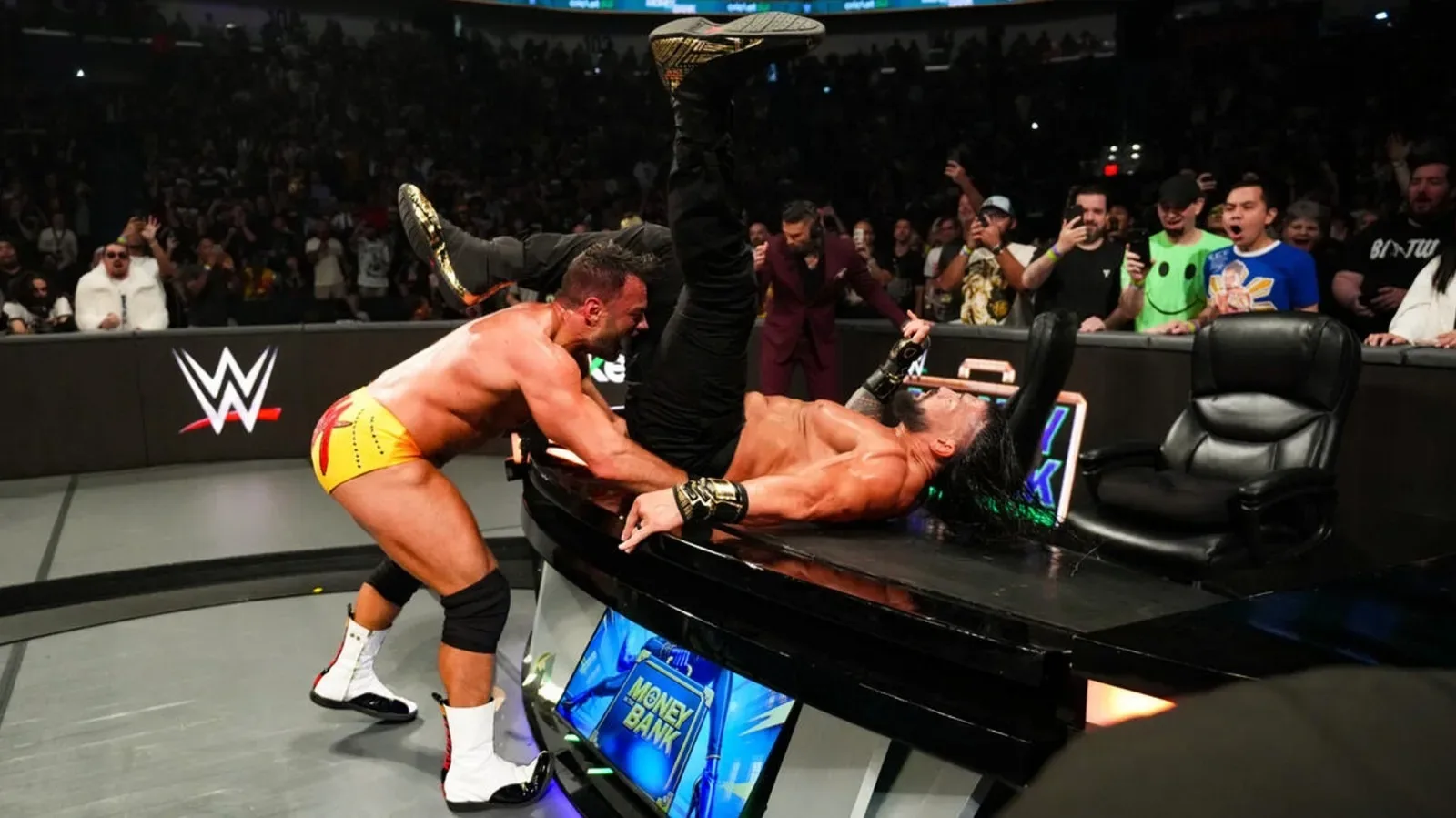
Bully Ray has strongly defended the announce table sequence between LA Knight and Roman Reigns at WWE Money in the Bank, pushing back on criticism that Knight’s initial inability to complete a powerbomb was a botch or an example of a spot going wrong.
The moment came late in Knight’s match with Reigns, who entered the bout as WWE World Heavyweight Champion. Knight tried to lift Reigns and put him through the announce table, but the first attempt did not result in the champion going through the furniture. Knight eventually got Reigns up, drove him through the table, returned him to the ring and followed with an elbow drop. The sequence produced a major near fall, with the crowd reacting loudly as Knight appeared to have a genuine opening to defeat Reigns.
For Bully Ray, the fact that the move required more than one attempt was not a flaw. It was a crucial part of making the confrontation feel like a physical fight between two men, rather than a sequence built solely around executing a move as cleanly as possible.
“Nothing went wrong with the announce table spot,” Ray said on Busted Open. “Not everything is supposed to be perfect. Not everything is supposed to be smooth. It’s supposed to look like a struggle. It’s supposed to look like a fight. It shouldn’t be easy.”
For more background on this topic, read Michael Cole Reflects On CM Punk’s WWE Return And Letting Go Of The Past.
A struggle that served the match
Announce-table spots have become a familiar high-impact element of major WWE matches, particularly when a rivalry reaches its late stages and the wrestlers need to convey exhaustion, desperation and escalating damage. Yet the visual language of those moments can sometimes create a disconnect when a wrestler effortlessly picks up an opponent and delivers a major move without resistance.
Ray’s argument is that Knight and Reigns avoided that problem. Reigns is presented as an elite, physically imposing champion, and the story of the match required Knight to overcome that stature. An immediate, effortless powerbomb would have offered a cleaner visual, but Ray believes it would have been less credible in the context of the wrestlers involved.
Knight’s first attempt established the difficulty of the task. When he finally put Reigns through the table, the completion of the move became a payoff rather than simply another planned transition. That, in Ray’s view, is why the crowd’s response matters far more than whether the sequence unfolded in one smooth motion.
“That announce table spot went perfectly fine. It worked,” Ray said. “How do I know it worked? Because when LA Knight powerbombed Roman Reigns through it, the people went crazy.”
The reaction did not end with the table breaking. Knight brought Reigns back into the ring, hit his elbow drop and created what Ray viewed as the most effective false finish of their contest. The audience bought into the possibility that the challenger could end Reigns’ championship reign, precisely because the preceding table spot had made Knight’s surge feel earned.
“He threw him back in the ring, he hit the elbow drop, and more people bit on that false finish than any other false finish in the match,” Ray said. “It was as great of a false finish in a Roman Reigns match as any false finish in any Roman Reigns match of all time.”
Why a clean execution is not always the goal
Modern wrestling discussion often focuses closely on execution. Fans regularly identify missed timing, awkward positioning and visible communication, and many of those observations can be fair. A dangerous spot that is not performed safely or a sequence that visibly breaks down can pull viewers out of a match. But Ray’s assessment draws a clear distinction between a legitimate error and a moment designed to look competitive and difficult.
A wrestling match is not meant to resemble a demonstration of cooperative athletic ability. At its best, every major move should fit the physical realities and emotional stakes of the story. A powerbomb, especially one involving a wrestler of Reigns’ size and status, should appear demanding. Reigns should not look helpless before the challenger has had to fight for control. Likewise, Knight should not be expected to look as though he can casually manhandle the champion at will.
That is the standard Ray applied to the Money in the Bank table sequence. He argued that criticism over the first unsuccessful lift misses the point of what the wrestlers were attempting to communicate. Knight was not supposed to make the champion look weightless. He was supposed to prove that he could finally force Reigns into a vulnerable position after a hard-fought battle.
“If you think there was something wrong with the announce table spot, there’s something wrong with you,” Ray said. “If you’re calling that a botch, you were botched at birth. Why? Because they didn’t get it on the first try? Who cares? It made it more realistic. It’s a struggle. Roman is heavy. LA Knight shouldn’t be able to manhandle Roman Reigns.”
Ray’s delivery was characteristically forceful, but his broader point concerns the value of imperfection in wrestling. A moment can be messy without being ineffective. In fact, a degree of visible exertion can strengthen a match when it creates tension, gives the audience a clearer reason to rally behind a wrestler and makes the eventual completion of a big move feel consequential.
The crowd response remains the central evidence
For Ray, the decisive measure is not a freeze-frame analysis of the first attempt. It is the live audience response that followed. The fans reacted when Knight finally powerbombed Reigns through the announce table, then reacted again when the challenger used the elbow drop to pursue victory in the ring.
Those beats are especially important in a Roman Reigns title match. Reigns’ matches have often been structured around dramatic stretches in which challengers seem poised to defeat him, only for the champion to survive. The better those near falls are received, the more the match’s central conflict succeeds. Ray believes Knight’s post-table elbow-drop cover created a level of belief comparable to the biggest false finishes in Reigns’ history.
That response also reflects Knight’s standing with the WWE audience. Whether or not the challenger secured the championship, the Money in the Bank match offered him a major platform against one of WWE’s defining stars. The announcement-table sequence gave Knight an opportunity to display resilience, strength and urgency. Rather than treating the difficulty of the lift as embarrassing, Ray sees it as a mechanism that made Knight’s eventual momentum more relatable.
A challenger trying, failing, regrouping and finally succeeding is a familiar and effective wrestling story. It gives the crowd a natural reason to get louder. The audience is not merely waiting for a move; it is watching a competitor overcome resistance. In this case, the table did not need to break on the first attempt for the scene to work. Ray believes the delay made its destruction matter more.
Bully Ray wants another Knight-Reigns match
Ray’s praise was not limited to one spot. He came away impressed enough by Knight’s work opposite Reigns that he would like to see the two wrestlers meet again. He indicated that a rematch between Reigns and Knight interests him even more than another encounter between Reigns and Penta, following Reigns and Penta’s recent match.
That view underlines how highly Ray rated the Knight-Reigns dynamic at Money in the Bank. A rematch would give WWE the chance to build on the sense of jeopardy created in their first meeting, particularly if Knight’s near victory is positioned as evidence that he can compete with the champion at the highest level.
Reigns remains an opponent whose size, aura and championship pedigree make every credible challenger’s breakthrough attempt significant. Knight’s failure to put him through a table on the first try did not lessen that challenge. In Ray’s eyes, it clarified it. The table spot was not a missed opportunity for a cleaner highlight. It was a physical obstacle that Knight had to overcome before he could make the audience believe an upset was possible.
The debate over the sequence is likely to continue among viewers who prioritize precision and those who prioritize realism. Ray has made his position unmistakable: the moment delivered the intended reaction, advanced the match’s drama and helped create a memorable false finish. By those standards, he believes the announce-table struggle did exactly what it needed to do.
In pictures

Darryl Polo
Darryl Polo is a passionate wrestling fan covering WWE, AEW, TNA and beyond. He loves great rivalries, breakout stars and the moments that keep fans talking long after the bell. How we work.