
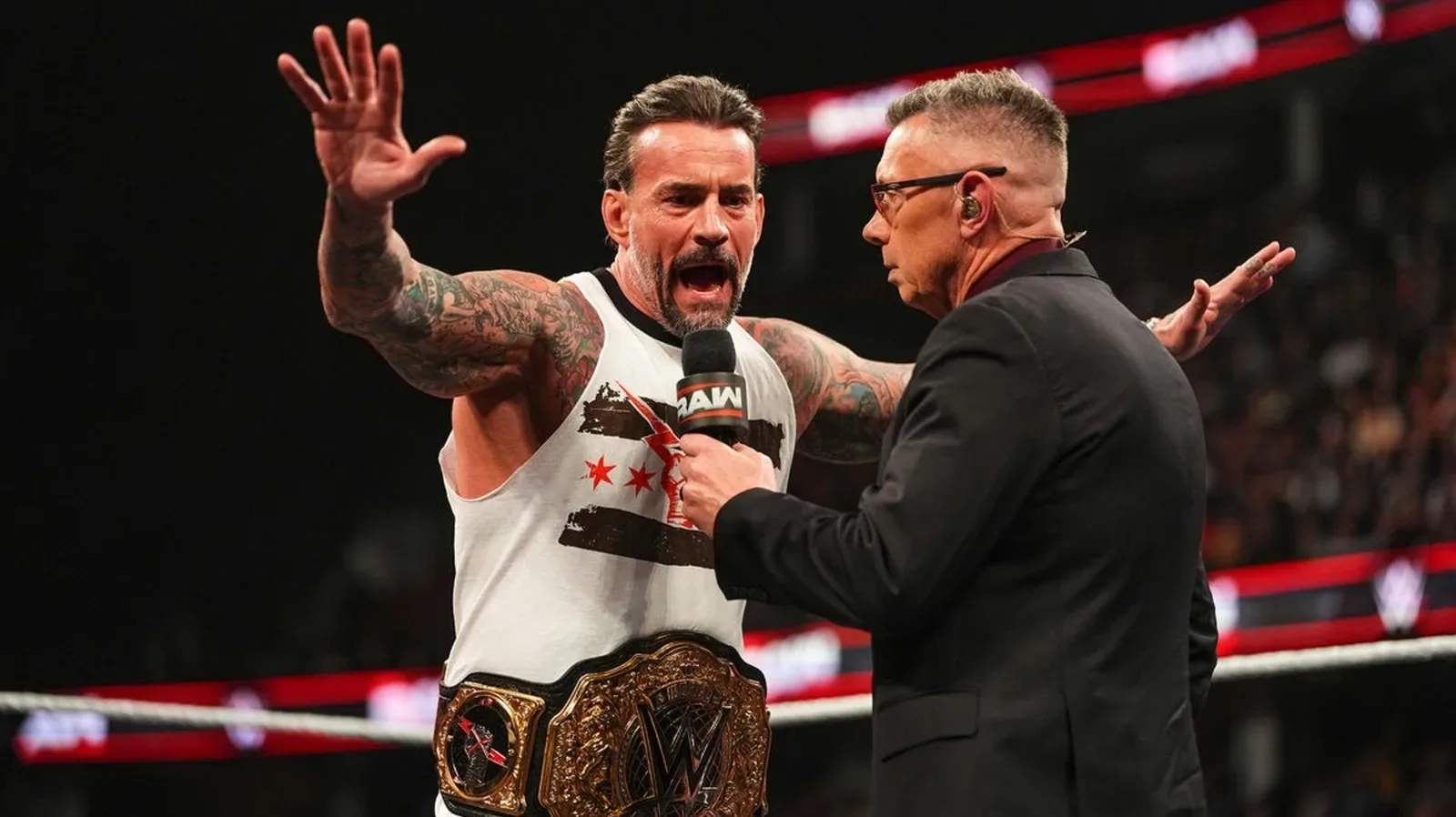
CM Punk’s return to WWE was one of the most surprising developments in modern professional wrestling, not simply because of the way he left the company years earlier, but because of everything that happened in the time between his departure and his eventual comeback. For fans, the question was whether Punk could truly coexist with the WWE system again. Inside the company, there were equally obvious questions about how colleagues who knew Punk before his exit would receive him.
Michael Cole has now discussed his own perspective on that return, explaining that he and Punk had been close during Punk’s first WWE run. While their friendship faded after Punk left the company, Cole said he approached the comeback with a practical attitude shaped by three decades in WWE: past disagreements cannot be allowed to stand in the way of doing business.
Speaking in an interview with OutKick, Cole recalled that he and Punk had a genuine friendship before Punk’s departure. However, their relationship changed after Punk was no longer with WWE, which Cole described as a familiar reality in an industry where people’s careers and circumstances can move in entirely different directions.
“Punk and I were real close when he was here the first time around. Obviously, he leaves the company. This business is weird because you can be best friends with someone while they’re working here and then they leave and you might not talk to them for a few years. That was my situation with Punk,” Cole said.
For more background on this topic, read Cappuccino Jones and Santi Rivera Announce WWE ID Departures.
Punk’s original WWE departure came in 2015 following a difficult stretch that had already become one of the most discussed stories in wrestling. For years afterward, Punk was closely associated with the idea that he would never go back. His return at Survivor Series 2023 therefore carried an undeniable sense of shock, both in the building and among those watching around the world.
Cole said that he was excited by the possibility of Punk coming back, even as he understood that there would be uncertainty around what the reunion would look like. Punk had become a major figure outside WWE, including during his time in AEW, and his relationship with WWE had long seemed beyond repair to many observers.
“Listen, business is business. I learned that a long time ago when I started here. Never say never to anything in WWE. I was excited when Punk was going to come back,” Cole said.
Questions Surrounded Punk’s Return
There was no shortage of intrigue surrounding Punk’s reappearance. His career had taken several dramatic turns since he last wrestled for WWE, and his name had been connected to intense public discussion throughout that period. Punk had also spoken negatively about elements of his prior WWE experience after leaving the promotion.
Cole acknowledged that he did not know exactly how Punk would behave once he returned or how the WWE locker room would react to him. That uncertainty did not create a problem for Cole, however. The longtime commentator said he was prepared to work with Punk and was happy to see him back in WWE.
For Cole, the issue was not about ignoring history or pretending that nothing had been said over the years. Instead, he emphasized a larger philosophy about longevity in wrestling. In an industry built around strong personalities, shifting alliances, and highly public rivalries, Cole believes it is essential not to take every past conflict personally.
“You, you can’t hold a grudge. If you take anything personal in our business, you won’t survive. There’s a reason I’ve been here for 30 years. You have to just let it slide down your back, move on with a smile on your face, and do business,” Cole said.
That outlook is especially notable coming from Cole, whose WWE career has spanned multiple eras of the company. Over those years, he has served in a variety of onscreen and behind-the-scenes capacities while becoming one of WWE’s most recognizable voices. He has worked alongside a lengthy list of performers and executives, witnessed major changes in the company, and remained a constant presence through periods when the roster and creative direction have changed dramatically.
Cole’s comments present Punk’s return less as a personal reconciliation story and more as an example of the realities of professional wrestling. Personal connections can be meaningful, but the business is often defined by separation, change, and eventual reunions that once seemed impossible. For a veteran such as Cole, adapting to those changes is part of the job.
“Never Say Never” In WWE
The phrase “never say never” has been used countless times in wrestling, but Punk’s WWE return is one of the clearest recent reminders of why it endures. After leaving in 2015, Punk repeatedly appeared to be finished with the company. His eventual comeback showed that circumstances can evolve, relationships can be repaired, and the right people can create an opening for a fresh chapter.
Punk has said that WWE President Nick Khan and Chief Content Officer Paul “Triple H” Levesque played important roles in his decision to return. Their involvement helped make a comeback possible despite the history attached to Punk’s departure and the years that followed.
That decision reshaped WWE almost immediately. Punk returned to a company that was considerably different from the one he left, both structurally and creatively. WWE’s leadership had changed, its talent roster had changed, and its relationship with its audience had changed. Punk himself had changed as well, having spent years away from WWE before reestablishing himself as an active wrestler elsewhere.
The reaction to Punk’s return demonstrated his continuing significance as a major wrestling figure. His arrival was not treated as a routine roster addition. It was a moment that invited attention from fans who had followed every stage of his career, from his first WWE run to his time away from wrestling, his return to the ring, and the unexpected path that ultimately led him back.
For those who worked with Punk during his first WWE tenure, though, the return also involved a more personal layer. Cole’s recollection makes clear that he remembered the positive relationship they once shared. At the same time, he did not make his reaction dependent on restoring that friendship exactly as it had been before.
His stance was straightforward: Punk was back, WWE had business to do, and Cole was willing to move forward.
Cole’s Perspective On Professional Wrestling
Cole’s comments offer a useful look at the professional mindset required to remain successful in WWE for an extended period. Wrestling is a business where departures can be emotional and where public comments can linger with fans long after the people involved have moved on. It is also an environment in which former rivals and estranged colleagues can find themselves working together again with little warning.
In that setting, Cole’s belief that grudges are counterproductive is not merely a personal preference. It is a survival strategy. He connected that approach directly to his 30 years in WWE, suggesting that durability depends on the ability to accept change and focus on the work in front of you.
That does not erase the uncertainty that surrounded Punk’s comeback. Cole openly said he was unsure how Punk would act or what the locker-room response would be. But Cole also made clear that those questions did not outweigh his excitement or his willingness to conduct business professionally.
For Punk, the WWE comeback marked the end of a long period in which a return seemed unlikely. For Cole, it was another example of why definitive statements do not always hold up in professional wrestling. Careers take unexpected turns, relationships evolve, and even the most seemingly final exits can eventually lead back to the same place.
As WWE continues with Punk once again part of its landscape, Cole’s reaction underscores the measured approach taken by someone who has watched the business change repeatedly. The past may be part of the story, but Cole’s message is that the future of the business requires people to keep moving forward.
In pictures

Darryl Polo
Darryl Polo is a passionate wrestling fan covering WWE, AEW, TNA and beyond. He loves great rivalries, breakout stars and the moments that keep fans talking long after the bell. How we work.