
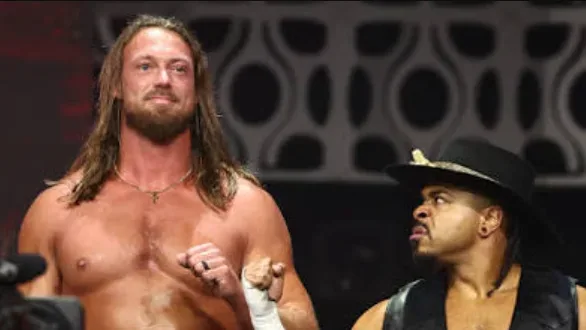
Bryan Keith has spent much of his professional wrestling career operating as a singles competitor, building a reputation around intensity, toughness, and an unmistakably confrontational presence. His time alongside Big Bill in All Elite Wrestling gave him a different kind of challenge: learning how to function as one half of a regular tag team while working beside one of the largest and most experienced athletes in the locker room.
Speaking on Knockouts and 3 Counts, Keith looked back on the partnership with Big Bill, who has since returned to WWE under the Big Cass name. The pairing spent time together in AEW and, for part of that run, operated under Chris Jericho’s Learning Tree umbrella. For Keith, the experience was not simply a change in presentation. It was an opportunity to study how an established performer approached his work and to understand the responsibilities that come with tag team wrestling.
“So, I never was a tag team. It was my first time I was in a legitimate tag team with someone else, and usually, the pressure’s on me; the work is up to me,” Keith said. “So sharing that burden with somebody else is definitely cool, definitely something that I wasn’t so sure of.”
Keith’s comments underline a major adjustment that comes with a genuine tag team role. A singles wrestler controls the pace, personality, and structure of their own performance in a more direct way. In a team setting, timing, positioning, character chemistry, and trust all become shared duties. The wrestlers need to make their styles complement one another, particularly when they are dealing with a major size difference like the one between Keith and Big Bill.
For more background on this topic, read Kevin Knight Names Mr. Perfect, The Rock, Jeff Hardy and NFL Stars as Character Influences.
That contrast became one of the defining features of their act. Keith brought a compact frame and an explosive, fiery demeanor, while Big Bill supplied a towering physical presence. Rather than treating that difference as an obstacle, Keith believed it gave the duo a natural identity and opened the door for compelling matchups against a variety of opponents.
A learning experience alongside a veteran
Keith spoke highly of Big Bill’s work ethic and the qualities that made him stand out. He noted the obvious visual strengths of his former partner, from his seven-foot stature to his conditioning and charisma, but Keith’s strongest takeaway concerned the daily influence Big Bill had on him.
“I know he’s a hard-working dude. I mean, look at him. He’s freaking 7-foot tall, chiseled, charismatic — you can’t teach it. They say you can’t teach it,” Keith said with a laugh. “I just feel like being around him made me constantly wanna be better, made me wanna constantly strive to do better, and just learn from him.”
Big Bill arrived in AEW with significant tag team experience already behind him, including his well-known run alongside Enzo Amore during their time in WWE. Keith said that background mattered to him as he was navigating a new side of his own career. Observing how Big Bill carried himself, structured his work, and handled the dynamic of a partnership gave Keith a firsthand education that he had not previously received during his years as a singles wrestler.
“He came from one of the greatest tag teams, and just being in a tag team, and picking off his energy and just learning the way he did things and how he would carry himself was definitely an invaluable thing for me,” Keith said. “Just being around him and being able to mirror him and learn from him is amazing.”
Keith framed the team as the ideal introduction to a format he had not seriously explored before. Rather than entering tag competition with another wrestler of similar size or a nearly identical style, he was paired with a performer whose physical profile demanded that they think about matches differently. The arrangement allowed Keith to emphasize speed, aggression, and personality, while Big Bill could loom as the decisive force capable of changing a match at any moment.
Holy Demon Army inspiration
Keith also connected the pairing to his appreciation for Japanese professional wrestling. Specifically, he compared the broad dynamic of himself and Big Bill to Holy Demon Army, the legendary All Japan Pro Wrestling tandem of Toshiaki Kawada and Akira Taue. Kawada and Taue are six-time AJPW World Tag Team Champions, and their combination of danger, attitude, and sharply contrasting physical characteristics made them one of the most celebrated teams of their era.
Keith did not present his team with Big Bill as a direct replica of Kawada and Taue. Instead, he saw a familiar kind of energy in the smaller, angry wrestler standing next to a much larger partner whose presence could instantly alter the tone of an encounter.
“The big man/little man dynamic, you know, perfect as well,” Keith said. “Again, big fan of Japanese professional wrestling so I always loved Holy Demon Army, you know, Toshiaki Kawada and Akira Taue, and I always felt like that was kind of the dynamic with me and Big Bill.”
“We had this f*cking ball of anger, ready to just whoop somebody’s ass all the time. Small as hell, but big personality. Then you got this freaking giant that, at a moment’s notice, he could rip your freaking head off if he wants to and it made for good matchups.”
The description fits Keith’s wrestling persona particularly well. He has frequently portrayed a wrestler who is willing to confront anyone regardless of the disparity in size or power. Standing beside Big Bill added another layer to that character. Keith could remain the volatile instigator, while Big Bill became the imposing threat whose involvement could turn Keith’s hostility into a much larger problem for their opponents.
Memorable opponents and a new perspective
Keith pointed to matches with Gates of Agony and Top Flight as examples of the matchups that made the partnership enjoyable. Those opponents offered distinctly different challenges. Gates of Agony brought their own considerable size and power, giving Keith and Big Bill an opportunity to work in a more physical environment. Top Flight, meanwhile, presented a quicker and more aerial-based contrast that could highlight Keith’s aggression and Big Bill’s reach.
“We had great matchups with Gates of Agony, and we wrestled Top Flight a lot and I feel like it was, again, just something that I appreciated because it was a different aspect of my career,” Keith said.
For a wrestler who had spent roughly 14 years primarily pursuing singles wrestling, that difference carried real value. Tag wrestling can change the way a performer views crowd reactions, transitions, offense, selling, and match pacing. It also asks wrestlers to create a bond that audiences can understand quickly, whether that bond is rooted in friendship, shared goals, intimidation, or a common association such as The Learning Tree.
Keith’s comments suggest that the Big Bill partnership helped broaden his outlook rather than pull him away from his established identity. He did not describe the team as a departure from what made him effective. Instead, it became a setting where his existing strengths could be applied in a new structure, with a veteran partner offering guidance through the process.
“Being a singles wrestler for like, what? 14 years? Actually being able to see that side of professional wrestling and enjoy that side of professional wrestling,” Keith said. “It was a really cool thing for me to go through.”
Keith remains active with AEW and ROH
Big Bill’s return to WWE has brought that chapter of Keith’s AEW career to a close, but Keith remains part of the AEW and Ring of Honor landscape. His most recent match for the company came at a Ring of Honor taping in August.
Whether Keith’s next major direction is as a singles wrestler, in another tag team setting, or through a broader role on AEW or ROH programming, his reflections make clear that his run with Big Bill remains a meaningful part of his development. The partnership gave him a chance to work with a performer he respected, test himself in a format that was unfamiliar to him, and draw from a tag team tradition he has admired as a fan of Japanese wrestling.
For Keith, the ultimate value of the experience appears to be simple: proximity to Big Bill raised his standards. In an industry where wrestlers often speak about learning through repetition and exposure to different opponents, Keith found that the day-to-day example of his partner motivated him to keep improving.
Darryl Polo
Darryl Polo is a passionate wrestling fan covering WWE, AEW, TNA and beyond. He loves great rivalries, breakout stars and the moments that keep fans talking long after the bell. How we work.