
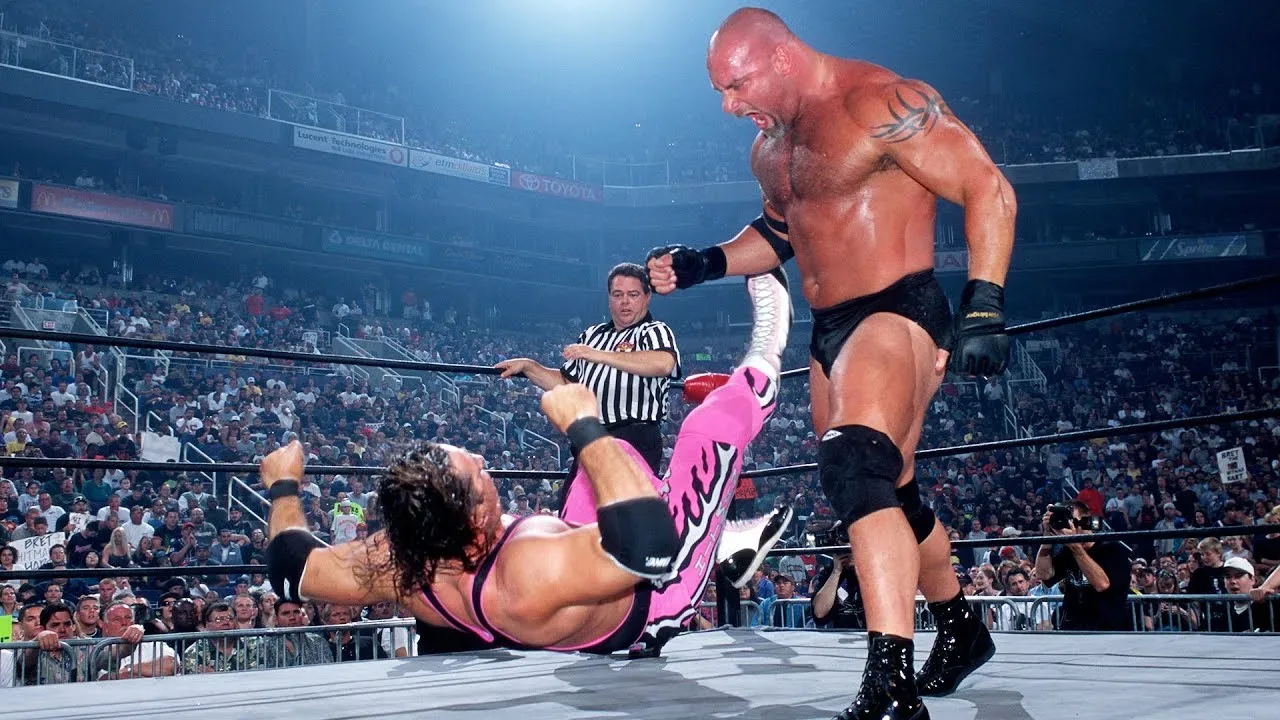
Bret Hart has again addressed the incident involving Goldberg that he believes brought his in-ring career to an end, directing his frustration not only at Goldberg but at WCW’s responsibility for allowing the situation to happen.
During an appearance on The Johnny I Pro Show, Hart discussed the importance of wrestlers protecting one another in the ring. The WWE Hall of Famer has long been regarded as one of the safest and most technically polished performers of his generation, and he contrasted that approach with what he says happened when he worked with Goldberg in WCW.
Hart has repeatedly been critical of Goldberg over the years, maintaining that Goldberg was unsafe and insufficiently experienced in the finer points of professional wrestling. This time, Hart’s comments focused heavily on the environment that allowed Goldberg to work at that level without what Hart believes was the necessary guidance.
“You’ve got to know what you’re doing when you go out there a little bit,” Hart said. “It’s not like Goldberg — I won’t go on a big thing about Goldberg, but Goldberg just hurt me because he didn’t know how to do anything different.”
For more background on this topic, read Tetsuya Naito Retains GHC Heavyweight Championship Over Kenoh at NOAH Korakuen Hall Show.
Hart said that wrestling safely requires training, communication and an understanding that the physicality of a match must remain controlled, even when it is intended to look forceful to the audience. In his view, the problem was not merely that Goldberg made a mistake. Hart argued that Goldberg had not been properly taught how to execute dangerous-looking offense without legitimately harming an opponent.
“No one taught him, no one showed him, no one explained to him like Bill, it’s not really real,” Hart said. “You can’t actually kick somebody in the head as hard as you can, you just can’t.”
The comments are consistent with Hart’s longstanding position on the matter. He has never hidden his belief that Goldberg’s in-ring approach was unprofessional and unsafe. At the same time, Hart made clear that he believes WCW itself deserves substantial blame for placing him in the ring with someone he felt did not have an adequate grasp of wrestling fundamentals or performer safety.
“No one took the time to tell him that in WCW, where it’s like, they should be sued for unprofessional wrestling, for putting me in the ring with a guy that didn’t know anything about wrestling,” Hart said.
Hart Places Responsibility on WCW’s System
Hart’s latest remarks are notable because they place the central focus on WCW’s management and training culture rather than solely on Goldberg as an individual. While he did not back away from criticizing Goldberg, Hart described a situation in which a wrestler was sent into a high-pressure national environment without the level of instruction Hart believes should have been required.
Professional wrestling depends on cooperation between performers. Matches may be presented as fights, but the people involved must work together to make every exchange look convincing while limiting unnecessary risk. Strikes, throws and other physical sequences require timing and trust. Hart’s point was that a wrestler cannot simply execute moves with full force because the result can be a genuine injury rather than a controlled piece of a performance.
For Hart, that distinction appears central to his frustration. His criticism was not framed as a complaint that wrestling is inherently dangerous. Instead, he argued that danger must be managed by people who understand what they are doing and by a promotion that ensures its talent receives the appropriate preparation.
Hart’s use of the phrase “unprofessional wrestling” underscored that broader complaint. He believes the company failed a basic duty to protect him by allowing a performer who, in Hart’s estimation, had not been properly educated on how to deliver offense safely. The comment was delivered as a sharp assessment of WCW’s judgment, rather than as confirmation of any legal action.
A Dispute That Has Continued for Years
The issue remains one of the most discussed and emotionally charged subjects connected to Hart’s career. Hart has consistently said the situation with Goldberg ultimately led to the end of his time as an active in-ring wrestler. Because of that, his comments have carried lasting weight whenever the subject has resurfaced.
Goldberg has apologized to Hart multiple times over the years and has encouraged him to move past the situation. Those apologies have not changed Hart’s public view of what happened or his criticism of Goldberg’s work. Hart’s newest comments indicate that he still sees the incident through the same lens: a preventable failure that should never have occurred.
There is an important distinction in Hart’s latest framing. While Goldberg remains the person Hart says hurt him, Hart also presented Goldberg as someone who had not been adequately trained or instructed. Hart said, “he didn’t know how to do anything different,” suggesting that he sees a failure of education and supervision as part of the reason the dangerous contact occurred.
That does not soften Hart’s assessment of Goldberg’s performance. Hart plainly said he did not believe Goldberg knew enough about wrestling. But it does explain why his anger extends to the company that booked the two men together. In Hart’s view, WCW should have recognized the risk and taken steps before allowing the match situation to happen.
The Importance of Safety in the Ring
Hart’s comments also speak to a larger principle that has shaped his reputation throughout his career. He has regularly emphasized the craft involved in professional wrestling, including the obligation performers have to safeguard the person standing across from them. A move can appear explosive, a punch can look devastating and a kick can seem to connect with full impact, but the execution must remain disciplined.
That balance is one of the reasons safety is often discussed as a defining measure of in-ring professionalism. Wrestlers perform in a physical setting where timing can be disrupted and mistakes can happen. The goal is not to eliminate all risk, but to reduce avoidable danger through training, communication and proper technique.
Hart’s criticism of WCW is rooted in his belief that those safeguards were not respected in this case. He stated that nobody took the time to explain the difference between making an attack look real and actually delivering it with harmful force. His remarks leave little doubt that he sees this as a structural failure, not an unavoidable accident of the profession.
For audiences, the best wrestling often looks spontaneous and brutal. For the wrestlers involved, however, maintaining that illusion requires a shared understanding of the limits of physical contact. Hart’s comments stress that lesson directly: performers must know how to create the appearance of violence without causing legitimate injury.
Hart’s Position Has Not Changed
Hart did not offer a new resolution to his conflict with Goldberg, and his comments did not indicate that he has reconsidered his past statements. Instead, he reiterated the core of his argument with unusual bluntness: Goldberg hurt him, Goldberg lacked the knowledge to work differently, and WCW should not have put Hart in that position.
His reference to WCW being sued was an expression of how strongly he feels about the company’s conduct. Hart did not announce a lawsuit or describe any current legal process. The point he made was that, in his view, the promotion’s decision-making was so reckless that it represented a profound failure of professional responsibility.
The subject is likely to remain part of the conversation whenever Hart reflects on his career, Goldberg’s legacy, or WCW’s final era. Hart has made clear that the incident is inseparable from the ending of his active wrestling career, and he continues to reject the idea that it should simply be forgotten.
For now, Hart’s latest interview adds another firm statement to a dispute that has endured for years. He remains convinced that wrestler safety was compromised, that Goldberg was not properly prepared for the demands of the ring, and that WCW bears responsibility for letting the situation happen.

Darryl Polo
Darryl Polo is a passionate wrestling fan covering WWE, AEW, TNA and beyond. He loves great rivalries, breakout stars and the moments that keep fans talking long after the bell. How we work.