
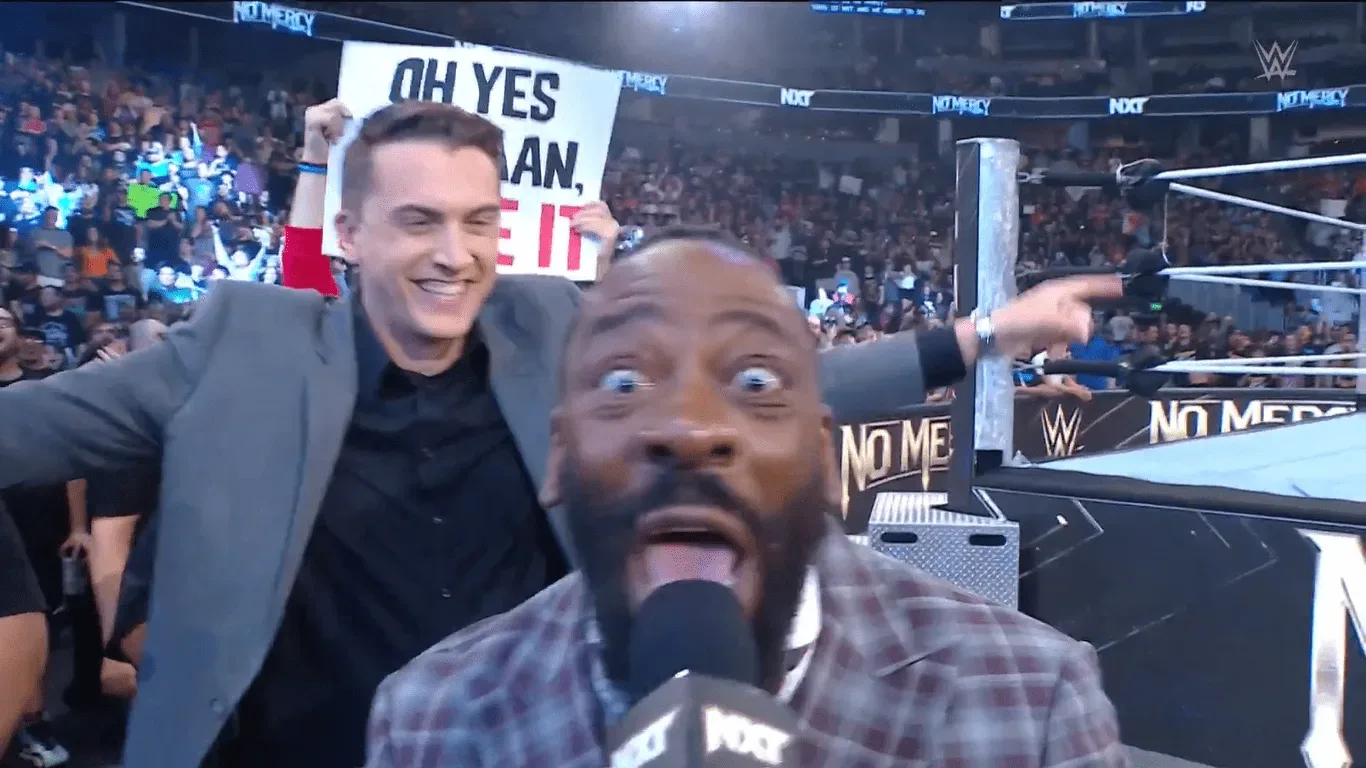
Booker T has spent decades adapting to new roles in WWE, from a decorated in-ring career to authority-figure appearances, panel work, and eventually a prominent place behind the desk. His current position as NXT color commentator has become one of the most recognizable parts of the brand’s presentation, with Booker bringing an energetic, spontaneous style alongside play-by-play announcer Vic Joseph.
That freedom, Booker explained, has made NXT a dramatically different experience from his earliest days calling matches on WWE’s main roster. During an appearance on Insight, Booker recalled feeling less able to speak in his natural voice when he first moved to commentary after stepping away from full-time wrestling in 2001.
The WWE Hall of Famer said the contrast between the environments under Vince McMahon and Shawn Michaels was immediately apparent. Booker’s account centered on a memorable instruction he received through his headset while working under McMahon’s regime: use the word “chagrin” during commentary.
“Hey, Book, say ‘much to his chagrin,’” Booker recalled being told.
For more background on this topic, read John Cena Explains WWE and TKO’s Stake in His Name, Addresses Taiwan Backlash and Company Loyalty.
Booker said he did not know what the term meant at the time and humorously admitted that the unfamiliar word made him think of “the chin area.” More importantly, he felt that using language that did not sound authentic to him would undermine the personality and credibility he had built with fans.
“I knew if I said that, all my street cred would have been gone,” Booker said.
For Booker, that moment represented a larger challenge during his first run as a commentator. He did not believe he could fully be himself on Raw and SmackDown. WWE commentary has long involved a demanding production structure, where announcers must balance live action, character development, sponsor reads, production cues, storytelling priorities, and direction coming through their headsets. Booker’s experience illustrates how difficult it can be for a former wrestler to find a natural broadcast identity within that setting.
His current assignment on NXT, however, has given him an outlet that better suits his personality. Booker became the brand’s full-time color commentator in 2022 and continues to work with Joseph. Their partnership mixes Joseph’s play-by-play responsibilities with Booker’s reactions, analysis, enthusiasm, and the unexpected phrases that have become part of his on-air appeal.
Booker credited Shawn Michaels, who has played a central role in NXT’s creative direction, with establishing a more welcoming approach. Rather than pressing him to fit a prescribed verbal mold, Michaels gave Booker room to develop the presentation in his own way.
“Just be you. Whatever you want to do, just do it,” Booker said Michaels told him.
The reassurance continued after Booker’s first night in the NXT booth. Booker remembered returning backstage and receiving a response from Michaels that was simple but meaningful.
“Man, I don’t know what you were saying, but I liked it,” Booker recalled Michaels saying.
That response helped Booker recognize that the role could work precisely because it did not require him to abandon the instincts, delivery, and vocabulary that distinguish him. His color commentary can be loose, loud, playful, and emotional, but it also comes from someone with firsthand experience at nearly every stage of the professional wrestling journey.
Booker’s career gives him a particularly relevant perspective for NXT. He has been a young wrestler attempting to break through, a major championship-level performer, a member of a tag team, a singles star, a WWE main-roster regular, and now a commentator and coach-like presence around developing talent. NXT’s programming is built around wrestlers trying to establish themselves and refine their work before reaching WWE’s larger platforms, making Booker’s ability to speak to growth especially useful.
Why NXT’s Developmental Setting Appeals to Booker T
Booker said working in NXT is refreshing not only because of the creative freedom on commentary, but because he gets to observe and interact with talent still learning the craft. He described himself as a teacher at heart, someone who enjoys explaining ideas and helping performers understand the strategy behind their decisions.
That perspective affects how he assesses mistakes. Booker acknowledged that errors are inevitable for younger wrestlers. Having made mistakes himself earlier in his career, he feels able to address them with a level of understanding rather than simply dismissing a performer for getting something wrong.
His outlook is notably different when considering established WWE main-roster talent. Booker said it can be more difficult to critique wrestlers on the main roster because they are expected to be finished products. The standards are naturally higher once someone reaches Raw or SmackDown, where performers are presumed to have the experience and polish needed for WWE’s biggest weekly stages.
In NXT, by comparison, Booker sees room for instruction and correction. A misstep is not necessarily a final judgment on a wrestler’s potential; it can be part of the learning process. That is where he finds satisfaction in a more hands-on role around the brand.
“I’m a teacher at heart,” Booker said. “I love teaching and explaining and trying to get you to understand.”
Booker compared wrestling strategy to chess, emphasizing that success does not come from simply moving without purpose. In his view, performers need to think ahead, understand why they are making particular choices, and build a plan if they want to reach a high level.
The analogy fits the unique value veteran voices can bring to developmental systems. Wrestling is physical, but it is also rooted in timing, positioning, crowd awareness, character choices, match structure, and long-term decision-making. A performer may have athletic ability, but Booker’s point is that the mental side of the profession requires deliberate study as well.
As an announcer, Booker can communicate parts of that process to viewers while matches are happening. As a veteran around NXT, he can also contribute beyond what fans hear during broadcasts. He specifically noted that he has opportunities to work with the talent hands-on, further tying his commentary position to his interest in mentorship.
From Main-Roster Commentary to a Lasting NXT Voice
Booker’s broadcasting path has not been a straight line. After transitioning away from full-time competition in 2001, he worked as a main-roster color commentator. That run did not last long before his WWE roles shifted. He later became a general manager for a period and also appeared as an analyst on WWE programming.
Those transitions gave him experience in several different forms of television performance. Each role asks for something different: a commentator needs to react instantly and enhance the match; an authority figure must help drive stories; an analyst is expected to offer perspective and discussion. Booker has occupied all of those spaces, and his current NXT work draws on the full range of that background.
His honesty about the early commentary difficulties also makes clear why NXT has become such a fitting destination. Booker did not frame his first main-roster experience as a lack of opportunity. Instead, he identified a creative disconnect. He felt constrained by the expectations placed on his language and delivery, while NXT has allowed the personality fans know from Booker T to come through more naturally.
That distinction matters for an announcer whose appeal is closely tied to emotional immediacy. Booker reacts like someone invested in the outcome, celebrates when he sees a breakout moment, and brings the perspective of a performer who understands what it means to fight for a place in the industry. Not every call must sound identical for it to serve the broadcast. Booker’s reflections suggest that Michaels understood that idea and gave him the confidence to lean into it.
With Joseph handling the play-by-play framework, Booker has been able to occupy a complementary role rather than trying to force himself into a conventional style that does not fit him. The result has been a booth dynamic that matches NXT’s identity: a show focused on hungry wrestlers, evolving characters, and the unpredictable energy of performers working to make a lasting impression.
Booker’s story about “chagrin” may be humorous, but it also highlights the broader evolution of his WWE broadcasting career. His earliest time calling main-roster action left him feeling unable to speak naturally. His return to regular commentary in NXT has given him the opposite experience: an opportunity to be distinctive, to guide younger talent, and to bring his own voice to the product.
For Booker T, the assignment is more than a job at the announce desk. It is a chance to teach, react, critique, and help shape an environment where the next generation can learn the same lessons that defined his own journey.

Darryl Polo
Darryl Polo is a passionate wrestling fan covering WWE, AEW, TNA and beyond. He loves great rivalries, breakout stars and the moments that keep fans talking long after the bell. How we work.