
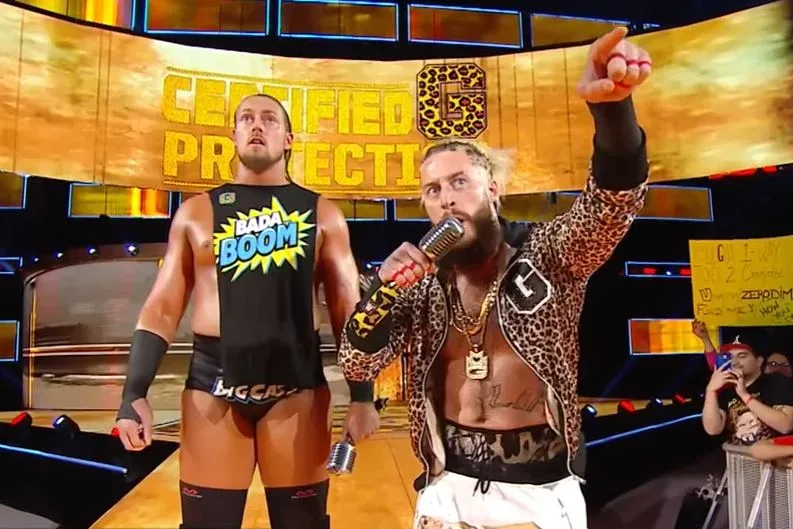
Big Cass has offered a candid assessment of the unique challenge facing him in his current WWE run: the audience remembers him as one half of an extremely popular act, while his return has placed him in a solo heel role.
Speaking on The Sal Licata Show, Cass addressed whether the enduring connection fans have with his partnership with Enzo Amore has made this stage of his career more difficult. His answer was immediate. He believes that the contrast between the team’s old babyface popularity and his present-day character has created an obstacle that would not exist if he were returning with no established history in the company.
“It definitely does. Yes,” Cass said when asked if the previous run affects his singles work now. “Because I’m coming back into WWE as a heel, right? I think we could talk about like heels and faces on the show. I’m pretty sure I’m coming back as a heel, and the last time anybody that in that viewing audience saw me, that they recognize me from, I was in one of the hottest baby face acts in the company.”
Cass places the former act among WWE’s top babyfaces
Cass did not downplay how highly he rates the team’s standing during its WWE run. In his view, the act he and Amore built was not simply popular or memorable. He sees it as one of the company’s three strongest babyface presentations at that particular point.
For more background on this topic, read Big Cass Addresses WWE Speculation, Says He Is Ready for Any Role on RAW.
“Top three, I would say, at that time, and you argue with a wall if you don’t agree with that,” Cass said. “I would say at that point, we were top three babyface act in the entire company.”
That belief is central to why Cass views his present assignment as complicated. A wrestler’s prior relationship with the audience can be an advantage, especially when a returning performer is greeted with recognition and enthusiasm. But it can become more difficult to redirect that reaction when the performer is intended to be disliked. Cass is not walking into WWE as an unknown singles attraction with an entirely new relationship to the crowd. He is entering arenas where a portion of the audience associates him with a beloved tandem, familiar routines, and catchphrases that remain part of fans’ memories.
For Cass, the central issue is not that fans have forgotten the old act. It is that they have not. Their recollection of the pairing with Amore has followed him into a run that is designed to generate a different emotional response.
Old catchphrases remain part of the crowd response
Cass said fans still call out phrases connected to his time alongside Amore. He interprets that behavior as an attempt to needle him, which makes it useful from the perspective of his current heel character even if it reinforces the association with the old team.
“Now coming back as by myself as a heel, it makes things a lot harder,” Cass explained. “You go out there as a heel and people are booing you, but you do hear people in the crowds saying the old catchphrases at me, and I think they’re doing that to get under my skin, and I think that’s their true intention, which as a heel is a good thing.”
That distinction matters. The chants and callbacks do not necessarily mean audiences are rejecting Cass’s current role. In fact, a crowd using recognizable material to provoke a heel can be actively participating in the character dynamic. Still, it presents a balancing act. The louder the echoes of the prior team become, the more Cass must establish his present identity as a solo performer rather than merely serve as a reminder of a past act.
He characterized the overall situation as more difficult than beginning with a clean slate. A clean slate can allow a wrestler to define their character without fans filtering every appearance through a previous role. Cass, however, is attempting to move forward while the audience continues to bring its own history into the building.
“But yes, to answer your question, it’s a lot,” he said. “It makes it way more difficult than having a clean slate.”
Expectations of an Enzo Amore reunion added another layer
The reaction was not shaped only by nostalgia. Cass said that once news of his WWE signing emerged, fans quickly connected it to the possibility that Amore would return with him. That expectation, he said, was amplified through wrestling discussion and left some people surprised when Cass appeared by himself.
“Especially because when news came out of me signing with WWE, it immediately got linked to him,” Cass said. “‘They’re coming back together. They’re going to be running it back together.’ A lot of like a lot of podcasts ran with that story and people believed it. So then I come back on my own and some people like, wait, what?”
As things stand, a reunion has not happened on WWE programming. Cass’s remarks make clear that the assumption of a joint return had consequences before he even had the opportunity to define his current role. Instead of fans simply reacting to the performer who arrived, some were also measuring the arrival against a scenario they had expected to see.
That is a familiar pressure point in professional wrestling. A successful tag team can create a powerful connection between two performers in the minds of viewers. Even after the team is no longer active, the possibility of a reunion can remain a major part of how fans view either individual. When one member returns alone, the response can include anticipation for what is happening in the moment as well as questions about the person who is not there.
Cass acknowledged that the expectation caused some difficulty, but he also believes he has handled it effectively. Rather than framing the reaction as something that has prevented him from succeeding as a heel, he pointed to the hostile crowd responses as evidence that the work is taking hold.
“So it kind of, you know, it made it a little difficult,” Cass said. “But I think so far I’ve done a pretty damn good job with, with the, in the situation I’m in getting booted out of buildings, which is really the goal.”
Generating boos is the priority for the current character
Cass’s final point is a straightforward reflection of his present objective. A heel is not supposed to receive the same uncomplicated affection that a top babyface act receives. If crowds are booing, jeering, and attempting to get under his skin with callbacks to his old partnership, that response can support the role he is playing.
At the same time, the comments reveal the unusual amount of baggage that can accompany a return. Cass is not only trying to win over viewers with a new singles direction. He is also working against a prior image that was built around a popular double act, while managing the expectations created by fan speculation that the duo would return together.
His assessment of the former team is emphatic: he believes it stood near the top of WWE’s babyface landscape during its run. That confidence explains why he does not dismiss the legacy as irrelevant to the present. The audience’s connection to that era is strong enough that old catchphrases are still being directed his way, even as he works to draw boos as a heel.
For now, Cass is focused on making the solo presentation work on its own terms. The absence of an on-screen reunion means that the responsibility for defining this chapter rests with him. His comments suggest he understands both sides of that equation. The history with Amore remains an important part of how WWE audiences see him, but in Cass’s view, turning that history into crowd hostility is not a problem to avoid. It is part of the job.

Darryl Polo
Darryl Polo is a passionate wrestling fan covering WWE, AEW, TNA and beyond. He loves great rivalries, breakout stars and the moments that keep fans talking long after the bell. How we work.