
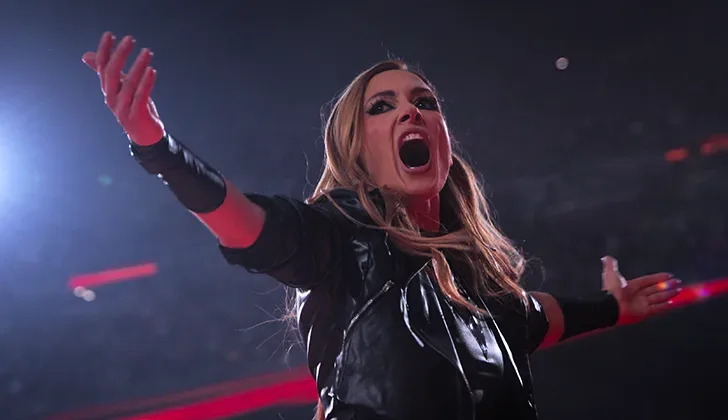
Becky Lynch’s WWE presentation may have taken a significant turn, even if the voice, attitude and verbal bite that define “The Man” have not changed. Lynch is reportedly now listed internally as a babyface, marking a notable adjustment after a run in which she generated substantial negative reaction as an antagonist.
The reported shift follows Lynch assisting Stephanie Vaquer against Liv Morgan in Chile. That moment positioned Lynch opposite Morgan, whose role at the front of Judgment Day gives WWE a clear heel presence for Lynch to confront. The change does not necessarily mean Lynch will suddenly become a softer or more traditionally heroic character. Her ability to be abrasive, confrontational and relentlessly self-assured has always been a major part of her appeal, regardless of whether crowds are meant to cheer or boo her.
In many ways, the reported babyface designation reflects the flexibility of Lynch’s character more than it signals a complete reinvention. She has long been at her most effective when she is allowed to speak with conviction and attack an opponent’s weaknesses directly. The audience reaction often comes down to the person standing across the ring from her. Against an opponent whom fans see as more villainous, Lynch’s trademark confidence and cutting promos can quickly become traits to celebrate.
A Change in Alignment, Not a Change in Personality
Lynch’s recent character direction has shown how fluid WWE alignments can be. She initially moved into a heel role in this stretch after betraying Lyra Valkyria. At the time, that betrayal gave Lynch a clear antagonistic edge and established a personal issue with a rising WWE name. A betrayal can be difficult for fans to overlook, particularly when it is aimed at a popular babyface, and it provided the foundation for Lynch to embrace a more hostile role.
For more background on this topic, read Trick Williams Joins Tyrese Haliburton on Cover of SLAM 264.
However, the dynamic has changed since then. Valkyria has become a heel, which substantially alters the emotional context around Lynch’s actions and the audience’s response to their history. What once appeared to be an unforgivable attack on a sympathetic competitor no longer carries the same weight when the wrestler who was wronged is no longer positioned as a straightforward fan favorite.
That does not erase the events that happened between Lynch and Valkyria. Instead, it illustrates how quickly WWE storytelling can reshape the way fans interpret past conflicts. If the audience is being encouraged to distrust or dislike Valkyria, Lynch’s earlier betrayal no longer automatically makes her the more objectionable figure in any renewed interaction between the two.
The same principle applies to Lynch’s emerging association with Vaquer and opposition to Morgan. Lynch does not need to abandon her sharpest character traits to receive a favorable reaction. She can remain a trash-talker who believes she is the most important person in the room. The difference is that, with Morgan as the opponent, many fans may be more willing to embrace that behavior rather than reject it.
The CM Punk and AJ Lee Program Showed Lynch’s Range
Over the past year, Lynch has been a prominent source of heat, particularly during the couples feud involving her husband Seth Rollins against CM Punk and AJ Lee. That rivalry gave Lynch a high-profile environment in which to lean fully into her antagonistic side. The personal nature of the program, combined with the involvement of Rollins, Punk and Lee, created an atmosphere where Lynch’s words and actions could draw particularly strong reactions.
AJ Lee’s comeback carried considerable emotional weight for viewers, and the desire to see her silence Lynch became an important part of the feud’s appeal. Lynch’s effectiveness in that role was tied to her willingness to be loud, dismissive and provocative. She gave supporters of Punk and Lee a target for their frustration, while also ensuring the conflict felt bigger than a standard in-ring disagreement.
That program also reinforced a key point about Lynch as a performer: she can generate a strong reaction without fundamentally changing the way she carries herself. As a heel, her confidence can be presented as arrogance. As a babyface, that same confidence can be treated as defiance. The words may be similarly pointed, but the crowd’s interpretation changes based on the opponent and the broader story.
It is a useful quality for WWE, especially in a division and a roster environment where characters can move between rivalries with very different emotional stakes. Lynch does not require a complete reset every time her alignment changes. Her established persona already contains the traits that can work on either side of the fan reaction.
Liv Morgan Provides a Natural Opponent
If WWE continues to place Lynch against Liv Morgan, the reported babyface adjustment makes practical sense. Morgan’s connection to Judgment Day makes her a natural target for a wrestler positioned as a fan favorite. Judgment Day’s identity as a conniving group gives Lynch an obvious enemy, and it gives audiences a reason to support her even when she is being as confrontational as ever.
Lynch is unlikely to lose her verbal advantage in such a rivalry. She remains one of WWE’s strongest talkers, and Morgan presents an opponent who can absorb the force of Lynch’s character work while keeping the conflict rooted in a clear good-versus-evil framework. Whether Lynch or Morgan ultimately wins a match is separate from the storytelling value of the pairing. The central hook is that Lynch has a believable reason to direct her most aggressive verbal attacks at someone fans may be eager to see challenged.
A Lynch-Morgan issue could also clarify how firm this alignment shift is intended to be. WWE audiences often respond to the immediate rivalry more than a formal label, particularly with a performer such as Lynch. If she continues taking aim at Morgan and Judgment Day, the crowd response should offer a strong indication of whether WWE is presenting her as a full babyface or simply allowing her to occupy a more sympathetic position in a specific feud.
For now, the reported internal classification is the clearest sign that the company sees Lynch differently than it did during her most recent heel material. Still, the on-screen execution will matter more than any designation behind the scenes. Wrestling fans will judge the turn through Lynch’s promos, her actions, the opponents selected for her and the reactions she receives in arenas.
Why Lynch Can Thrive on Either Side
Lynch’s adaptability has been one of her greatest strengths throughout her WWE career. Her persona is built around conviction. She does not merely claim to be better than others; she delivers that belief with the sense that she expects a challenge and is prepared to dismiss anyone who tries. That quality is effective for a villain who needs to antagonize an audience, but it can be equally effective for a hero who refuses to be intimidated.
There is also a difference between being universally pleasant and being a babyface. Lynch has rarely needed to fit the first description. A compelling babyface can be flawed, proud, selfish or abrasive as long as the audience believes the character is fighting against someone worse or standing for a cause the crowd can understand. Lynch’s reported move in that direction does not require her to become less recognizable.
Her history with Valkyria demonstrates why context is so important. A betrayal created heel heat when Valkyria was the sympathetic party. With Valkyria now a heel, the same history has less power to make Lynch the obvious villain. Her involvement with Vaquer against Morgan adds another layer, placing Lynch alongside a competitor while opposing one of WWE’s more clearly manipulative forces.
The result is a potentially straightforward path forward: Lynch can retain the bravado that made her such an effective antagonist while directing it toward Morgan and Judgment Day. That approach preserves what audiences recognize about “The Man” rather than asking viewers to accept a drastically altered version of the character.
What Comes Next for “The Man”
The immediate question is not whether Lynch can play a babyface. Her career has already shown she can command fan support at the highest level. The question is how WWE chooses to define this version of her after the shift. Will she be presented as an outright heroic figure, or as an antihero whose edge remains as dangerous to allies as it is to enemies?
Her recent assistance of Stephanie Vaquer against Liv Morgan offers an early answer. Lynch appears to be moving toward a position in which her aggression is being directed at an opponent more likely to draw the crowd’s disapproval. That is a familiar and effective formula for her. She does not need to change the volume of her voice or the severity of her insults; she simply needs a target fans believe deserves them.
With Morgan in her sights and Judgment Day providing a ready-made source of conflict, Lynch has the ingredients for a strong babyface run without sacrificing the attitude that makes her stand out. The reported internal change may be official, but the larger story will play out in front of WWE crowds. If fans continue to rally behind Lynch as she confronts Morgan, “The Man” may find that the same sharp tongue that once generated heat is once again one of her greatest strengths as a fan favorite.

Darryl Polo
Darryl Polo is a passionate wrestling fan covering WWE, AEW, TNA and beyond. He loves great rivalries, breakout stars and the moments that keep fans talking long after the bell. How we work.