
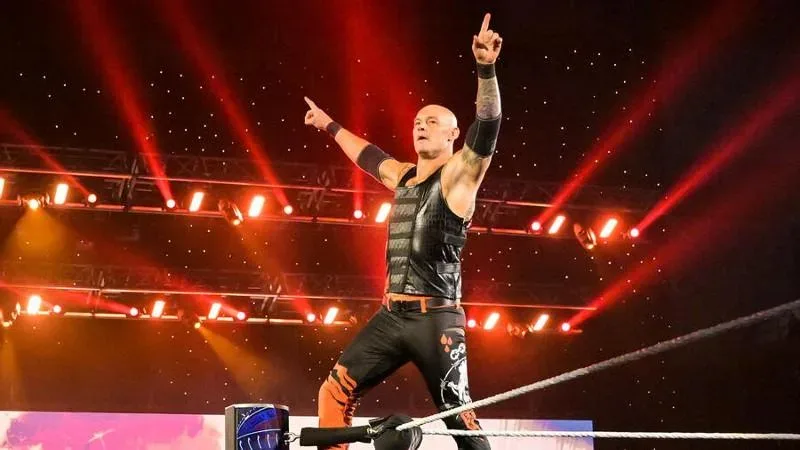
Baron Corbin has never been short on confidence, confrontation, or a willingness to make himself unpopular. In discussing his current WWE presentation, Corbin made clear that those traits are not merely elements he turns on for television. He views the character he is portraying following his return to WWE earlier this year as a particularly close extension of who he is away from the ring.
Corbin’s latest direction has drawn comparisons to the hard-edged “Lone Wolf” version of the wrestler, a persona built around self-reliance, intimidation, and an openly hostile attitude toward anyone standing in his way. For Corbin, though, the connection is deeper than revisiting a familiar nickname or visual identity. He said the attitude at the center of the character comes from his own competitive background and his natural disposition.
“I have a bad attitude. That’s the way I was an offensive lineman in college, in the NFL. I was known for getting in fights at practice. I was known for punching people in the face, and it’s like, that’s what I do best. I’ve always been somewhat of a salty prick in all aspects of life. Even my best friends will tell you that. They’re like, ‘Yeah, man, he doesn’t like a lot of people. You just got to deal with it. That’s not his thing.’ Being able to kind of just be myself and have that kind of ruthlessness is what I like.”
A Familiar Attitude With a More Personal Foundation
That assessment offers a straightforward explanation for the tone of Corbin’s current WWE work. Rather than leaning into an exaggerated personality completely separate from himself, Corbin is embracing qualities he says have followed him through athletics and everyday life: bluntness, aggression, impatience, and a readiness for conflict.
For more background on this topic, read WWE Women’s Champion Chelsea Green Joins Cast of ‘We Could Be Heroes’.
His references to football are central to that outlook. Before establishing himself in WWE, Corbin played offensive line in college and spent time in the NFL. Offensive linemen operate in a role that demands physicality, toughness, and an appetite for the less glamorous parts of competition. Corbin described that period as one in which he regularly got into fights during practice and developed a reputation for dealing with confrontation physically.
Those experiences do not define every aspect of a WWE character, but they provide an authentic foundation for the way Corbin carries himself. His in-ring presence has long been rooted in his size, power, and a demeanor suggesting that he does not need approval from the audience or the locker room. By his own description, the present version of the character allows him to use those real attributes with greater freedom.
The significant distinction, as Corbin framed it, is ruthlessness. The current persona may resemble him in real life, but WWE presents that attitude in a heightened competitive setting. Professional wrestling characters require clear motivations and visible emotional stakes, and ruthlessness gives Corbin a direct way to communicate his intentions whenever he enters a rivalry or a match.
The Lone Wolf Comparison
Corbin’s return earlier this year brought an immediate comparison to his previous “Lone Wolf” character. That identity was among the clearest expressions of Corbin as an isolated, abrasive force: a wrestler who did not seek alliances, did not soften his message, and did not present himself as someone interested in being liked.
The comparison is understandable because the broad qualities remain recognizable. Corbin’s current work once again centers on intensity and a sharp edge rather than on a more comedic or flamboyant presentation. Still, his comments indicate that he does not see the present character as simply a repeat of a past chapter. He sees it as a version where the personality behind the performance is closer to the surface.
That distinction can matter considerably in WWE. A character can revisit familiar elements without feeling static when the performer has a more immediate connection to the material. Wrestlers often speak about the value of finding traits that feel natural and then amplifying them for the screen. Corbin’s explanation follows that formula: his real-life attitude supplies the starting point, while the WWE environment adds the severity needed for a ruthless competitor.
Corbin’s willingness to describe himself in unflattering terms also fits the broader appeal of the persona. He did not attempt to frame his disposition as polished, universally appealing, or misunderstood. Instead, he presented it as an established fact that his friends recognize as well. That candor supports the kind of character work built on indifference toward approval.
Authenticity Can Strengthen a WWE Character
There is always a line between a wrestler’s actual personality and the role they play on television. The strongest presentations are not necessarily literal versions of a performer’s private life. They are often focused versions of real traits, designed to make motivations understandable in a few moments on screen. A wrestler who genuinely enjoys competition can become more obsessive in character. A confident performer can become arrogant. In Corbin’s case, a naturally combative attitude can become a more openly merciless WWE presence.
Corbin’s remarks suggest that he is comfortable working from that place. He specifically said he likes being able to be himself while adding the ruthless edge that serves the character. That comfort is important because WWE performers are required to communicate through more than dialogue. Their mannerisms, facial expressions, reactions to opponents, and body language all contribute to the audience’s understanding of who they are.
For a character rooted in hostility and self-belief, authenticity can make even simple actions feel more deliberate. Corbin does not need to force the idea that he is uninterested in pleasing everyone. He has openly said that he does not like a lot of people and that those close to him would agree. In a wrestling setting, that becomes an effective emotional baseline for a performer positioned as someone who is not looking for companionship or validation.
It also gives Corbin a consistent thread connecting his athletic past and his WWE identity. The same competitive intensity he associates with football practice can be redirected into wrestling. The arena setting is different, and the demands of sports entertainment are much broader, but the foundation of physical confrontation remains familiar territory for him.
Corbin Embraces the Rougher Side of His Personality
Corbin’s comments are notable because they do not present his current character as a complicated reinvention. Instead, he described it as an opportunity to lean into a side of himself that has long existed. His references to a “bad attitude,” fights during football practice, and his friends’ opinions all paint a consistent picture of a man who is comfortable being direct and difficult when the situation calls for it.
That does not require the audience to view every statement or action on WWE programming as literal. The essential point is that Corbin feels the character’s central attitude is genuine enough to play without relying on a mask. The added ruthlessness is the professional-wrestling amplification, but the emotional core is one he recognizes.
In an environment where WWE stars frequently evolve their personas across different eras of their careers, Corbin’s current approach gives him a defined lane. It recalls the “Lone Wolf” energy that many fans associate with him while placing more emphasis on the performer’s own outlook. The result is a character direction that is less about explaining why Corbin is abrasive and more about embracing the fact that he is.
Corbin has built much of his WWE career around being a disruptive presence, whether through his physicality, his attitude, or his ability to thrive in situations where he is expected to antagonize those around him. His latest comments make it clear that he believes the present version works because it is not far removed from the person he has always been.
For Corbin, being ruthless is not simply a storyline trait. It is the intensified expression of the competitive, confrontational edge he says he carried from football into professional wrestling. As his current WWE character continues to take shape, that real-life connection appears to be the feature he values most.

Darryl Polo
Darryl Polo is a passionate wrestling fan covering WWE, AEW, TNA and beyond. He loves great rivalries, breakout stars and the moments that keep fans talking long after the bell. How we work.