
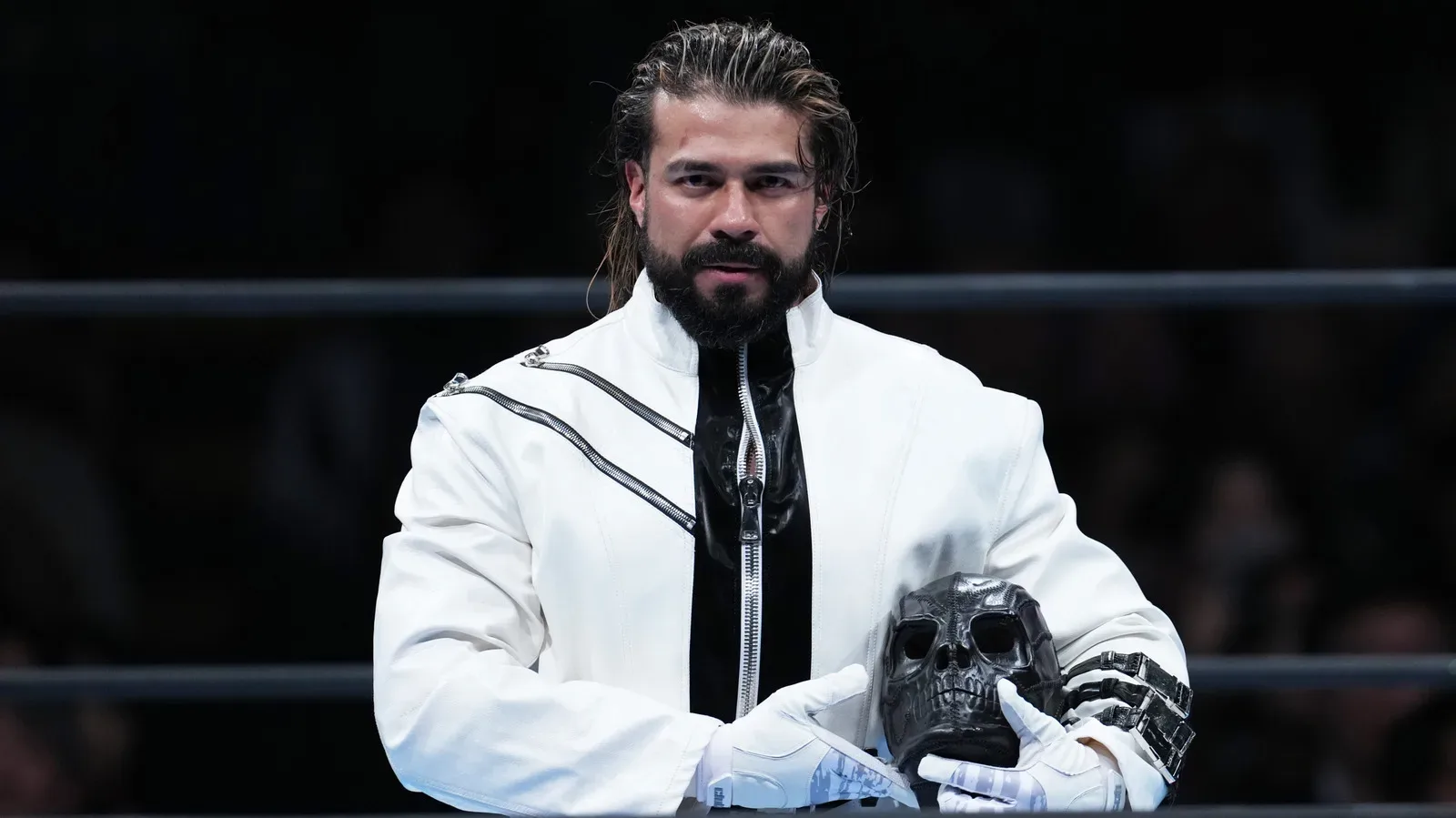
Andrade El Idolo has experienced two very different chapters in both WWE and AEW, and the former National Champion says the biggest contrast has been the amount of freedom he feels he has to shape his own character and speak in his own voice.
Speaking on Talk Is Jericho with Chris Jericho, Andrade looked back at his return runs with each company over the last two years. While he stressed that he was treated well during his second WWE tenure and received more opportunities than he did during his first stint there, Andrade said he still felt limited by the way his character and promos were presented.
In AEW, he believes the creative environment has allowed him to show more of the performer he wants to be. That includes being able to work from a general idea for a promo rather than being confined to dialogue that does not sound natural coming from him.
“This second round, now I’m like, okay, now I know, I understand, I pay more attention to the people, what people want, what people like, what people don’t like,” Andrade said. “So, now, I try to play in everything, [put] all the pieces together... WWE sometimes, never [gave] me a character.”
For more background on this topic, read Charlotte Flair Sees The Rock as a Possible Wild Card for WWE’s 2027 Royal Rumble.
For Andrade, the issue was not simply being told what to say. It was the broader challenge of trying to establish a defined identity while also making the material feel authentic. He said WWE supplied promo direction and expected performers to prepare it, but he did not always believe the words reflected how he would naturally communicate.
“WWE never gave me, like, the character... You are the Mexican guy,” Andrade said. “Yes, [they] give you the promos, and you practice the promo, but sometimes it’s like, I’m not talking like that... So here, [they] just give you the idea, the promo, [and] you can have more freedom.”
Andrade’s WWE experience was not entirely negative
Andrade’s comments were not a blanket dismissal of WWE or of his second run with the company. In fact, he made clear that he preferred his later WWE stint to his first. He felt the company treated him well and opened more doors for him than it had previously. That distinction is important because Andrade’s perspective is centered less on personal treatment and more on what he believed he could contribute creatively.
His first WWE run included a rise through NXT, where Andrade aligned with Zelina Vega and became one of the brand’s leading stars. He later won the NXT Championship and produced a series of acclaimed matches, including a highly regarded title bout with Johnny Gargano. On WWE’s main roster, he went on to win the United States Championship, but his momentum was more inconsistent.
When Andrade returned for a second WWE stint, he entered with more experience, greater name value, and a better understanding of the audience he was trying to reach. He said he had learned to pay closer attention to what fans respond to, what they reject, and how all the different parts of a presentation can fit together. Even with that increased awareness, however, he wanted to do more than the role he felt was being asked of him.
Andrade indicated that part of the challenge involved a perception that his background, heritage, and in-ring ability naturally invited comparisons to Eddie Guerrero. Guerrero remains one of the most celebrated Mexican-American performers in wrestling history, and his influence is deeply felt across the industry. However, Andrade’s remarks suggest he did not want his presentation to be defined by an expectation that he should replicate another wrestler’s role or legacy.
The comparison is understandable on a surface level. Both men are elite in-ring performers with Mexican heritage who have succeeded on major American wrestling platforms. But Andrade’s career has been built through his own body of work, from his years in CMLL as La Sombra through his major championship accomplishments in WWE and his appearances in AEW. His comments underscore the balancing act that can come with representation: being proud of where one comes from while still wanting the latitude to create an individual identity.
Creative voice remains a central issue for performers
The difference Andrade described between WWE and AEW comes down to process. WWE has historically operated with a more centralized approach to character presentation and television promos, while AEW has often given wrestlers wider room to personalize their delivery. Neither approach guarantees success, and the amount of freedom can vary from performer to performer, but Andrade said the AEW structure has been a better fit for him.
Having freedom with an idea rather than a rigidly defined script can be particularly meaningful for a performer working across languages and cultures. Andrade has frequently spoken English on major American television while also maintaining the charisma and cadence that helped make him a star in Mexico. If the language of a promo feels artificial, it can affect confidence, timing, and the connection with an audience. Andrade’s point was that having a concept to work from gives him the opportunity to make the final presentation sound like him.
His remarks also reflect the reality that a wrestling character is not built solely by creative staff. A performer’s voice, body language, match style, entrance, alliances, rivalries, and response to crowds all contribute to whether a character feels complete. Andrade said he now pays more attention to audience preferences, suggesting he views character development as an ongoing process rather than something that can be handed over fully formed.
That approach could be especially important in the current AEW environment. The promotion features a broad collection of established veterans, younger wrestlers, international stars, and talent whose reputations were built in very different wrestling systems. Andrade sees that variety as one of AEW’s greatest strengths.
AEW’s international mix appeals to Andrade
Since returning to AEW in January, Andrade has said he has enjoyed seeing multiple wrestling cultures and styles represented in the same company. His return came after the rules surrounding his WWE non-compete clause were resolved, clearing the way for him to appear again in AEW.
For Andrade, the appeal is not limited to promo freedom. It is also about the chance to share a roster with wrestlers from around the world and to work within a product where different wrestling traditions are visible. He praised the “amazing talents” available in AEW and pointed to the way the company celebrates varying styles and cultures.
That international scope aligns naturally with Andrade’s own background. Before becoming known to many American viewers through WWE, he had already developed as a major wrestler in Mexico. His experience gives him familiarity with lucha libre’s pace, athleticism, masks, spectacle, and emphasis on distinctive personalities. At the same time, he has spent years adapting to the demands of wrestling on U.S. national television.
AEW’s roster gives him potential access to opponents and partners with roots in Mexican lucha libre, Japanese wrestling, American independent wrestling, technical styles, power-based styles, and more. That does not automatically determine his direction on television, but it provides a setting in which Andrade believes his versatility can be better utilized.
He has long had the in-ring credentials to stand out in that kind of environment. Andrade’s matches have often blended smooth technical wrestling, explosive offense, high-impact strikes, and the flair associated with lucha libre. His challenge has generally not been proving that he can deliver inside the ring. Instead, it has been finding a sustained presentation that matches his ability and makes the audience fully understand what separates Andrade El Idolo from every other talented wrestler on the roster.
A second chance with a clearer perspective
Andrade’s recent reflections show a performer evaluating his career from a more experienced position. He acknowledged that his second WWE run was better than his first, which indicates he saw genuine growth and improvement in that chapter. But he also believes AEW offers a better opportunity to build a character with more personal input.
That distinction may shape how he approaches his current return. Andrade said he is now more attentive to the audience and more focused on putting all the pieces together. The ability to adapt to fan reactions while retaining a consistent character is one of the most valuable skills a wrestler can have, particularly in a company with as many competing personalities and styles as AEW.
His comments should also be viewed as a statement of ambition. Andrade does not appear satisfied merely being regarded as a strong in-ring wrestler or as a representative figure based on nationality. He wants to demonstrate a fuller range as a character, talker, and performer. In AEW, he feels he has more space to pursue that goal.
Whether that freedom translates into the sustained positioning Andrade is seeking will depend on how his stories develop and how audiences respond. What is clear from his appearance on Talk Is Jericho is that Andrade sees his current AEW chapter as an opportunity to present a more complete version of himself—one shaped by his own instincts, his international experience, and a clearer understanding of what he wants his character to become.
In pictures

Darryl Polo
Darryl Polo is a passionate wrestling fan covering WWE, AEW, TNA and beyond. He loves great rivalries, breakout stars and the moments that keep fans talking long after the bell. How we work.