
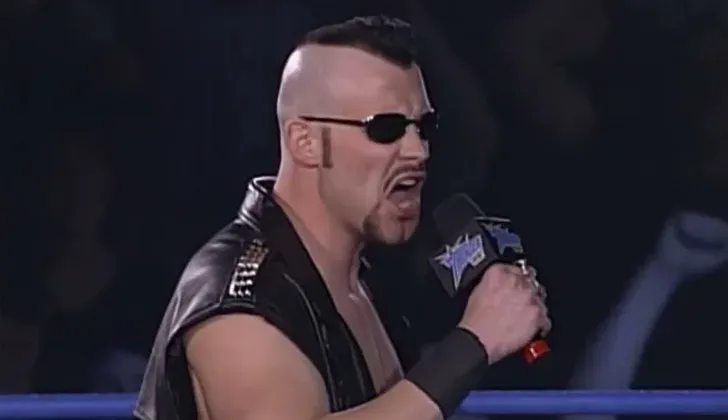
Alex Wright’s transformation from WCW’s dancing German babyface into the more severe and controversial Berlyn remains one of the most dramatic character changes of the late Monday Night War era. While the Berlyn persona was only on WCW television for a relatively brief period in 1999, Wright believes it had the ingredients to become something much bigger. In a new interview with GTV, Wright said the character’s ending ultimately came down to Vince Russo’s arrival in WCW creative rather than the widely repeated suggestion that the Columbine High School tragedy permanently derailed its planned direction.
Wright entered WCW in the mid-1990s as a young German wrestler whose upbeat dancing entrance made him immediately recognizable. The presentation was a clear contrast to the harder-edged personalities increasingly featured around the promotion, and it gave Wright a distinct place on the roster. By 1999, however, WCW introduced a radically different version of the performer. Berlyn was darker, more confrontational and positioned with an imposing enforcer in The Wall. The shift gave Wright an opportunity to show a side that was far removed from the persona audiences had known.
That change was not simply a cosmetic adjustment. Berlyn’s presentation carried a far more serious tone, and the character was introduced as someone intended to create discomfort rather than invite fans to cheer along. In an environment where WCW was regularly attempting to refresh its roster with new identities and storylines, Berlyn stood apart from Wright’s previous work. The character’s entrance, attitude and association with The Wall all emphasized that this was meant to be a restart, not a continuation of the dancing gimmick.
Wright traces Berlyn’s start to Eric Bischoff
Asked whether Russo was responsible for Berlyn, Wright made an important distinction: Russo did not create the character, but Wright believes he was responsible for bringing it to an end. Wright said Berlyn began while Eric Bischoff was in charge and stated that Russo did not appear interested in continuing gimmicks connected with Bischoff’s creative period.
For more background on this topic, read Perry Saturn Reflects on WCW Exit, Says Eric Bischoff’s Firing Changed Everything.
“No, he was [responsible] for the end of Berlin,” Wright said. “I started that gimmick under Eric Bischoff, and Vince Russo apparently didn’t want to use any gimmicks from Eric Bischoff.”
Wright’s account places the end of Berlyn within the broader leadership and creative changes that were taking place in WCW at the time. The company experienced frequent shifts in direction during that period, with talent often finding that a character’s momentum could change quickly depending on who was overseeing television. Wright’s comments do not suggest that the gimmick failed to connect on its own terms. Instead, he sees the decision as a result of a creative transition and the differing preferences of those in charge.
For Wright, that remains frustrating because he felt Berlyn had started well and still had room to grow. He described the character as one with “a lot of potential,” a view that helps explain why its short run has continued to be a point of discussion years later. The Berlyn concept gave Wright a new lane in WCW and appeared positioned to move beyond the limitations of his earlier presentation.
The character’s television run ended after The Wall turned on Berlyn in late 1999, and Wright was taken off television soon afterward. That sequence closed the book on a persona that had received substantial attention during its debut but never had the time to develop across a longer series of major stories. A heel character paired with an enforcer could have been built in several directions, but Wright’s remarks make clear that he sees the halt in momentum as a creative choice rather than a natural conclusion to the act.
Columbine delayed the debut, Wright says
Wright also addressed a long-standing belief surrounding the Berlyn rollout. Because the character’s imagery and timing became associated in some fans’ minds with the Columbine High School shooting in April 1999, rumors have persisted that the tragedy caused WCW to significantly reduce or abandon its plans for the gimmick. Wright rejected that version of events.
He said the shooting did affect the immediate timing of Berlyn’s television introduction, but only in the sense that WCW postponed the debut. Wright explained that the character was scheduled to appear around the time the tragedy occurred and that the company decided to wait before putting him on television.
“The only thing [that’s] true is that they postponed the debut,” Wright said. “I was supposed to debut right when that happened and they said, ‘Okay now, because that happened, we’re going to wait. Two, three months down the road. We’re going to put you on TV.’ That’s the only thing.”
That clarification is significant because it separates a delay in the launch from the eventual disappearance of the character. In Wright’s telling, Columbine changed when Berlyn debuted, not whether WCW intended to pursue the persona in a meaningful way. The later decision to end Berlyn was, in his view, tied to Russo’s creative approach after the change in leadership.
The distinction also provides a clearer timeline for how Wright remembers the period. The character was delayed for two or three months, then introduced, and later removed from the programming after its storyline with The Wall came to an end. Wright does not present the tragedy as the reason he was used less than originally planned. He instead points to the new creative regime and its lack of interest in retaining material that had begun under Bischoff.
A missed opportunity in Wright’s view
Wright went even further in assessing the character’s unrealized upside, saying he feels he should have saved Berlyn for WWE. That is not an indication that such a move was planned or that the character was ever formally proposed elsewhere. Rather, it reflects his present-day belief that the persona could have been more fully utilized in a different environment.
“I think I should have saved it for WWE, definitely,” Wright said.
It is an understandable observation from a performer looking back at a role that was markedly different from the one that made him recognizable. Berlyn allowed Wright to move away from a character built around youthfulness and dancing and toward a more intense presence. The gimmick also arrived at a time when striking reinventions were central to wrestling television. A successful change in persona could reshape a wrestler’s position on the roster, especially when the new version gave audiences a reason to see a familiar talent in a different light.
Whether Berlyn would have reached that level can never be known. What is clear from Wright’s recollection is that he does not view the character as a completed experiment. He sees it as something interrupted before its possibilities could be tested over time. The combination of a delayed debut, a brief on-screen run and the creative change in WCW meant there was little opportunity for the persona to establish a longer identity or settle into a sustained rivalry.
Berlyn remains a notable chapter of WCW’s final era
WCW’s final years are often remembered for rapid creative shifts, changing authority figures and storylines that could be redirected with little notice. Berlyn fits into that history as a character with a memorable visual identity and a premise that never fully reached a second stage. Wright’s comments add his own perspective to why that happened: the launch was postponed in the aftermath of Columbine, but the ending came after Russo took over and did not want to continue a gimmick that had started under Bischoff.
For fans who have wondered whether the tragedy was the defining factor in Berlyn’s limited use, Wright’s answer is direct. It was a timing issue at the beginning, not the cause of the character’s ultimate end. His account instead points to the instability of WCW creative during a pivotal period for the company.
Berlyn may have lasted only a short time, but it remains one of the clearest examples of Wright’s willingness to reinvent himself. The character was a decisive departure from his established WCW image, and Wright still sees substantial value in what it could have become. His latest comments do not change the on-screen outcome, but they offer a more precise explanation of the two events that have long been connected to the character: the delayed debut and the decision to stop using it.
Darryl Polo
Darryl Polo is a passionate wrestling fan covering WWE, AEW, TNA and beyond. He loves great rivalries, breakout stars and the moments that keep fans talking long after the bell. How we work.