
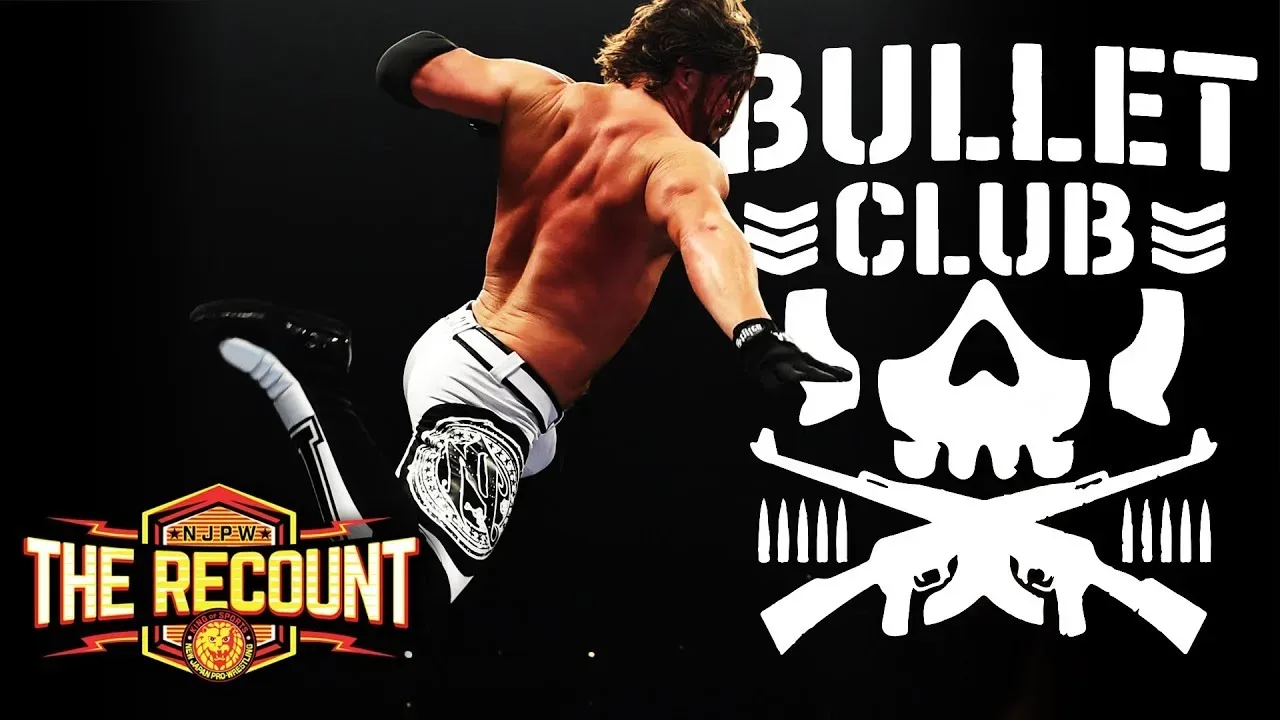
AJ Styles has offered a telling clarification on one of the most frequently repeated labels attached to his career in Japan: former leader of Bullet Club.
Styles was a central figure in Bullet Club during his New Japan Pro-Wrestling run, a period that helped define both the faction’s international profile and his own standing as one of professional wrestling’s most in-demand performers. Yet while fans and commentators often identify him as the group’s leader, Styles does not embrace that description in the conventional sense.
Speaking in a new interview with James Sweetnam, Styles explained that he never personally presented himself as Bullet Club’s leader. More importantly, he said the faction’s mentality during his tenure was not based on submission to one person’s authority. In Styles’ view, Bullet Club was united by an attitude of independence rather than a traditional chain of command.
“See, everybody thinks I was the leader of the Bullet Club. I never said that I was the leader of the Bullet Club. You could say I was the leader of the Bullet Club, but our thing when I was in the Bullet Club is that we didn’t follow anybody, including whoever the leader was. So we were the Bullet Club.”
For more background on this topic, read WWE SmackDown Holds Steady in Viewers, 18-49 Rating Slips on September 25.
The distinction is significant because Bullet Club has long been discussed through the lens of leadership changes. The stable became one of the most recognizable groups in modern wrestling, particularly as its popularity moved far beyond Japan and reached audiences around the world. Its history has also included shifting lineups, internal rivalries, branch groups, and several wrestlers viewed as major standard-bearers for the name.
Styles’ comments do not deny that he occupied a prominent position. Instead, they reframe what that prominence meant inside a faction whose presentation was deliberately built around rebellion. He was unquestionably one of Bullet Club’s defining personalities during his time in the group, but he sees the collective identity as more important than any individual title.
A Defining Chapter in Japan
Before arriving in WWE, Styles had already built a reputation through years of high-level work across the wrestling world. His career included a lengthy and important run in TNA, where he emerged as one of the company’s foundational stars, as well as extensive experience on the independent scene and in international promotions.
His time in New Japan came after that major TNA chapter and before his move to WWE. The run was especially important because it placed Styles in a major Japanese promotion at a time when he was continuing to prove that he could thrive at the highest level in any environment. He entered a landscape filled with established New Japan stars and quickly became a focal point of the promotion’s heavyweight scene.
Bullet Club was already a major force, but Styles became inseparable from the group’s image for many fans. His “Phenomenal” reputation, confidence, athletic style, and ability to perform in headline situations made him a natural fit for a faction that projected swagger, hostility, and a refusal to play by the expected rules.
That is why the leadership description has endured. Fans often use it as shorthand for Styles’ place in the era, not merely as a technical statement about a formal role. When audiences look back at Bullet Club’s evolution, Styles is regularly included among the names most associated with its rise into a global wrestling brand.
However, Styles’ own explanation adds nuance to that retrospective. A wrestling stable can have an acknowledged frontman while still operating with a culture that rejects the idea of followers. For Styles, Bullet Club’s defining message was that its members stood together as Bullet Club, not that they existed to serve one figure at the top.
The Bullet Club Mindset
That mindset fits the faction’s broader legacy. Bullet Club’s appeal was never solely about a roster list or a single wrestler holding influence. The group represented an outsider posture within New Japan, with its members presenting themselves as disruptive, unapologetic, and connected by a shared opposition to the establishment around them.
Styles’ wording also emphasizes the difference between how wrestling fans organize history and how performers experience it in real time. Fans often want a clean timeline: one leader succeeds another, eras begin and end, and major figures are assigned clear roles. Those labels can be useful, especially when discussing a stable with as many changes and extensions as Bullet Club has had.
But performers may see the situation differently. In this case, Styles is highlighting the atmosphere inside the group rather than disputing that others can view him as its leader. He explicitly leaves room for that interpretation when he says people can call him the leader. His point is that he did not define his own participation that way, and that the group’s operating philosophy did not revolve around following a leader.
It is a distinction that speaks to Bullet Club’s presentation at the time. The name itself was the unifying force. Each member brought a different personality and role, but the group’s identity was designed to feel larger than one individual. In Styles’ telling, that was the point: no matter who may have been perceived as the leader, the members were meant to be Bullet Club together.
Why Styles Remains Closely Connected to the Group
Even with his clarification, it is unlikely that Styles will ever be separated from Bullet Club in the public memory. His New Japan tenure came during a period that remains hugely influential in discussions of the faction. The association helped broaden his profile with fans who followed Japanese wrestling closely, while also strengthening the perception that Styles was capable of excelling anywhere in the world.
That reputation carried directly into the next phase of his career. When Styles eventually signed with WWE, he arrived with years of credibility behind him, including his accomplishments in TNA and his major work in New Japan. The Bullet Club connection was part of that broader story, though Styles’ career has always been larger than any single promotion or stable.
His comments are therefore less about revising his history than defining it on his own terms. Styles is not distancing himself from Bullet Club or minimizing its importance. Rather, he is challenging the simplified version of the story that places him above everyone else in the group.
For a stable built on collective defiance, Styles believes that is an important difference. He was not interested in the image of members lining up behind a leader. He saw a unit of wrestlers who did not follow anyone, including the person other people might have identified as being in charge.
A Career of Different Perspectives
Elsewhere in the same interview, Styles reflected on another major part of his WWE career: his Boneyard Match with The Undertaker. Styles said he wishes he had been able to face The Undertaker before that cinematic encounter, adding another example of how he looks back at landmark moments with a personal perspective that may differ from the simplest fan summary.
That perspective has become a recurring strength of Styles’ career conversations. Because he has performed at such a high level in multiple promotions and across different wrestling cultures, his recollections offer context beyond the standard historical labels. He has been viewed as a franchise-level name, an international standout, a faction centerpiece, and a WWE headliner. Yet his own explanations often focus on the work, the people involved, and the way those situations actually felt from inside the ring and locker room.
In Bullet Club’s case, that means accepting why the leader label exists while declining to make it his personal claim. Styles recognizes the perception, but he also maintains that the group was never supposed to be about obedience to him or anyone else.
For fans revisiting that era of New Japan, Styles’ comments provide a useful reminder that Bullet Club’s legacy is not only a story of leadership transitions. It is also a story of a shared attitude — one that, in Styles’ words, meant the members did not follow anybody. They were simply Bullet Club.

Darryl Polo
Darryl Polo is a passionate wrestling fan covering WWE, AEW, TNA and beyond. He loves great rivalries, breakout stars and the moments that keep fans talking long after the bell. How we work.