
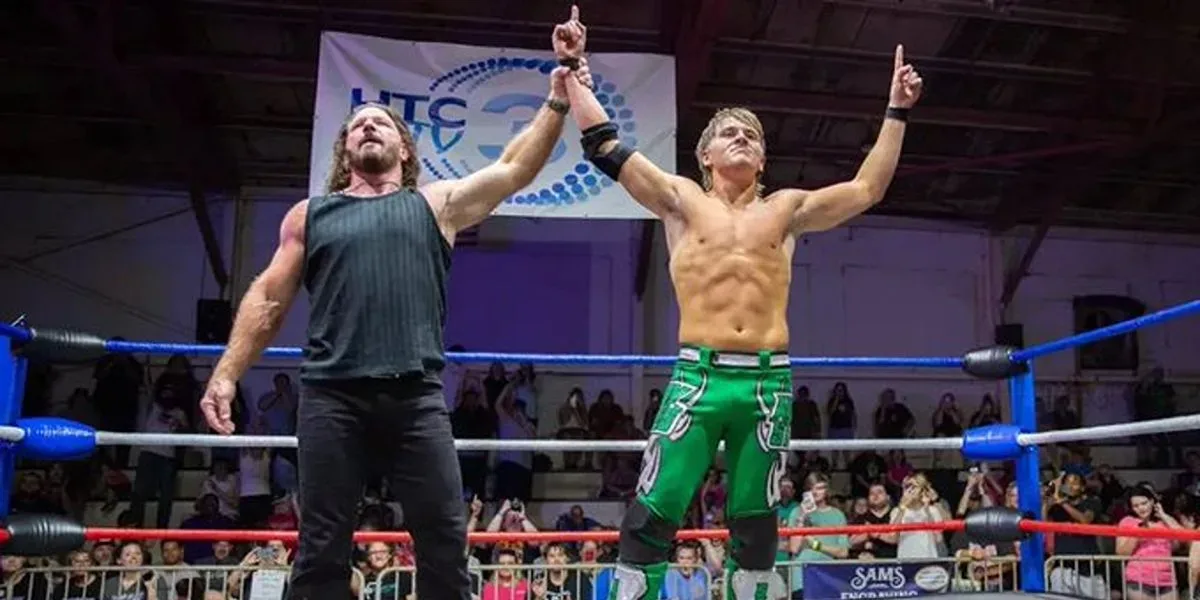
AJ Styles has looked back on the social-media argument surrounding his son, Avery Styles, and conceded that he may have been drawn into a debate that did not merit the level of attention it received.
The issue emerged over SummerSlam weekend after Arik Cannon, the promoter of F1RST Wrestling, publicly criticized Avery in connection with a GCW event in Minnesota. Cannon responded to comments from Nattie about Avery wanting to pay his dues, claiming he had watched the younger Styles avoid helping with work at the show, including setting up chairs.
AJ Styles pushed back on the criticism, stressing that Avery had been brought in to wrestle rather than to assist with ring crew duties. The exchange continued online, drawing comments from several figures in wrestling, including Cody Rhodes. What began as a narrow disagreement about responsibilities at an event quickly became a wider discussion about second-generation performers, access, expectations, and what it means to learn the wrestling business.
Speaking with Rhodes on What Do You Want To Talk About?, Styles was candid about his view of how the argument unfolded.
For more background on this topic, read Saquon Shugars vs. Tristan Angels Official for October 13 WWE NXT.
“Probably the most ridiculous thing that was ever talked about on X,” Styles said. “I may have gotten rage baited into that.”
It was a revealing acknowledgment from Styles, who has spent decades in professional wrestling and is accustomed to public scrutiny. In this case, though, the subject was not simply another performer or an angle involving his own career. It involved his son and a public claim that Avery had failed to meet a fundamental expectation often associated with wrestlers entering the industry.
For many wrestlers, helping set up a ring, arranging chairs, assisting with teardown, and handling other unglamorous tasks have long been part of the process of earning trust. Those duties are often discussed as lessons in respect as much as labor. They can also be practical realities for smaller independent events, where a limited crew means performers and trainees may be asked to contribute in several ways.
But the disagreement around Avery was rooted in a key distinction: whether someone specifically brought to an event as a wrestler should be judged by the same standard as someone attempting to earn a first opportunity. Styles’ original response centered on that distinction, and Ben Bishop later made a similar point in a video addressing the controversy.
Bishop argued that a new wrestler commonly helps with event setup in pursuit of getting booked, while Avery had already been booked to wrestle. From that perspective, expecting him to perform work unrelated to the assignment for which he was brought in was not a meaningful test of his commitment. Bishop summarized his position with a simple phrase: “Don’t hate the player, hate the game.”
Rhodes said Bishop’s explanation was among the more sensible contributions to an online exchange that became unnecessarily heated. Rhodes also explained why he felt compelled to involve himself, while making clear that he was not arguing that second-generation wrestlers should be excused from all of the work and standards that shape a career.
“I was standing by,” Rhodes said. “I like to get in there every now and again. That one, I thought, ‘This kid. We’re not doing that.’ Ben Bishop had oddly a really good take on it. I wish it would’ve ended with that. One guy thought he was supposed to, and he was there, another guy wasn’t even on the show. He had a really good ‘let it be.’ Some of us, myself included, couldn’t let it be.”
Rhodes’ comments underscored the conflicting viewpoints at the center of the conversation. One side viewed chair setup and other tasks as part of the traditional path into wrestling. The other recognized that Avery’s circumstances were different because he was already appearing in a wrestling capacity. The argument was therefore not necessarily about whether hard work matters, but about whether a particular task was relevant to his role at that event.
As the son of AJ Styles, Avery will inevitably face heightened scrutiny whenever he takes steps in wrestling. That reality was central to Rhodes’ explanation. Rhodes knows the dynamic well as a second-generation wrestler himself, and he described the kind of experiential knowledge that can come from growing up around the industry, even before someone takes on a formal role within it.
“I didn’t mean multi-gens didn’t need to do the thing they’re supposed to do,” Rhodes said. “What I meant is there is a level of knowledge and osmosis. My mom and sister, I consider them wrestlers. They’ve never set up a chair in their life. They lived it. You went through your run with your children, you lived by it. A little grace, it all I’m saying.”
The point was not that family connections erase the need for discipline, training, or accountability. Rather, Rhodes argued that people raised around wrestling can absorb aspects of the business through proximity, family experience, and years of observing the personal sacrifices behind the profession. That does not replace the work required to become a wrestler, but it can provide a foundation that is different from someone arriving with no connection to the industry.
Rhodes also addressed the unavoidable pressure placed on Avery because of the Styles name. In wrestling, lineage can open doors, but it also creates an immediate measuring stick. Fans and peers alike often assess a second-generation prospect through the achievements of a parent, sometimes before that prospect has had a meaningful opportunity to establish an identity of their own.
“He’s got a target on his back and that’s never going to go away,” Rhodes said. “I don’t regret for one second getting in there, but I didn’t mean second gens don’t need to set up chairs.”
That clarification is important because the online discussion risked turning into a broader argument about privilege in wrestling. Rhodes did not suggest that second-generation wrestlers should bypass the standards expected of everyone else. Instead, he argued for context and restraint, particularly when a young wrestler is being criticized over an expectation that may not have applied to the role he was asked to fill at a specific show.
Styles’ reflection that he may have been “rage baited” also speaks to the way wrestling debates can rapidly escalate on social media. A disagreement that might once have been handled privately, or perhaps ended with a brief explanation between those involved, can become a public referendum when it concerns a recognizable name. Once other wrestlers and fans begin weighing in, nuance can be lost quickly.
In this case, there were several overlapping questions: whether Avery was expected to help before the event, whether he had been assigned to do so, whether a booked wrestler should still assist with general setup, and whether an established wrestler’s son should be held to additional standards precisely because of his background. None of those questions can be fully settled by a single post or response.
What is clear is that both Styles and Rhodes believe the reaction went too far. Styles called the entire discussion one of the most ridiculous subjects debated on X, while Rhodes said he wished the matter had concluded with Bishop’s “let it be” perspective. Their conversation did not deny the value of paying dues. It instead questioned whether the chair argument was an appropriate or useful way to measure Avery’s attitude or future in wrestling.
For Avery Styles, the attention is a reminder that being connected to a major WWE name brings a difficult balance. The name offers visibility, but it also guarantees that small moments can become larger debates. Rhodes’ call for “a little grace” was ultimately directed at that reality: a young person connected to wrestling royalty will be watched closely, but should still be allowed room to learn without every disputed detail becoming a defining statement about his character.
As for AJ Styles, his comments suggest he has no interest in allowing the dispute to become bigger than it already has. The veteran’s admission was straightforward. He defended his son when he believed the criticism was unfair, but he can also recognize that the conversation became a social-media spectacle. In the end, the debate over chairs may be less memorable than the larger lesson it exposed: in wrestling, tradition matters, but context matters too.

Darryl Polo
Darryl Polo is a passionate wrestling fan covering WWE, AEW, TNA and beyond. He loves great rivalries, breakout stars and the moments that keep fans talking long after the bell. How we work.