
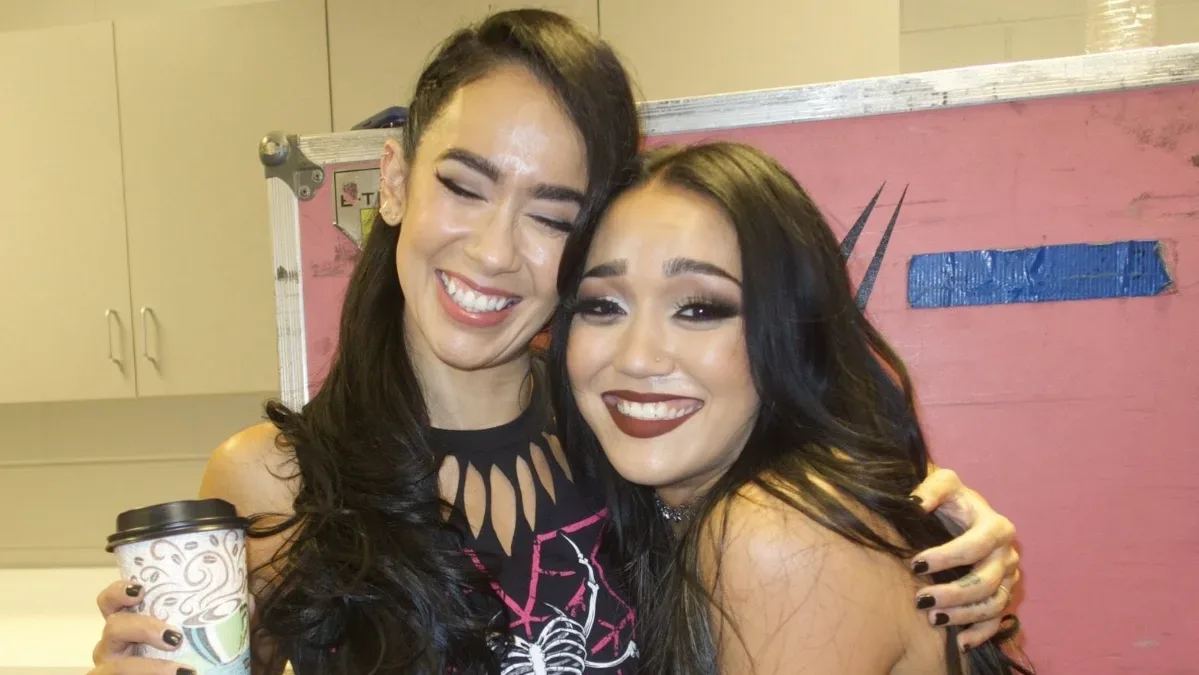
AJ Lee has reflected on the dramatic changes within WWE’s women’s division, contrasting the environment of her original run with the wider opportunities, deeper roster and stronger sense of unity she sees in the company today.
During her initial WWE tenure, AJ became one of the defining personalities of the Divas era. Her combination of sharp promos, unconventional presentation and in-ring work helped her stand apart at a time when women were frequently allotted limited television time and short matches. AJ made the most of those opportunities, but she has never minimized the difficult reality facing female talent in that period: there were few meaningful spots, and competition for them could become intense.
Speaking on Mind Over Mountain with Cheryl Strayed, AJ addressed the professional and personal impact of working in a system where women were often presented as competing for a narrow amount of space on a program dominated by male acts.
“It was hard because it was a time when women got this one crumb to fight over, and this system is in place where it’s, ‘be distracted fighting over this one crumb while the men get this feast.’ It’s really an unfair position to be in. I do realize that I was lucky to get the most of the crumb and make the most of it.”
For more background on this topic, read Roxanne Perez Says ‘The Prodigy’ Name Can Stay as She Embraces WWE Stardom.
That assessment speaks to a major part of WWE’s history. For years, women’s matches could be treated as brief interludes rather than central attractions, while the depth of character development and storytelling afforded to the men’s roster was rarely available to their counterparts. Talent could still break through, as AJ did, but the structure made sustained momentum and meaningful advancement harder to achieve.
AJ’s success within that landscape remains notable. She was able to turn a distinct character into a major presence on WWE television, becoming a multi-time Divas Champion and a focal point of the division. Yet her comments make clear that individual success did not erase the larger imbalance. Being one of the women who received a prominent role was valuable, but it did not change the fact that many others had little room to develop, perform or connect with the audience.
Her perspective has changed upon returning to WWE roughly a decade later. AJ credited generations of women for pushing the division forward, beginning with the efforts of performers from her own era and continuing through the women who followed. In her view, the difference is not merely that women now receive more minutes in the ring. It is that there are enough opportunities for performers to succeed without being forced into the same kind of scarcity-driven competition.
“It was harder back then. What was really cool this time around, coming back 10 years later, was to see that, because of the women, starting with me and then so many women pushing the envelope forward and forward, the business has evolved. There are more spots and there is a feast for women. In that, you can feel calm and there can be a sisterhood. That was the most beautiful thing to experience now.”
The term “sisterhood” is especially significant given AJ’s description of the earlier environment. When an entire group is made to compete for one visible place, solidarity can be difficult to build. A division with more featured matches, more championships, more storyline lanes and more television time can create a fundamentally different atmosphere. Talent are still competitors, but one wrestler’s success does not necessarily have to come at the expense of another woman receiving a chance.
WWE’s women’s division has evolved considerably since AJ’s original run. Women are now routinely positioned across Raw, SmackDown and premium live events in high-profile matches and stories. Championships are treated as central prizes, and the roster includes performers with a variety of wrestling styles, personalities and backgrounds. Major rivalries can be allowed time to unfold, while multiple women can be featured in different programs on the same show.
That expansion has also changed what viewers can see in the performers themselves. AJ explained that, when she began, her character felt different partly because she was presented as an ordinary girl rather than a conventional archetype. She now sees a far broader collection of identities and personalities represented on WWE programming, allowing more fans to find someone who feels recognizable and inspiring.
“It used to be that my character was so different simply by being an ordinary girl. That’s what made such a difference. To see that now there are so many women who are different in their own ways. There was a different type for any person in the world to relate to.”
For AJ, that range is not a superficial development. It is connected to the impact wrestling can have on young viewers. She considered what it would have meant to her as a child to have such a broad field of women to watch and support. Instead of a limited set of presentations, she described a lineup where numerous performers could have become a favorite.
“I thought of myself as a kid, and there were so many kids who would’ve killed to see a woman like that on TV. There were like 20 women where I was like, ‘She would’ve been my favorite, she would’ve been my favorite.’ It really started to speak to the inner child in me that these people would’ve been really helpful for me to look up to.”
Representation has been a recurring subject in conversations about WWE’s women’s evolution. The current division is made up of athletes who differ in appearance, personality, experience and approach to wrestling. Some are presented as dominant champions, some as technical specialists, some as charismatic entertainers, and others as unpredictable rivals. That variety helps move the division beyond the idea that there is only one acceptable way for a woman to be featured in professional wrestling.
AJ specifically praised the fact that different forms of beauty are being acknowledged rather than narrowed into a single standard.
“All different kinds of beauty were finally represented and celebrated. That’s the world I want to live in.”
Her comments place WWE’s progress in a longer historical context. The women currently receiving major opportunities did not arrive in a vacuum, and neither did the change in audience expectations. The evolution has been shaped by women who worked through periods with limited time and limited creative space, then by those who continued demanding more substantial matches, stronger stories and recognition equal to the importance of their work.
AJ’s own legacy is part of that path. Her willingness to embrace an unconventional persona and make the most of short segments demonstrated that women could command attention with layered character work. The performers who came after her continued to broaden that foundation, ultimately helping create a division in which multiple women can be treated as major stars at the same time.
There is still competition in WWE, as there always will be in a results-driven industry built around championships and television exposure. But AJ’s point is that competition can exist without artificial scarcity. A women’s roster does not need to be restricted to one match, one story or one definition of marketability. When more women are allowed to thrive, performers can compete while also supporting the larger growth of the division.
That is the central contrast in AJ Lee’s reflection. Her first run demanded that she fight for a small share of opportunity and make it count. Her return has allowed her to witness a deeper, more varied women’s landscape—one where there is room for more stars, more stories and, in her words, a meaningful sisterhood.

Darryl Polo
Darryl Polo is a passionate wrestling fan covering WWE, AEW, TNA and beyond. He loves great rivalries, breakout stars and the moments that keep fans talking long after the bell. How we work.