
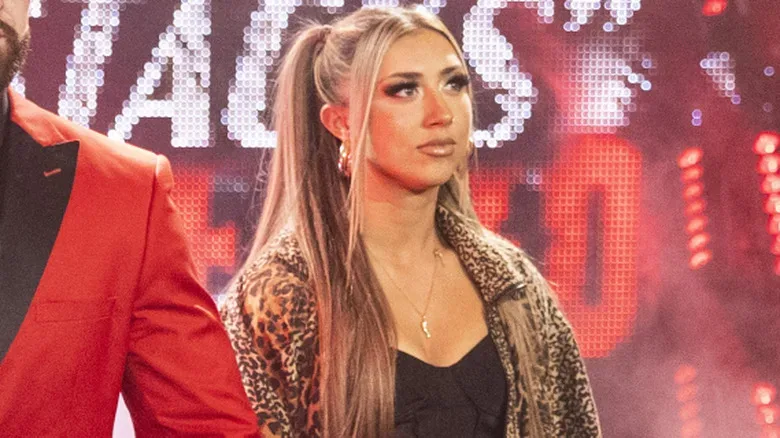
Adriana Rizzo has opened up about the difficult timing surrounding her WWE release, explaining that she believed she had finally reached a point where she was ready to contribute in multiple roles after an injury-plagued stretch with the company.
Rizzo, who spent four years in WWE and was released on September 4, had been a familiar presence in NXT as part of the D’Angelo Family. Her momentum in the promotion was interrupted by significant injuries, including a torn Achilles and a torn ACL. She was sidelined for nearly a year before returning to the ring in July 2026, only to be released not long after she felt prepared to make the most complete version of her case as a WWE performer.
Speaking on Talk Is Jericho, Rizzo said she understood the reality of working in a constantly changing wrestling environment. Still, she made a point of looking for ways to remain valuable to WWE while she could not wrestle.
“I knew with my position… WWE is a revolving door. People are in and out. Why would I be valuable if I can’t even get in the ring for two of my four years? I was very aware of that, but I really wanted a shot, and I believed in myself in wrestling and reinventing myself.”
For more background on this topic, read Adriana Rizzo Reveals She Entered NXT Vengeance Day 2024 With A Partial ACL Tear.
That awareness pushed Rizzo to pursue work outside the traditional in-ring role. Rather than simply waiting for medical clearance, she said she tried to show WWE that she could be useful in media and personality-driven settings as well. Rizzo had already developed a presence through social media segments, including interviews and her “Rizzo Rants” content following shows.
Those efforts helped lead to a position as an interviewer on WWE EVOLVE. Rizzo also served as an authority figure at NXT live events during her time away from the ring, giving her additional experience in front of a live crowd and in a role that relied on character work, speaking ability, and presentation rather than physical competition.
For Rizzo, those opportunities were not a replacement for wrestling. They were part of an effort to prove that she could offer WWE more than one skill set while recovering from two serious lower-body injuries.
“I knew I had so much knowledge in wrestling after four years. ‘I can do these other roles.’ I made an effort and showed interest. ‘If you need me doing this.’ On social media, I did a lot of interviewing and Rizzo Rants post-show. That got me a spot on WWE EVOLVE. I was an interviewer on EVOLVE and I was getting back in the ring.”
Rizzo said the circumstances became especially frustrating because, by the time she was released, she felt physically and creatively ready to move forward. She believed she could return to competition, resume developing her character, and continue interviewing if needed. From her perspective, the release came just as she was finally able to present herself as an all-around performer after spending a major portion of her WWE tenure rehabilitating.
“At the point of my release, I was fully ready to go in the ring, ready to go with my character, ready to interview. I felt like I had a lot to offer. That was the unfortunate thing: the timing. ‘I’m ready to go now.’”
A difficult moment after a long recovery
Injuries can alter the trajectory of any wrestler’s career, particularly for performers still attempting to establish themselves on television. Rizzo’s situation was compounded by the nature of the injuries involved. A torn Achilles can require a lengthy rehabilitation process on its own, and an ACL tear brings another demanding recovery timeline. For someone attempting to earn consistent opportunities in a developmental system, extended time away can create an uphill battle once they are cleared.
Rizzo acknowledged that she had been aware of those stakes. She did not portray the release as something that came entirely without warning in the broader context of WWE’s business. Instead, she explained that she was especially uneasy as rumors circulated about potential talent cuts.
She noted that she had experienced numerous rounds of releases during her WWE run, describing the ongoing uncertainty that can affect a roster whenever cuts are expected. This particular round, however, felt different to her because she believed she was finally at her strongest as a wrestler.
“There were rumors of ‘cuts are coming on Friday.’ I was most nervous for that round of cuts. There had been 20 rounds of cuts since I had been there. Everyone is always nervous, but I was very nervous for this round. I finally feel like I’m really good at wrestling, and I have it all figured out at this moment. ‘I can get in the ring and wrestle.’ It was going to be the time that hurt the most because I felt like I was finally ready. It was really bad timing.”
That last point is central to Rizzo’s reaction. The disappointment was not only about losing a job with WWE. It was about losing that position at the moment she felt she had the tools, confidence, health, and versatility to make a meaningful push. The years spent dealing with injury had given her perspective, but they had also limited her ability to consistently show what she could do between the ropes.
Her comments also illustrate why she pursued on-camera assignments while injured. Interviewing on EVOLVE and appearing as an authority figure at NXT live events gave Rizzo a way to remain visible and involved. It also allowed her to demonstrate that she could communicate, engage viewers, and inhabit a role within WWE programming even while unable to compete.
Rizzo describes a brief, cold release call
Rizzo recalled that she was driving to Savannah, Georgia, when the call came. She said she recognized what the call might mean before answering, but admitted that she was still in denial in the moment.
“I knew, I saw it. In denial, I answered. It’s a really short phone call. It’s nobody related or someone you see day-to-day or face-to-face. It’s kind of brutal and sad. You give everything for four years and you get a really short phone call.”
She characterized the conversation as lasting roughly 10 seconds. While she clarified that “Hey, you’re done. Bye” was not the literal wording used, Rizzo said that description captured the abrupt nature of the exchange. She ultimately called the experience “cold,” emphasizing the emotional disconnect of receiving such significant career news through a brief call from someone outside her daily working circle.
Professional wrestling releases frequently bring a sudden end to routines, creative plans, and relationships built over years. For Rizzo, the abruptness appears to have been magnified by the personal investment she had made in returning from injury. She had not only worked to get medically cleared; she had also sought out alternative ways to contribute and remain present in the company’s ecosystem.
Her experience underscores a difficult aspect of the modern WWE system. Talent are often required to be adaptable, especially when injury removes them from the ring. Rizzo appears to have embraced that challenge by expanding into interviewing, social media content, and live-event character work. Yet even adaptability does not eliminate the uncertainty that comes with roster decisions.
What Rizzo leaves behind in WWE
During her WWE tenure, Rizzo was most notably associated with the D’Angelo Family, the NXT group led by Tony D’Angelo. The act provided a distinct identity and gave Rizzo a place within one of NXT’s more recognizable factions. However, injuries prevented her from building the uninterrupted in-ring body of work that she had hoped to create.
Her return in July 2026 represented an important milestone after nearly a year away. Rizzo’s comments make clear that she saw that return as the beginning of a new phase, not a conclusion. She felt ready to wrestle again, had confidence in the evolution of her character, and had established experience in interview-based content through WWE EVOLVE.
Instead, her release on September 4 closed the WWE chapter shortly after she returned to active competition. Rizzo also discussed how what began as a short-term ACL injury became a long-term absence, adding further context to the obstacles she faced during her final period with the company.
For now, Rizzo’s remarks present the release as a matter of painful timing rather than a lack of belief in what she can do next. After four years in WWE, time with the D’Angelo Family, major rehabilitation periods, and work in several on-screen capacities, she believes she exits with more experience than her interrupted ring time may immediately suggest.
Rizzo was clear that she wanted one more opportunity to show that she had put the pieces together as a wrestler. That chance did not arrive in WWE. But her willingness to work across in-ring, interview, social-media, and live-event roles could be an important part of whatever comes next following her departure.

Darryl Polo
Darryl Polo is a passionate wrestling fan covering WWE, AEW, TNA and beyond. He loves great rivalries, breakout stars and the moments that keep fans talking long after the bell. How we work.