
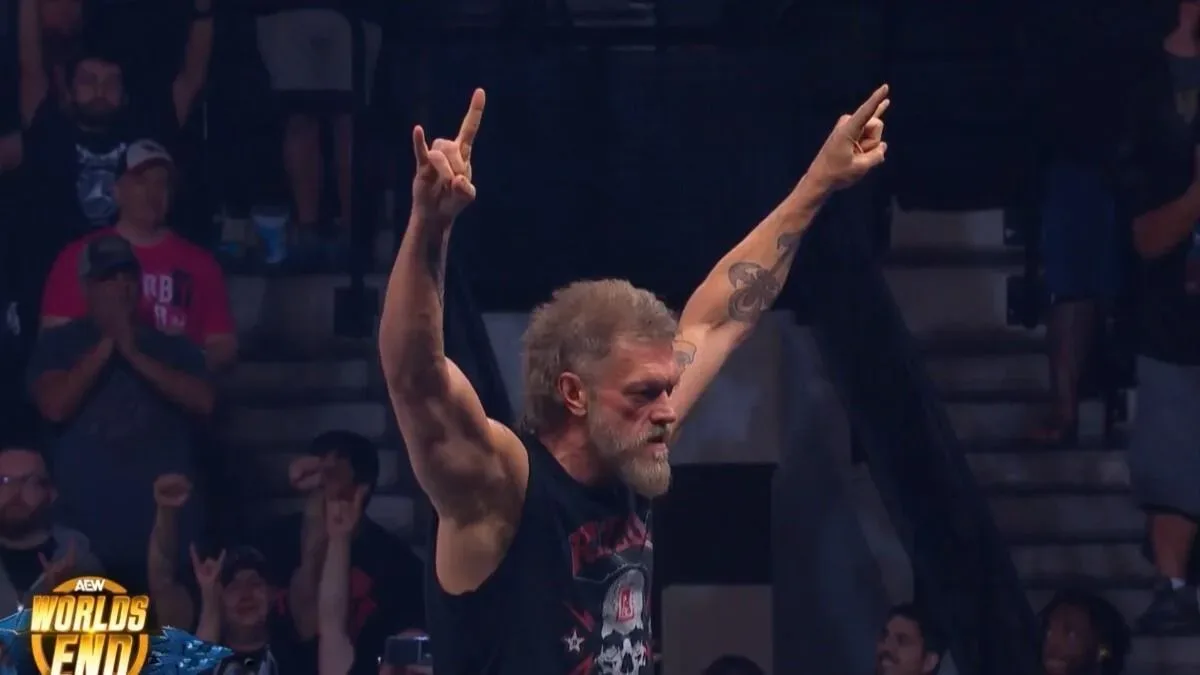
Adam Copeland has performed some of professional wrestling’s most recognizable high-risk moments, but the AEW star does not believe spectacular offense alone is what makes a wrestler truly resonate with an audience.
In a recent interview, Copeland discussed the point in his career when he began to understand what could elevate him beyond being a reliable in-ring performer. For the former WWE World Heavyweight Champion, that breakthrough came during his major program with Matt Hardy. It was there, he said, that he started to recognize the value of patience, camera awareness and giving viewers time to absorb an emotion before moving to the next beat.
Copeland’s comments speak to a philosophy that has informed his work across multiple eras. Whether he was competing in WWE as Edge or has been working under his real name in AEW, he has consistently been associated with matches and rivalries that leaned heavily on character stakes. His career includes ladder-match chaos, championship victories, betrayals, comebacks and long-running personal feuds, but he sees those moments as effective only when fans have a reason to care about the people involved.
“I think, honestly, it was probably the program with Matt Hardy,” Copeland said when asked when he realized he could become one of the industry’s top stars. “That’s when I started to put together what exactly was going to move me beyond where I was at.”
For more background on this topic, read Rohan Raja Says Empty-Arena NXT UK Wrestling Made Every Impact Feel Harder.
The Matt Hardy rivalry was built around deeply personal conflict and gave Copeland an opportunity to work in a more dramatic, character-driven setting. Rather than treating every segment as a vehicle to reach the next move, Copeland explained that he began paying closer attention to presentation. That meant knowing where the cameras were positioned, recognizing when a producer had the coverage needed and allowing a facial expression or a reaction to land before continuing.
It is an aspect of television wrestling that viewers may not consciously notice, but it can make an enormous difference. A wrestler can deliver the same physical performance in front of the same crowd, yet a well-timed close-up can transform a brief expression into a lasting image. Copeland said that process made him think more like a director, considering not just the action in front of him but the visual story being created for the audience at home.
“Now I start thinking more like a director as opposed to a wrestler,” Copeland said. “I’m thinking of shots because shots become moments, and moments are what actually stay and resonate with an audience.”
That distinction is central to Copeland’s point. Athletic innovation can earn an immediate reaction, especially in an era where audiences have access to an unprecedented amount of wrestling from around the world. However, the AEW veteran believes the moves themselves are rarely what fans carry with them most vividly. They remember the emotion surrounding the move, the stakes that made it matter and the image it produced.
Copeland pointed to the spear from a ladder as an example of a sequence that endures because it was more than a routine maneuver. The visual scale, the danger and the atmosphere all helped turn it into a memorable spectacle. He recalled the flashbulbs that accompanied major moments in an earlier era, when fans in the crowd commonly brought still and disposable cameras to events. The move was important, but so was everything that made the audience feel as if it was witnessing something extraordinary.
For a wrestler, that is the difference between receiving appreciation for an impressive spot and building an attachment that can sustain a career. Copeland emphasized that he would prefer a crowd to be invested enough in him to chant his name rather than merely offering a generic response to the action. In his view, chants such as “This is awesome” can certainly reflect a positive crowd atmosphere, but they do not automatically mean the audience has connected with the wrestlers on a personal level.
“Moves are great, but it’s all about making a connection,” Copeland said. “I would rather the people be chanting, you know, ‘Copeland,’ than ‘ECW’ or whatever company you’re in. To me, that means you’ve made the connection.”
Copeland’s observation also reflects a wider conversation within modern wrestling. Fans are more knowledgeable about promotions, match styles and performers than ever before. They frequently celebrate a company, a style of match or a sequence of athletic offense. Those reactions can add energy to a show, but Copeland’s goal is more specific: he wants viewers to respond to the individual at the center of the story.
He compared some of the more automatic crowd responses to Pavlovian conditioning, suggesting that audiences can be trained to offer certain chants whenever the pace and spectacle reach a familiar level. The more meaningful marker, he argued, is when people react because they are emotionally invested in a wrestler’s situation. That is when a performer is making real progress and becoming genuinely popular rather than simply participating in a well-received match.
This approach has been visible throughout Copeland’s career. His most celebrated work has generally paired physical intensity with clear motivations. The conflicts have given audiences someone to support, someone to resent or a relationship to follow as it changes. Even when the matches have featured dangerous stunts or dramatic weapons-based sequences, the emotional framework has been designed to make the action feel consequential.
That remains relevant during his AEW run, where Copeland has continued to wrestle prominent names and bring decades of television experience to the promotion. He is part of a roster filled with highly athletic performers capable of producing eye-catching sequences. His perspective offers a reminder that athletic execution and emotional storytelling do not need to compete with one another. The strongest moments often combine both, with the in-ring action serving as the payoff to a story that has already made the fans care.
Copeland’s comments are also useful for understanding the role of pacing. Wrestling is a live performance, but television production adds another layer to it. A performer must work with the audience in the building while also making sure the people watching on screen can follow the story. By waiting for the correct camera angle and allowing a reaction to register, a wrestler can ensure that the intended emotional beat is not lost amid the speed of the match or segment.
That patience can be difficult in a business where momentum is prized and performers often feel pressure to keep escalating. Yet Copeland sees the pause as part of the craft. A look, a hesitation or a moment of realization can sometimes accomplish more than another move. When that image is captured correctly, it can become the visual fans remember long after the show ends.
The veteran also addressed the importance of venues in professional wrestling elsewhere in the same interview, further underlining his interest in the elements around a match that shape the audience experience. The building, the crowd, the camera work and the performers all contribute to the final product. For Copeland, none of those details are secondary when the objective is to create something lasting.
Ultimately, his message was straightforward: the most impressive offense in the world has limited value if it does not make people feel something. A move may draw cheers in the moment, but an authentic connection can turn a wrestler into a star. Copeland’s career has supplied plenty of spectacle, yet he credits the lessons learned in character-rich programs such as the Matt Hardy feud for showing him how to make those spectacular moments matter.

Darryl Polo
Darryl Polo is a passionate wrestling fan covering WWE, AEW, TNA and beyond. He loves great rivalries, breakout stars and the moments that keep fans talking long after the bell. How we work.