
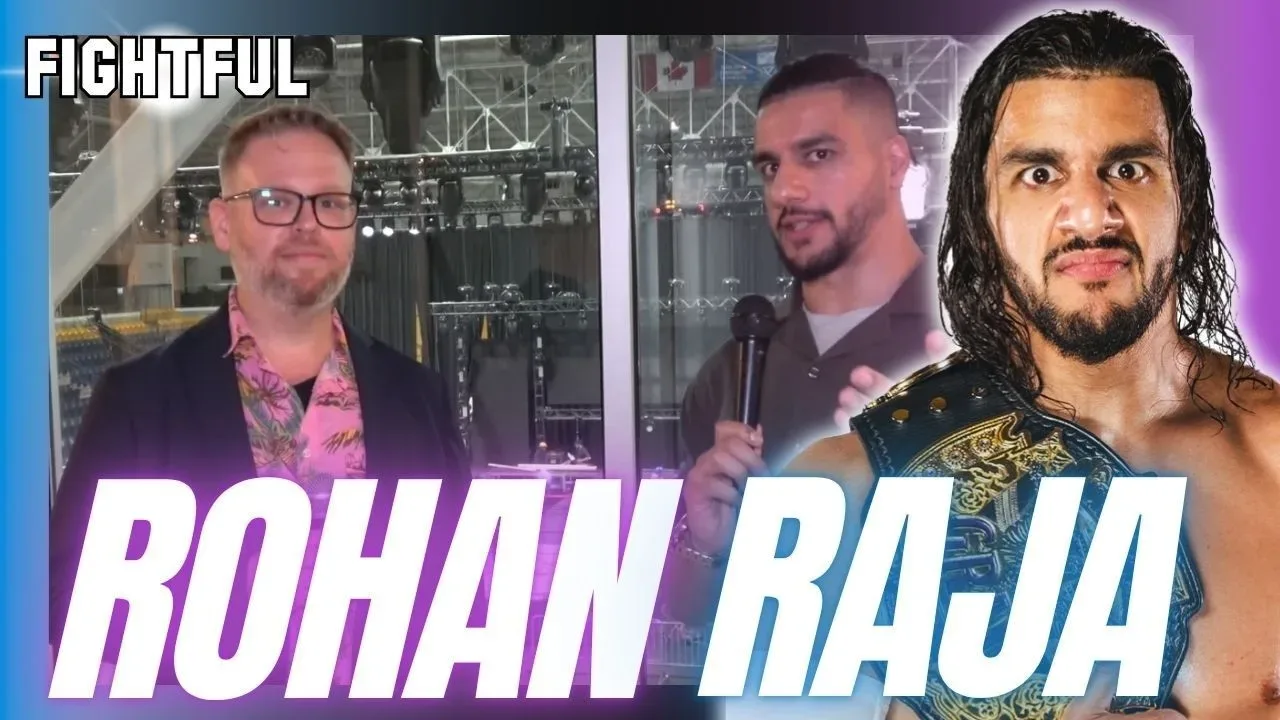
Rohan Raja’s first match in NXT UK came under circumstances that few wrestlers would have anticipated when they imagined a WWE television debut. Rather than walking through the curtain in front of a packed building and feeding off the response of fans, Raja entered an empty setting for his April 2021 debut during the pandemic-era presentation of NXT UK.
Raja faced Teoman on the April 29, 2021 edition of NXT UK, with the bout ending in a referee’s decision loss for Raja. While the result marked an early setback in storyline terms, the experience itself offered a distinctive introduction to the demands of televised wrestling. Raja has since described how the lack of a live crowd affected both his concentration and the physical toll of the match.
For Raja, the start of the performance still provided an immediate cue to shift into professional mode. He recalled watching for the production signal that told him it was time to make his entrance. Once the camera light turned red, he said his mindset changed instantly, regardless of how many people were physically in the building.
“I’m a very skilled TV wrestler, and I love TV wrestling,” Raja said. “When the camera—I remember seeing the light turn red. When it turned red, I had to go out and make my entrance. I was like, ‘Okay.’ I was in the zone.”
For more background on this topic, read The MFTs Send Stern Message to Bakusai After SmackDown Confrontation.
That ability to focus on the camera rather than the room was especially important during the empty-arena period. The performers may not have had fans reacting from ringside, but the matches were still being delivered to a major television audience. Raja said that awareness allowed him to approach the moment with the same sense of responsibility he would have brought to a much larger live crowd.
“So it didn’t matter if there was one person or 200 or 2,000 or 20,000,” Raja said. “I was in the zone as soon as I seen that light because I’m like, there’s millions of people watching. So that got me in the groove.”
The physical difference of an empty building
Although Raja could find his rhythm through the television production environment, he said the in-ring side of the experience felt dramatically different without the energy generated by spectators. In wrestling, crowd noise can serve as more than atmosphere. It can accelerate momentum, reinforce emotion, and provide an adrenaline boost that helps performers push through the strain of a demanding match.
Without that response, Raja said the impacts were more difficult to absorb. He did not suggest that the physical contact itself changed, but rather that the normal rush surrounding a live match was absent. As a result, he felt every aspect of the bout more acutely.
“Everything in the ring hurt so much more because you don’t feel the adrenaline from the crowd and everything like that,” Raja said.
That observation captures one of the defining challenges wrestlers faced during the empty-arena era. A crowd can react to a strike, a throw, a near fall, or a comeback in real time, giving performers an external rhythm to work with. The audience’s volume also creates a kind of shared momentum that can help make the cumulative physical punishment of a bout easier to power through.
In a quiet building, wrestlers had to create that rhythm themselves. There were no cheers to tell them a sequence had landed strongly and no chants to raise the intensity of a closing stretch. Instead, they had to trust their timing, communicate with their opponent, account for the cameras, and maintain their performance level while feeling the full wear of every collision.
Raja recalled returning backstage after the match and finding that others felt the same physical effects. He remembered a conversation among the wrestlers about how much their bodies were hurting after working without the emotional lift normally supplied by a live audience.
“I remember coming to the back and all the boys were like, ‘God damn, we’re going to have some ice baths or something.’ I’m like, ‘This hurts.’ But yeah, that was weird,” Raja said.
Learning to anticipate reactions
While the setting was unusual and physically taxing, Raja believes it ultimately improved his abilities as a wrestler. The empty building forced him to think more carefully about reactions that would ordinarily be immediately visible and audible. Rather than responding to crowd noise in the moment, he had to anticipate how viewers would receive particular beats of the match.
That is an important distinction in television wrestling. A wrestler is always balancing several considerations at once: the action in the ring, the opponent’s position, the referee, the hard camera, the pace of the match, and the story being communicated. In front of a crowd, audience response can make it easier to judge when to pause, when to speed up, and when a major moment needs extra time to breathe.
Raja said the no-crowd environment required a more deliberate thought process. He had to consider the reactions that were meant to occur at each point of the bout and effectively account for them without being able to hear them from the stands.
“I feel like, in a weird way, it really made me a better worker because it made you kind of think about what certain reactions are happening at particular times,” Raja said. “You had to think about that as you’re in there.”
In that sense, the absence of fans became a training ground for a different kind of ring awareness. Raja’s debut was not simply about executing moves in an unfamiliar environment; it was about understanding where the match’s emotional peaks were supposed to be and ensuring they translated through the broadcast. The skill set is especially valuable for performers who place a premium on connecting with the camera and delivering a clear story to viewers at home.
Raja believes the lessons from that period continued to benefit him after NXT UK. He said the experience has helped him as his career has moved forward, suggesting that the forced adjustment to empty-arena wrestling became a foundation for his later development.
“I feel like that’s really helped me out fast when I fast-forward down the track,” Raja said.
From an unusual debut to a new championship opportunity
Raja’s recollection also provides added context for how much performers had to adapt during that stretch of wrestling television. His April 2021 match against Teoman was a debut in the literal sense, but it was also a first major opportunity conducted under conditions far removed from the traditional wrestling experience. There was no live audience to welcome him, react to the match’s turning points, or help elevate the sense of occasion inside the venue.
Instead, Raja had to rely on professional focus. The red camera light became the signal that mattered. It represented the transition from preparation to performance and reminded him that the work still carried a substantial audience, even if that audience was watching from elsewhere rather than seated a few feet from the ring.
His next major announced challenge will take place in a very different chapter of his career. Raja is set to challenge Andrade El Ídolo for the AEW National Championship at MLP Northern Rising. The match places Raja opposite a prominent opponent in Andrade and gives him an opportunity to pursue championship gold.
The contrast between Raja’s NXT UK debut and that upcoming title challenge underscores the value he places on adaptation. A wrestler cannot always control the venue, audience size, presentation format, or circumstances surrounding a match. What Raja could control in 2021 was his readiness when the camera went live, and he now views the unique challenge of that empty-arena debut as an experience that sharpened his craft.
For Raja, wrestling without a crowd was undeniably strange. It hurt more, demanded more internal awareness, and removed the adrenaline rush that many performers depend on during a match. At the same time, it taught him how to better identify the reactions a match should create and how to work with television in mind. Those are lessons he will carry into his championship opportunity against Andrade El Ídolo at MLP Northern Rising.

Darryl Polo
Darryl Polo is a passionate wrestling fan covering WWE, AEW, TNA and beyond. He loves great rivalries, breakout stars and the moments that keep fans talking long after the bell. How we work.