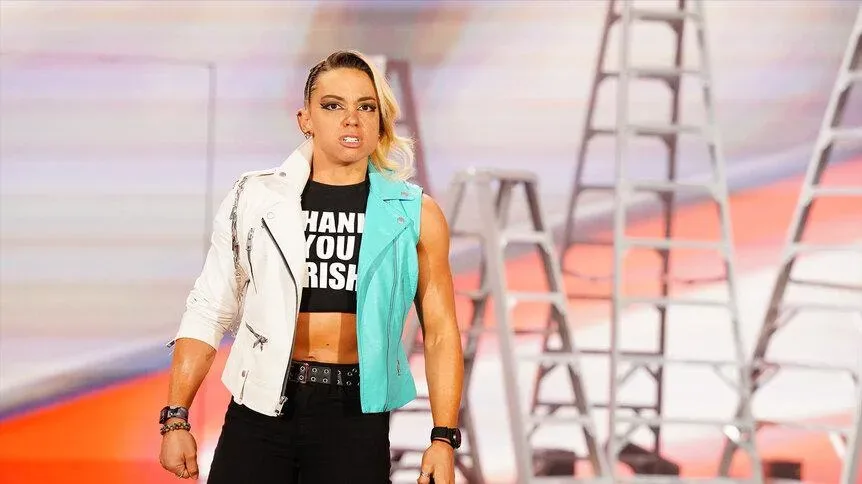
Zoey Serrano is taking an honest look at the biggest area she believes she left unexplored during her time in WWE: letting viewers see more of who she is away from the moves, matches, and presentation of her on-screen character.
Serrano, who wrestled in WWE as Zoey Stark, built a reputation for strong in-ring performances during her run with the company. However, she now feels that she did not consistently bring enough of her natural personality into the work audiences saw on television. Speaking as part of her Zoey 1001 video series, Serrano acknowledged that this remains a genuine disappointment for her.
“Yeah, yeah, I am. I’m actually really disappointed in myself because there were a lot of moments and opportunities where I could have and should have shown my true personality, but I didn’t.”
The admission is notable because it separates Serrano’s assessment of her past from a simple criticism of the opportunities she received. Rather than framing the issue solely around creative direction or television time, she said there were instances where she believes she personally could have done more to reveal herself to the audience.
For more background on this topic, read Mandy Rose Calls TNA’s Elayna Black Her ‘Little Sister’ After WWE Exit.
That distinction matters in professional wrestling, where a performer’s connection to viewers can be shaped by far more than ring results. Matches establish credibility, but promos, reactions, body language, interviews, and smaller character moments often determine whether fans understand what makes a wrestler different from everyone else on the roster. Serrano feels she had openings to make that connection more clearly and did not always take them.
For Serrano, the challenge was not necessarily a lack of personality. It was the difficulty of communicating it in an environment where the stakes are high and the audience is enormous. She explained that speaking directly to a camera and speaking before millions of people can be intimidating, a reality that can make it difficult for performers to present themselves with the same comfort they might have in more private settings.
“It’s hard to talk in front of the camera. It’s hard to talk in front of millions of people. But this is a good way for me, one, to practice, and two, for all of you to get to know me personally and who I am.”
Her video series has become an outlet for that process. Instead of treating it merely as additional content, Serrano described the project as both practice and an introduction. It gives her room to become more comfortable speaking on camera while allowing fans to see a side of her that she feels was not fully represented during her WWE run.
That approach can be especially valuable for a wrestler entering a new stage of her career. Character growth does not always have to begin with a dramatic reinvention, a new catchphrase, or a wholesale change in presentation. In Serrano’s case, the goal appears more personal: to close the distance between the person she is and the performer audiences encounter on screen.
She now sees TNA as the place where that can happen. Serrano said the promotion is giving her the freedom to be herself, show her capabilities, and enjoy the process. While she did not lay out a detailed blueprint for what her TNA character will look like, she was clear that authenticity and enjoyment are central to what she wants from this chapter.
“I get this opportunity now with TNA. TNA is allowing me to be true to who I am and show what I can do and just have fun, and that’s my number one goal, right? This is a whole new rebirth for me. I just want to go out there, have fun.”
The phrase “whole new rebirth” captures the significance Serrano attaches to the transition. This is not simply a new employer or a continuation of the same approach under a different banner. She is viewing the moment as a chance to reassess what she wants audiences to know about her, how she wants to communicate it, and how much more of herself she is willing to put into her work.
That does not erase the accomplishments of her WWE tenure. Serrano specifically recognized that she had good performances from an in-ring perspective. Her reflection is instead about adding another layer to that foundation. She wants the athletic component of her game to be accompanied by a more visible personality, one that can give fans a clearer sense of her perspective and make her presentation feel more complete.
For wrestlers, that kind of evolution can be difficult to measure from the outside. A performer may execute at a high level in the ring and still feel that audiences have not seen the full range of what they offer. Serrano’s comments suggest she has identified that gap in her own body of work and is deliberately trying to address it rather than avoiding the subject.
There is also an accountability in the way she spoke about it. Serrano did not say that showing personality is easy, nor did she minimize the pressure involved in live television and public-facing performance. But she also did not use that pressure as an excuse. Her disappointment comes from knowing that, in her view, she had moments in which she could have taken a greater risk creatively or personally.
That self-awareness may be an important part of what makes the TNA opportunity meaningful. By openly recognizing the aspect of her previous presentation that she wants to improve, Serrano has established a clear objective for herself. Fans will be able to watch whether the confidence she is building through direct-to-camera content translates into the way she speaks, carries herself, and develops on TNA programming.
A Different Kind of Opportunity
Serrano’s comments point to a familiar tension in wrestling: the difference between performing a role and allowing a role to be shaped by the performer’s genuine traits. The most effective wrestling personas are not always identical to the people portraying them. Still, many successful characters are built around recognizable pieces of a performer’s real voice, sense of humor, attitude, intensity, or worldview.
Serrano believes she did not show enough of those recognizable pieces in WWE. Now, she is seeking to make the audience’s understanding of her more personal without losing the competitive edge that helped define her work in the ring.
Her stated desire to “have fun” should not be confused with a lack of ambition. Within the context of her remarks, it sounds like a priority born from wanting to be more relaxed, more expressive, and less constrained by the fear of saying the wrong thing or failing to meet expectations. If she can perform with that freedom, she appears to believe the result will be a truer representation of what she brings to wrestling.
The video series is an early part of that effort. It gives Serrano a forum where she can speak directly and repeatedly, rather than relying only on brief, tightly structured wrestling segments to communicate personality. Every appearance provides another opportunity to build comfort, and that comfort may help her take advantage of the moments she felt she missed before.
There is no guarantee that a new environment automatically solves the challenges Serrano described. Finding a voice on camera remains a process, and developing a resonant wrestling character takes time. Yet Serrano is approaching the situation with a clear understanding of what she wants to change. She wants to be more open, more recognizable as herself, and more willing to let fans see the personality behind the performer.
As she continues her TNA journey, that will be the key development to watch. Serrano has already identified her past frustration: not showing enough of her true self. She has also identified her current aim: make the most of a fresh start, become more comfortable in front of the camera, and enjoy the chance to present a fuller version of Zoey Serrano to the wrestling audience.
Darryl Polo
Darryl Polo is a passionate wrestling fan covering WWE, AEW, TNA and beyond. He loves great rivalries, breakout stars and the moments that keep fans talking long after the bell. How we work.