
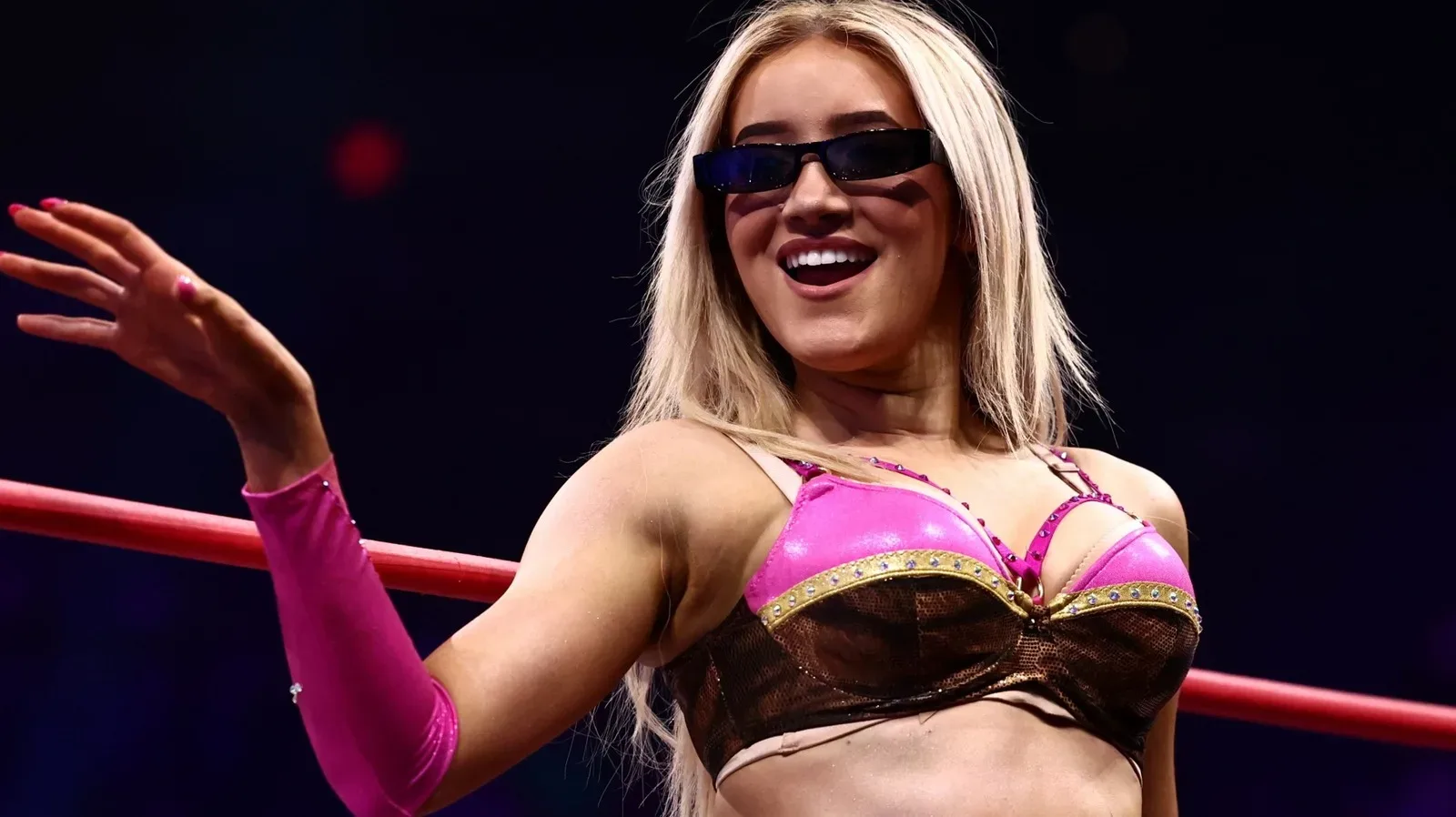
Zayda Steel’s path to AEW included a notable stop in WWE’s developing WWE ID initiative, where she was announced as the first prospect in the program in 2024. Steel ultimately moved on and signed with AEW, but she has no interest in diminishing the role WWE ID played during a demanding stage of her independent wrestling career.
During a virtual signing with Captain’s Corner, Steel described the early days of WWE ID as an uncertain but important learning experience. As one of the first talents involved, she said the initial group was effectively helping establish how the program would work in practice.
“Yeah, we were like the guinea pigs of the program; the test dummies, if you will,” Steel said.
That description was not offered as a condemnation. Instead, Steel explained that the program gave wrestlers practical help at a time when earning a living on the independents could require extensive travel, low-paying bookings, and additional employment away from the ring. For a young wrestler trying to build momentum, even modest financial support can make a significant difference.
For more background on this topic, read MJF Appears in New Trailer for Christmas Heist Comedy Stranglehold.
Steel initially believed WWE ID would resemble WWE’s NIL program, albeit with a weekly payment attached. As she discussed the realities of independent wrestling, however, her broader point became clear: the assistance was designed to help prospects continue pursuing their careers between shows and opportunities.
“It’s hard out here, driving, making 20 bucks,” Steel said, describing the support as money that could help wrestlers “get through the next week before you’re wrestling.”
WWE ID was presented as a pathway intended to identify and develop independent talent while allowing those wrestlers to continue gaining experience in their usual environments. The idea of a major company providing support to performers still working outside its main roster system has drawn differing reactions, particularly because independent wrestling has long been built around wrestlers navigating a patchwork of promotions, travel commitments, training schedules, and side jobs.
Steel’s comments offer a perspective rooted in firsthand experience rather than theory. She knows what it is like to balance wrestling with two jobs, and she made clear that the financial stability supplied by WWE ID changed what she could devote to her craft. Rather than seeing the arrangement as something to criticize, Steel views it as assistance for wrestlers facing the difficult economics of the independent scene.
“I was on the indies and I know how much it sucks at times, like, working two jobs and then wrestling. It sucks!” Steel said. “So any help from bigger companies, the merrier!”
For Steel, the most meaningful outcome was that the program helped her leave those two jobs and rely on income generated through wrestling. That transition gave her more time and energy to focus on improving as a performer, preparing for bookings, and pursuing the opportunities that could shape her career.
From Independent Prospect to AEW Talent
Steel’s move to AEW has made her WWE ID history especially interesting. She was the first wrestler publicly announced for the initiative, only to later leave and sign with another major national wrestling company. In an industry where affiliations and developmental routes can become topics of intense discussion, Steel’s reflections show that her time in WWE ID and her present position in AEW do not have to be framed as opposing experiences.
Her assessment was straightforward: WWE ID was valuable when she was on the independents and trying to establish herself financially. AEW is where she is now making her mark. Both can be true without changing the facts of her career.
Steel has also received encouraging recognition within AEW. Christopher Daniels has identified her as one of the company’s promising young wrestlers, a notable endorsement given Daniels’ extensive experience as both a performer and a talent-development figure. It also underlines why Steel’s journey has drawn attention. She is not simply discussing a program from the outside; she is a young talent whose career has continued to advance after participating in it.
The leap from independent wrestler to a performer with a major-company platform is rarely a straight line. Wrestlers often work for years in front of small crowds, drive long distances for limited pay, and take every possible booking in hopes of becoming more visible. Television exposure and access to decision-makers can make a major difference, but those opportunities are only part of the equation. A wrestler must also have the resources to keep training, traveling, and performing long enough to capitalize when an opportunity appears.
Steel said WWE ID helped wrestlers gain television time and be seen by the people whose attention could matter for their futures. That visibility, combined with weekly financial assistance, is why she believes the initiative can be beneficial even if it has attracted criticism in some corners.
The Financial Reality Behind Independent Wrestling
Steel’s remarks also shine a light on a fundamental part of the wrestling business that can be overlooked when fans focus only on the finished product. Independent wrestlers may be responsible for travel, lodging, gear, training, and the countless day-to-day expenses that come with trying to become a better performer. A booking itself is not always enough to cover the full cost of reaching it.
For emerging wrestlers, the struggle is often not a lack of desire or talent. It is the challenge of finding enough time and financial breathing room to develop. Working multiple jobs may be necessary, but it can leave limited time to train, recover, study, travel, or pursue additional dates. Steel’s experience reflects that tension directly.
Her description of working two jobs while wrestling was blunt because it was personal. She did not romanticize the sacrifice. Independent wrestling can provide crucial experience and the chance to build a name, but it can also be exhausting. The support she received through WWE ID allowed her to step away from outside employment and concentrate more fully on wrestling, which she credited as a key benefit.
That does not mean every wrestler’s experience in a developmental initiative will be identical, nor does it settle every debate around how major promotions interact with the independent landscape. Steel did not claim that the program solved every issue facing wrestlers trying to break through. Her point was narrower and more practical: help matters, particularly for performers who understand the strain of working jobs while attempting to build a professional wrestling career.
Why Steel Does Not Want to Tear Down the Program
There is often pressure in wrestling to characterize a departure from one company or system as proof that the experience was unsuccessful. Steel’s comments reject that kind of all-or-nothing framing. She has moved forward with AEW, but she remains appreciative of the assistance WWE ID provided at a pivotal time.
Her stance is especially notable because it comes from someone who was involved at the beginning. Being among the first prospects meant entering a program still defining itself. Steel’s “guinea pigs” description acknowledges that reality. Yet she also emphasized the positive impact it had on her ability to pursue wrestling as her primary source of income.
That distinction matters. A wrestler can choose a different destination while still recognizing the value of a previous opportunity. Steel’s career has continued in AEW, where she is positioned as an emerging talent with considerable potential. Her time in WWE ID remains part of the route that helped get her there.
For fans following Steel’s development, the comments provide useful context for her rise. Her journey was shaped not only by what happened in the ring, but by the financial and professional support that gave her a chance to put more of herself into the ring. She has experienced the independent grind, benefited from a program created to assist prospects, and then taken the next step into AEW.
Steel’s message was ultimately one of empathy for the wrestlers still trying to make that same climb. She understands why outside support can matter because she lived the alternative: balancing two jobs with wrestling and trying to force a career forward through a demanding schedule. As she continues her AEW run, her candid view of WWE ID stands as a reminder that the road to a major promotion is often sustained by far more than what audiences see under the lights.
In pictures

Darryl Polo
Darryl Polo is a passionate wrestling fan covering WWE, AEW, TNA and beyond. He loves great rivalries, breakout stars and the moments that keep fans talking long after the bell. How we work.