
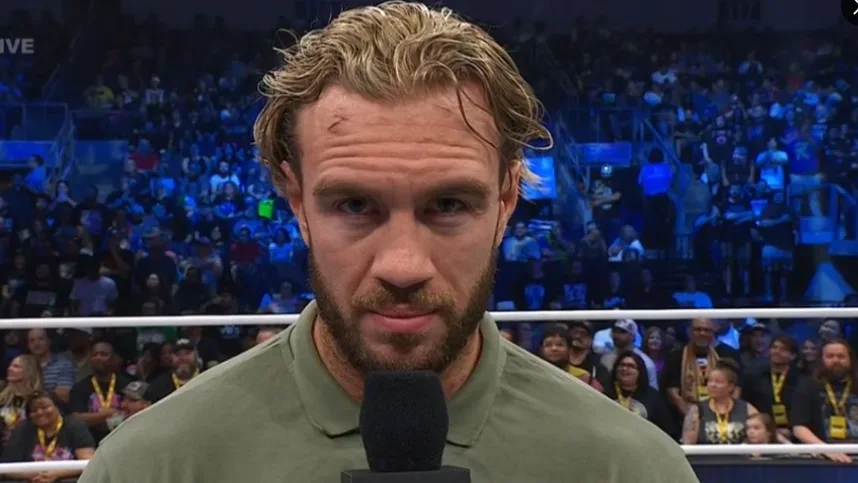
Will Ospreay’s career has taken him from relentless weekends on the British independent circuit to major stages around the world, including his current position as one of All Elite Wrestling’s defining in-ring performers. But when discussing the beginnings of that journey, Ospreay made clear that financial gain was never the reason he entered professional wrestling.
In an interview recorded before AEW All In, Ospreay reflected on the circumstances that helped create openings for him, the sheer volume of shows he accepted while building his name, and the support system that enabled him to keep pursuing the profession. His message was a candid one: he wrestled because he wanted to be part of wrestling, even when the money was minimal.
“I never did this for money. I did this because I fucking loved it,” Ospreay said.
That perspective has long been evident in the shape of Ospreay’s career. Before becoming an internationally recognized wrestler, he was a young talent working his way through the United Kingdom’s thriving independent scene. The period required regular travel, physical sacrifice and a willingness to take opportunities wherever they arose. Ospreay said he was working essentially every weekend, traveling around the country from Friday through Sunday in an effort to gain experience and establish himself.
For more background on this topic, read WWE Raw Preview: Liv Morgan Defends Women’s World Title Against Stephanie Vaquer in Birmingham.
For a wrestler trying to break through, that workload can be as important as any single high-profile match. Independent wrestling offers performers the chance to develop in front of different crowds, learn how to adapt to varying opponents and promotions, and build the body of work necessary to attract attention beyond their home territory. Ospreay viewed that constant activity as fundamental to eventually reaching the next level.
Timing and opportunity played major roles
Ospreay did not present his ascent as a story of individual effort alone. He acknowledged that timing was a major component. As he entered the British wrestling scene, PAC’s departure created room for another British high-flyer to emerge prominently. Ospreay was ready to capitalize because he was consistently working and steadily making his name.
He also identified a second opening that arrived when AJ Styles, Shinsuke Nakamura and The Good Brothers were signed away from New Japan Pro-Wrestling. Their exits left a notable opportunity in NJPW for new or rising wrestlers to make an impact. Ospreay would become one of the wrestlers who seized that chance, evolving from a spectacular junior heavyweight prospect into one of the company’s central stars.
“All of this is about timing,” Ospreay said, while stressing that opportunity alone would not have been enough. In his view, the work he had put in on the British circuit put him in a position to benefit when those openings appeared.
That balance is an important part of Ospreay’s reflection. Wrestling history is filled with talented performers whose careers changed when a roster shift, a vacancy, a tournament, or a well-timed audition gave them an opening. Ospreay’s point was not that timing diminishes the effort involved. Rather, the opportunity needs to meet preparation. By wrestling every weekend and accepting dates for little money, he had developed both a reputation and a foundation that could carry him forward.
A career built before the biggest paydays
Ospreay’s comments also offer an unfiltered look at a reality often overlooked when fans assess a wrestler’s eventual success. Major contracts, international television exposure and arena main events come after years in which many performers are operating with far less financial security. Travel costs, training, equipment and the basic demands of everyday life can make pursuing an independent wrestling career difficult even for talented athletes.
Ospreay stated that he worked for “next to nothing” during the earlier stages of his career. Yet he described that period with appreciation rather than resentment, because wrestling itself was what motivated him. He loved the work, the travel and the chance to perform. That passion, he believes, became a source of his success.
“I loved every single bit of it,” Ospreay said. “I just did it because I wanted to be involved in this.”
For Ospreay, that distinction matters particularly in a difficult economic climate. He spoke about the pressure facing people who are trying to put food in the refrigerator, take care of family members and make their money stretch. His remarks were grounded in the recognition that pursuing a dream is not equally accessible to everyone, especially when basic costs continue to rise.
That awareness led Ospreay to openly credit his parents and wider family. He said he was fortunate to have their support while trying to make his dream a reality. It is a significant acknowledgement, because family support can take multiple forms for a wrestler at the beginning of a career: a place to live, help with travel, emotional encouragement, or simply the patience to understand why someone keeps spending weekends chasing bookings around the country.
Family support made the pursuit possible
Ospreay’s gratitude toward his family was one of the most revealing elements of his comments. He did not frame his journey as entirely self-made, despite the grueling schedule and personal commitment he described. Instead, he recognized that being able to work constantly for limited pay required help from people close to him.
That is a reality shared by many aspiring wrestlers, even though it is not always discussed publicly. The early years of a wrestling career are often uncertain, and the commitment involved can place strain on personal finances and relationships. Ospreay’s willingness to speak plainly about that support adds context to his current success. His rise was driven by his talent, effort and ambition, but he also had a family network that helped give him the chance to pursue those qualities.
The result was a career trajectory that became increasingly remarkable. Ospreay made a name in Britain, then in New Japan, where he expanded far beyond the high-flying identity that initially drew attention. Over time, he became known for his athleticism, versatility, intensity and ability to deliver in major-match situations. His move to AEW placed him in another environment filled with elite competition and heightened expectations.
Even with that evolution, his latest comments connect the current AEW star to the wrestler who was driving up and down the United Kingdom for bookings every weekend. The settings have changed, the audiences have grown and the stakes have risen, but Ospreay’s stated motivation remains centered on the same feeling that got him started.
Ospreay’s perspective resonates beyond his own career
There is no suggestion in Ospreay’s comments that wrestlers should ignore financial realities or that compensation does not matter. He specifically spoke about the hardship many people are experiencing and the need for families to meet their essential needs. Instead, his point was personal: money was not what initially compelled him to take the risk of entering wrestling.
That sentiment helps explain the intensity with which Ospreay has approached his craft throughout his career. From his early independent work to his breakthrough in NJPW and now his AEW run, he has built a reputation around treating high-level performance as a priority. His comments indicate that the drive to wrestle preceded the rewards that eventually followed.
He also recently discussed WWE’s interest in him around the Cruiserweight Classic, another reminder that major opportunities have surfaced at multiple points in his career. Still, Ospreay’s reflection on his path emphasized the opportunities he did take rather than lingering on alternate routes. He focused on the British circuit that sharpened him, the New Japan opening that helped elevate him, and the people who made it possible for him to stay committed when the financial returns were limited.
As Ospreay continues his AEW career, that outlook remains central to how he describes his relationship with wrestling. His story is not simply about being in the right place when vacancies emerged. It is about being ready because he had spent years doing the work, embracing the struggle and pursuing the profession out of genuine love for it.
For Will Ospreay, the biggest lesson from his rise is straightforward: passion gave him the reason to start, persistence put him in position when the doors opened, and family support helped him keep going until the dream became a career.
Darryl Polo
Darryl Polo is a passionate wrestling fan covering WWE, AEW, TNA and beyond. He loves great rivalries, breakout stars and the moments that keep fans talking long after the bell. How we work.