
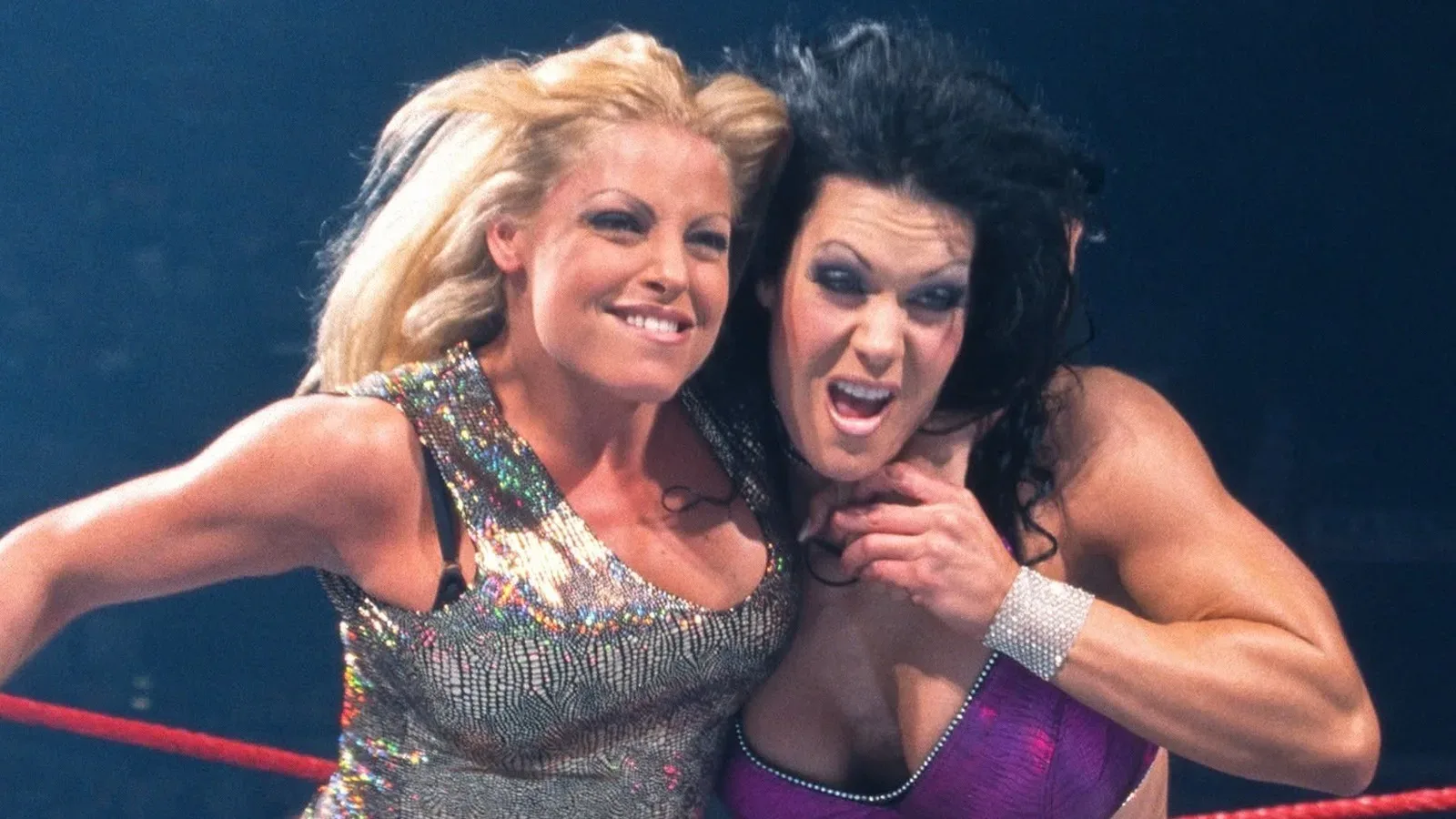
Trish Stratus has looked back on one of the most consequential transition periods in WWE women’s wrestling, describing how the division had to find a new direction after Chyna departed the company in 2001 while still holding the Women’s Championship.
During the Attitude Era, WWE’s women’s programming featured several distinct roles and personalities. Chyna and Sable were among the era’s most prominent female stars, while performers and on-screen figures including Stephanie McMahon, Debra, Ivory, and Jacqueline also held important places in the company’s presentation. But the arrival and development of Stratus and Lita helped signal that the division was changing, particularly as WWE began putting a greater focus on a new generation of competitors.
For Stratus, however, that change was not simply a smooth handoff from one group of stars to another. She recalled that Chyna’s exit created a situation in which the championship itself was no longer available to anchor the division. In Stratus’ view, the wrestlers who remained had an opportunity, but they first needed WWE to formally commit to restoring a competitive women’s scene.
“Chyna had left with the championship; she was the champion, so there was no real women’s division. There was nothing for us to be really competing for,” Stratus said on INSIGHT with Chris Van Vliet.
For more background on this topic, read Mickie James Recalls Standing Firm on Bringing the TNA Knockouts Title to WWE’s 2022 Royal Rumble.
That detail is central to understanding why the period stands out in Stratus’ career. A championship does more than identify a top performer. It gives a division a clear destination, establishes stakes for matches, and creates a structure for rivalries. Without that focal point, the women on the roster could appear regularly and still lack a defined competitive path.
Stratus said WWE eventually made the decision to bring the division back, working with a small group of women who were already on the roster or in the company. She recalled there being six women involved at the time, an indication of how limited the available field was as the promotion sought to relaunch the championship picture.
A Small Roster and a Major Opening
The rebuilding effort was not only about reinstating a title. It also required WWE to identify performers who could help carry a renewed division. Stratus specifically pointed to Jazz, whose experience prior to arriving in WWE had made her an important addition, and Molly Holly as another key figure in the group.
Those names reflect the range of talent WWE had available during that stretch. Stratus and Lita were becoming breakout stars with contrasting styles and strong connections to the audience. Jazz brought a different presence and background to the roster, while Molly Holly’s work gave the group another credible in-ring performer. Alongside established names such as Ivory and Jacqueline, the ingredients were there for a fresh start, even if the division was still working from a relatively small base.
The fact that the group was limited in size also heightened the importance of every major opportunity. When a division has only a handful of active contenders, a title match can immediately reshape the hierarchy. A single win can turn a developing performer into a central figure, while a loss can send a wrestler in a different creative direction. Stratus recalled that WWE’s plan to crown a champion through a six-pack challenge put all of those possibilities into one match.
For the women involved, the match represented more than another entry on a card. It was effectively a statement that the Women’s Championship was returning and that WWE was prepared to build around the performers competing for it. The winner would not merely receive a belt; she would become the first standard-bearer for the division’s new chapter.
Stratus Did Not Expect the Outcome
Stratus said she was thrilled simply to be included in the six-pack challenge. At that point, being in a match to determine the next Women’s Champion was already a significant moment for someone who viewed herself as part of a rebuilding process. She did not initially believe she was being positioned to leave with the title.
“Complete underdog story, unexpected moment,” Stratus said on INSIGHT with Chris Van Vliet.
She also recalled that the event took place in North Carolina, a setting that led many fans to anticipate a Lita victory. Lita’s popularity made that expectation understandable, and the potential result would have made sense on paper to viewers who saw her as one of the division’s most recognizable rising names. Stratus said the prevailing belief was that Lita would be the choice.
Instead, WWE selected Stratus. The result became one of the major early milestones in what would grow into a defining WWE career. Yet her recollection makes clear that the victory did not feel inevitable from her perspective. She characterized it as an underdog breakthrough rather than the culmination of a publicly obvious plan.
That distinction matters because Stratus’ legacy can make the outcome seem predictable in hindsight. She went on to become one of WWE’s most acclaimed women’s champions and one of the key figures associated with the evolution of women’s wrestling in the company. Looking backward from that position, it would be easy to assume she had always been viewed as the unavoidable choice to lead the division. Her account instead presents the title win as a moment of belief from people behind the scenes at a time when the division itself was still being reassembled.
Fit Finlay’s Role Behind the Scenes
Stratus credited Fit Finlay with advocating for her before the decision was made. She said Finlay went to bat for her backstage and persuaded Vince McMahon that she should be the wrestler chosen to win the championship.
That support was meaningful in a period when WWE was determining not only who would receive the title, but also what kind of division it wanted to present going forward. Stratus had been developing into a more complete performer, and the decision to make her champion gave the company a new centerpiece. Finlay’s belief in her, as described by Stratus, was part of the story behind that transition.
There is also a broader significance to the account. The rebuilding of a wrestling division is often remembered through its champions, landmark matches, and rivalries. Those visible accomplishments are essential, but Stratus’ memories underline how much uncertainty can exist before the pivotal moments happen. The championship had to be restored. A limited roster had to be organized around a new competitive goal. New or emerging talents had to be trusted. And someone had to receive the first major vote of confidence.
In this case, Stratus said that vote went to her when many observers expected Lita. The surprise was part of what made the moment resonate. Rather than following the most anticipated route, WWE used the six-pack challenge to establish Stratus as champion and give the relaunched division a different foundation.
The Importance of the Rebuild
Stratus’ reflection does not diminish the stars who came before her. Chyna, in particular, had been a central figure in WWE’s women’s landscape before her departure, and Stratus acknowledged the void created when the champion left the company. The point is not that the previous era lacked influential names. It is that the circumstances following Chyna’s exit required the remaining roster to build something new.
The women involved were working to establish regular stakes and a clearer identity for the division at a time when WWE was reintroducing the championship. Jazz and Molly Holly were among the additions and contributors Stratus remembered, while Lita’s popularity helped make the eventual title decision feel uncertain to fans. Stratus’ own ascent added another element, positioning a performer who had not expected to win as the face of a renewed title picture.
Her comments offer a reminder that divisions are not sustained by history alone. Even after memorable stars and championship reigns, a promotion must continue creating opportunities and identifying the people who can carry the next phase. For Stratus, the six-pack challenge was the moment when that possibility became tangible.
She entered excited to be included. She left as champion after a result she considered unexpected, backed by Finlay’s confidence and approved by McMahon. More importantly, the victory came as WWE was restoring a destination for its women’s roster to pursue.
That is why the match remains larger than an individual title win in Stratus’ recollection. It represented a reset for the women’s division: a small group of performers, a revived championship, and an opportunity to establish who would lead WWE into its next chapter.
In pictures

Darryl Polo
Darryl Polo is a passionate wrestling fan covering WWE, AEW, TNA and beyond. He loves great rivalries, breakout stars and the moments that keep fans talking long after the bell. How we work.