
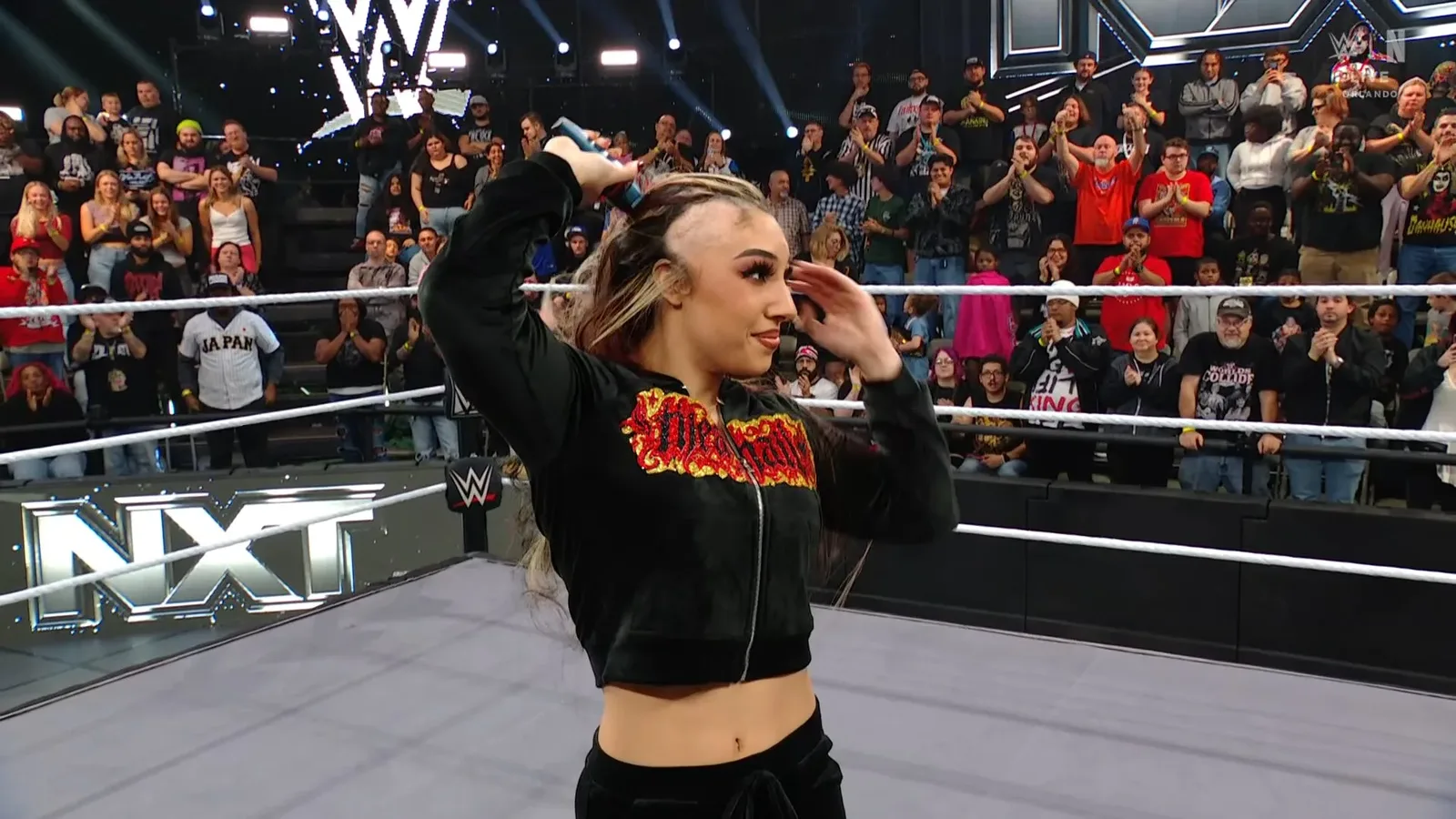
Thea Hail delivered one of the most personal and emotionally direct moments of her WWE NXT career on the November 24, 2026 episode when she shaved her head in the ring after speaking candidly about living with alopecia areata.
Hail had previously revealed during the summer of 2026 that she has alopecia areata, an autoimmune condition associated with hair loss. Rather than keeping that reality separate from her WWE presentation, Hail has allowed the subject to become part of her NXT story. On this occasion, the issue reached a major turning point as Hail addressed both the condition itself and the pressure of trying to meet someone else’s standard of appearance.
The segment followed ongoing tension between Hail and Chantel Monroe. Monroe has repeatedly targeted Hail over her alopecia during their storyline, turning a real-life condition into a point of emotional conflict on NXT television. On November 24, Hail made clear that she had reached her limit with those attacks.
A Personal Message From Thea Hail
In the ring, Hail spoke about the difficulty of her situation and acknowledged that she had not been optimistic about the condition. The openness of the moment was central to its impact. Rather than presenting a simple response to an antagonist, Hail addressed the insecurity and uncertainty that can accompany visible changes to a person’s appearance.
For more background on this topic, read Mason Rook Earns NXT Title Match Against Grayson Waller at TLC.
Hail’s message extended beyond her immediate dispute with Monroe. She emphasized that nobody should have to live according to another person’s idea of perfection. That theme gave the segment a wider meaning, particularly in an industry built around presentation, confidence, athletic image, and constant public scrutiny.
Professional wrestling frequently asks performers to communicate through heightened conflict, but moments drawn from genuine personal experiences can land differently. Hail’s decision to discuss alopecia areata in front of the NXT audience gave her story a level of vulnerability that went well beyond a standard rivalry. Her words framed the issue as one of individual worth, not simply appearance.
Hail’s central message was that no one should be forced to measure themselves against somebody else’s definition of perfection.
That point resonated with the visual decision that followed. Hail proceeded to shave her head in the ring, creating a striking image and taking control of the subject that Monroe had used against her. The act was not presented as Monroe deciding Hail’s appearance for her. It was Hail making her own choice publicly after refusing to let another person define how she should feel about herself.
The Story With Chantel Monroe Reaches a Defining Moment
The conflict with Monroe has been built around Monroe’s remarks about Hail’s condition. Those comments gave the rivalry a deeply personal edge, with Hail positioned against someone seeking to exploit a vulnerable area of her life. The November 24 segment changed the dynamic by placing Hail in control of the conversation.
Instead of allowing Monroe’s insults to remain the focus, Hail redirected the story toward self-acceptance and agency. That distinction matters. A wrestling feud can use personal material to generate heat, but the emotional center of this segment was Hail’s response and her ability to speak for herself. Her decision to shave her head underscored that she would not allow an opponent’s cruelty to dictate the terms of her identity.
It also gives the Hail-Monroe rivalry a new level of stakes heading forward. Their issue is no longer limited to verbal barbs or a conventional clash of personalities. Hail has made the conflict about respect, dignity, and the right to exist without being judged against an artificial standard. That kind of motivation can be especially powerful in NXT, where wrestlers often establish the defining traits and emotional foundations of their television personas.
For Monroe, the segment leaves a significant question: how will she respond after Hail refused to be diminished by her attacks? For Hail, the moment may represent a major evolution in her NXT character. She has long been capable of delivering high-energy reactions and competing with intensity, but this segment displayed a different kind of resolve. It was quieter in its message than a typical wrestling confrontation, yet forceful in its conclusion.
Understanding the Significance of Alopecia Areata
Alopecia areata is an autoimmune condition that can cause hair loss. While every person’s experience with the condition can differ, it can carry emotional challenges because hair is often closely connected to self-image and the way people believe they are perceived by others. Hail’s willingness to discuss her own experience on WWE NXT placed an issue that many people face into a major televised setting.
Hail did not suggest that her feelings about the condition had been simple or easily resolved. By admitting that she had not been optimistic, she added honesty to a moment that could have otherwise been reduced to a dramatic visual. The head-shaving itself was memorable, but it was her acknowledgement of the emotional difficulty that gave the scene its weight.
There is a meaningful difference between presenting confidence as something that appears instantly and showing it as a decision made in the face of fear, anger, or uncertainty. Hail’s segment leaned into the latter. She did not erase the reality of the condition or pretend that harmful comments do not matter. Instead, she used the moment to reject the notion that her value depends on whether she matches an external image of perfection.
That message is especially notable within WWE, where the physical aspects of presentation are inevitably visible. Wrestlers are athletes, entertainers, and television personalities, and audiences see them at moments of triumph, defeat, celebration, and vulnerability. By bringing alopecia areata into her story, Hail has allowed fans to see a more personal dimension of the person behind the NXT character.
A Major Image and a Potential Turning Point
The image of Hail shaving her head is likely to remain associated with the November 24 edition of NXT because it was a decisive statement made on her own terms. Wrestling is full of transformations, whether they come through a new look, a new attitude, a betrayal, or a hard-fought victory. Hail’s transformation carried a different kind of significance because it was tied directly to an experience she had already shared publicly.
It was also an example of a performer taking a personal reality and turning it into a message that can reach beyond the immediate storyline. Fans may view Hail’s decision through the lens of her rivalry with Monroe, but the segment’s broader point was not dependent on winning an argument or securing revenge. It was about rejecting the pressure to fit another person’s expectations.
For Hail, that can become a defining piece of her NXT identity moving forward. The segment showed determination without requiring a match result, a title announcement, or a surprise angle. It established that her conflict with Monroe has real emotional stakes while also making room for Hail to connect with viewers who understand the difficulty of being judged by appearance.
The road ahead for Hail and Monroe remains to be seen, but the November 24 episode ensured that their program now carries greater emotional importance. Monroe’s treatment of Hail’s alopecia helped ignite the confrontation, yet Hail’s response ultimately belonged to her. She used a painful subject to deliver a message of self-determination and to make a bold decision in front of the NXT audience.
Hail’s candid remarks and head-shaving moment made clear that the segment was about more than an opponent’s insult. It was a declaration that perfection is not something anyone else gets to define. In an environment where image can often feel inseparable from success, Thea Hail used WWE NXT to assert that confidence can mean taking ownership of one’s story exactly as it is.

Darryl Polo
Darryl Polo is a passionate wrestling fan covering WWE, AEW, TNA and beyond. He loves great rivalries, breakout stars and the moments that keep fans talking long after the bell. How we work.