
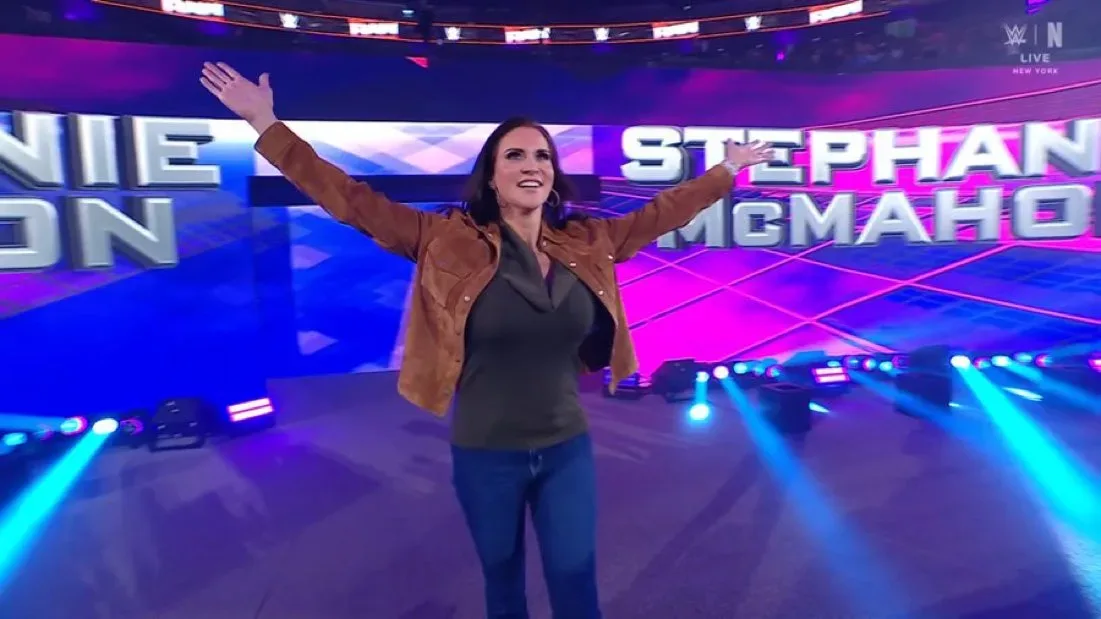
Stephanie McMahon has reflected on one of the more unusual responsibilities she took on while learning the WWE business alongside her father, Vince McMahon: helping write promos designed to take playful shots at the United Kingdom.
During a conversation with Grayson Waller on What’s Your Story, the subject turned to WWE’s long-running relationship with UK audiences and the continuing discussion around the possibility of WrestleMania eventually being held in the country. Waller, an Australian performer who has regularly embraced antagonistic comments about the UK as part of his on-screen persona, joked that nobody wants WrestleMania “in the rain.”
That comment prompted Stephanie McMahon to recall her early years shadowing Vince McMahon and getting an up-close education in how WWE promos were built. She said that working on material aimed at the host country’s fans was particularly enjoyable because of the reaction it could create in the building.
“I remember when I first started, I was shadowing my dad. I would get to work on his promos. I remember being in the UK and getting to work on some of his promos that were along those lines. It was so fun. It’s always so much more fun to do that.”
For more background on this topic, read Paul Heyman Salutes Christian Watson’s Ambulance Return, Recalls Sting’s 1991 WCW Moment.
The recollection offers a look at the creative process Stephanie McMahon experienced while developing her own understanding of WWE presentation. Before becoming one of the company’s most recognizable executives and on-screen personalities, she spent time learning directly from Vince McMahon, whose approach to promotional material often placed a premium on generating an immediate and emotional response from a live crowd.
For WWE, international appearances have long presented a distinct opportunity. The company is arriving in a market where the audience is excited to see major stars and programming that may not be available to them as often as it is in the United States. That enthusiasm can make a crowd especially vocal, and wrestlers or authority figures can use local references to sharpen their material quickly. A pointed remark about a city, a sports team, the weather, or a national stereotype can produce a loud reaction within seconds.
The UK, in particular, has become one of WWE’s most reliable international markets. British fans have developed a reputation for sustained chants, direct interactions with performers, and an appetite for being part of the show rather than simply observing it. The result is an environment where performers can often be more playful and more confrontational in equal measure.
A Crowd Dynamic Built Around Participation
Waller suggested during the discussion that UK fans enjoy being the target of those remarks because they understand the exchange. Stephanie McMahon agreed with that assessment. In wrestling, the strongest crowd reactions are not always based on genuine hostility. A crowd may boo a performer loudly because it is enjoying the role it has been given in the segment. The audience knows it is being challenged and responds with enough volume to ensure the performer knows the message landed.
That dynamic is especially useful in WWE, where promos are designed to establish characters, advance rivalries, and give live audiences a reason to emotionally choose a side. A villain mocking a local audience can create instant resistance. A heroic figure defending the city or country can then receive an equally immediate endorsement. Even when the insults are lighthearted, they can make the crowd feel directly involved in what is happening.
Stephanie McMahon’s comments also underline why WWE has frequently incorporated regional material into its international presentations. The aim is not necessarily to create a serious dispute with a market. Instead, it is to recognize the crowd in a way that makes that specific event feel unique. Fans attending a show want to believe the stars are reacting to the place they are in, not simply repeating the same script they would deliver anywhere else.
That approach can be especially effective for a personality such as Waller. His presentation has often leaned into arrogance, provocation, and a willingness to say the thing that will draw the loudest negative response. As an Australian, he has another built-in element available when addressing a UK crowd, with the sporting and cultural rivalry between Australia and the United Kingdom offering familiar ground for competitive banter.
Stephanie McMahon’s Early Education In WWE
Stephanie McMahon did not frame the memory as a major creative revelation or detail the specific promos she helped shape. However, her description of shadowing Vince McMahon provides a concise reminder of how closely she was exposed to WWE’s internal creative process early in her career. The company’s television product has always required a combination of long-term storytelling, character voice, live-event awareness, and adaptability to a crowd’s response.
Promo writing is a particularly important part of that process. A promo must communicate the central issue of a storyline while still sounding natural for the person delivering it. It must also account for the setting. Material that works in one city may need to be adjusted elsewhere, particularly when WWE is presenting a major show outside its usual domestic touring schedule.
Vince McMahon was central to WWE creative for decades, both as a promoter and as an on-screen character. His promos frequently relied on broad, direct messaging and a willingness to provoke audiences. Stephanie McMahon’s account indicates that, while shadowing him, she was given the chance to participate in preparing that type of material during UK events.
Her observation that it was “always so much more fun” to work on promos of that nature speaks to the appeal of crowd-specific writing. There is an element of risk involved: an audience can reject a joke, ignore it, or respond in a way that changes the intended tone. But when it succeeds, the reaction can be immediate and memorable. In wrestling, that instant connection is often what turns an ordinary promo into a segment that feels alive.
The WrestleMania Conversation Continues
The exchange came against the backdrop of ongoing interest in bringing WrestleMania to the United Kingdom. WWE has made numerous trips to the country over the years, and its British audience has consistently demonstrated the scale of its support for the company. A WrestleMania in the UK remains a subject that continues to draw discussion among fans, performers, and prominent WWE figures.
John Cena has continued to advocate for WrestleMania being held in the UK. That support has added another notable voice to a conversation already driven by the country’s passionate fan base and WWE’s history of successful events there.
Waller’s weather-based joke may have been intentionally provocative, but it also reflects the familiar tone surrounding the debate. UK fans are accustomed to being vocal about their desire to host one of wrestling’s biggest events, while performers have ample opportunity to playfully challenge that enthusiasm. The reaction itself is part of the appeal. Whether fans are cheering the prospect of a WrestleMania announcement or booing someone taking a shot at the country, WWE benefits from an audience invested enough to make noise.
Stephanie McMahon’s memory places that current conversation in a wider historical context. WWE’s connection with the UK has not only been built through live events and television, but also through the small, location-specific moments that make an audience feel seen. A pointed promo can be an easy way to draw heat, but it can also be a sign of respect for the audience’s willingness to participate.
For McMahon, the experience was also part of her formative education in WWE. For Waller, it remains a useful way to engage an audience that is ready to answer back. And for UK fans, the fact that they can be teased so directly is evidence of how important their response has become whenever WWE comes to the country.

Darryl Polo
Darryl Polo is a passionate wrestling fan covering WWE, AEW, TNA and beyond. He loves great rivalries, breakout stars and the moments that keep fans talking long after the bell. How we work.