
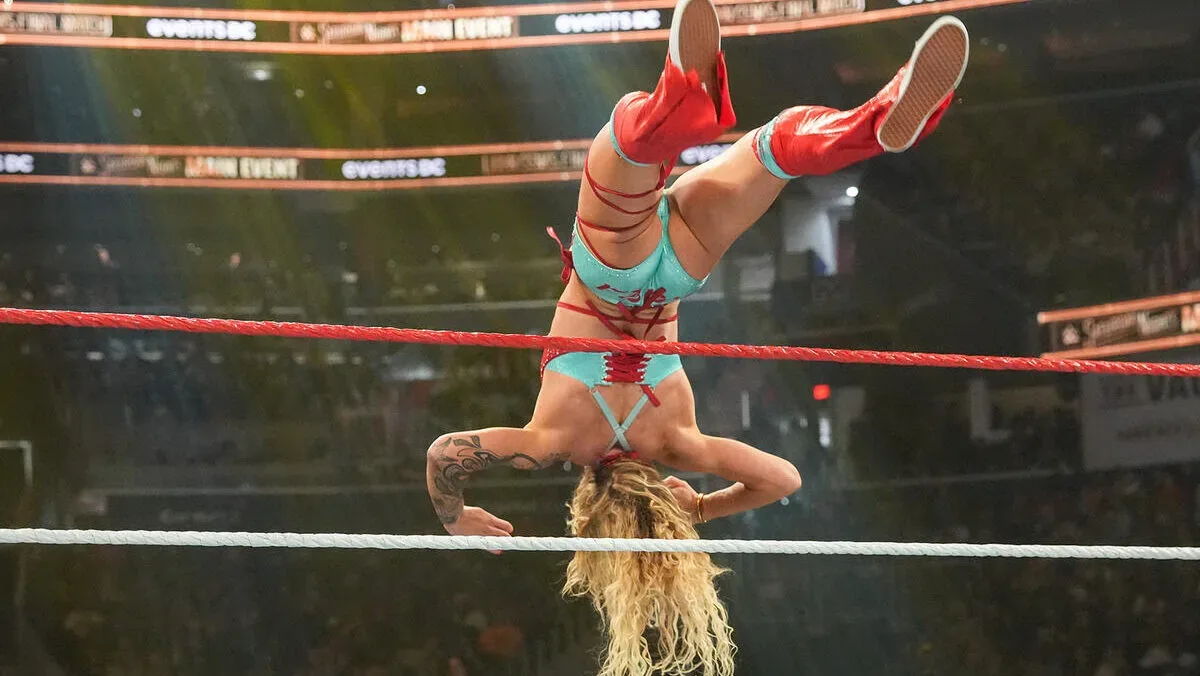
Sol Ruca has built her WWE reputation around athleticism that can change the temperature of a match in an instant. Her offense is filled with explosive movements, inventive attacks and the kind of highlight-reel risks that demand both confidence and precision. But as impressive as those moments can look from the outside, Ruca says one of her signature dives remains frightening every single time she attempts it.
During an appearance on Notsam Wrestling Live!, Ruca discussed the Sasuke Special, the dramatic dive in which a wrestler launches over the top rope and through the ropes to the floor. It is a move associated with speed, timing and a narrow margin for error. For Ruca, it produces a mixture of anxiety before the leap and excitement when it comes off cleanly.
“The Sasuke Special for example is absolutely terrifying to me,” Ruca said. “Every time I do it, I’m like, ‘Why am I doing this?’ But when I nail it, I’m like, ‘Hell yeah. That was so sick.’”
The admission offers a revealing look at the thought process behind high-risk wrestling. Fans often see only the finished moment: the launch, the impact and the reaction from the crowd. Ruca’s description makes clear that the physical execution is accompanied by a mental battle, particularly after a performer has experienced a frightening near-miss.
For more background on this topic, read Bron Breakker Names IShowSpeed As Hardest WWE Hit He Has Delivered.
Ruca recalled clipping the ropes with her feet while attempting the move. While she had initially performed the Sasuke Special cleanly on several occasions, the first time she caught her feet created a moment she did not forget.
“I have hit my feet on the ropes before and I remember the first few times I did it, I did it very clean and then the first time I hit my feet on the ropes, I was like, oh my God, that was absolutely terrifying,” Ruca said.
That kind of experience can understandably affect a wrestler’s approach to a move. A dive over and through the ropes requires the performer to commit fully while accounting for rope position, body rotation, distance to the floor and the placement of the opponent or opponents waiting to receive them. Even a small adjustment in timing can alter the result. Ruca did not portray that danger as something she simply ignores. Instead, she described working through the nerves by continuing to practice and perform the maneuver.
“But then I just had to keep doing it because the more reps I do, the more consistent I’m gonna be and things happen,” Ruca said. “We are doing live performances and that’s just part of what we do.”
That perspective is central to the reality of professional wrestling, where matches take place in real time and physical risks cannot be reset after a mistake. The wrestlers can prepare, train and develop chemistry, but they also have to adapt to the unpredictable elements that come with performing live in front of an audience. Ruca’s comments frame repetition as a way to build confidence rather than a guarantee that a move will never go wrong.
Confidence and caution can exist together
Ruca explained that she can hold two different mindsets at once when approaching difficult situations. One side of that mindset is focused on accepting setbacks and learning from them. The other is shaped by knowing that something has gone wrong before, which can make returning to the same move more intimidating.
“I feel like I have both of those sides in my head sometimes,” Ruca said. “I have one mentality that’s like, okay, well, that’s the worst that could happen and I can learn and grow from that and lightning doesn’t strike twice.”
She then acknowledged that prior mistakes remain in a wrestler’s memory, especially when the move in question is as physically demanding as a Sasuke Special. Still, the reward of successfully completing it can overcome those doubts.
“But then, also, knowing that that’s happened before when I do it and I’m a little bit more nervous for it but then I nail it, I’m like, ‘Hell yeah,’” Ruca said. “That feeling, I get chills every time.”
The contrast in those comments is notable. Ruca is not presenting fear as the opposite of confidence. In her view, fear can be present before the move while confidence is built by following through, landing safely and proving to herself that she can execute it again. That balance is part of what makes a high-flying style so compelling: the audience recognizes the risk, and the performer has to confront it directly.
The Sasuke Special has long been one of wrestling’s most visually striking dives because it combines the height of a top-rope-style aerial attack with the added challenge of navigating the ring ropes. When done correctly, it creates a spectacular image and can dramatically shift a match’s momentum. When the timing is slightly off, the ropes themselves become an immediate obstacle.
Ruca’s willingness to speak candidly about the move gives additional context to the moments when she chooses to use it. The dive is not simply an automatic part of her offense. It carries a conscious decision to embrace a risk she knows can be difficult, even after she has experienced a scare attempting it.
Ruca sees mistakes as part of the live process
While wrestling mistakes can become memorable for performers and viewers alike, Ruca believes they can also reveal something genuine about the people in the ring. Her focus is not on pretending errors never happen. It is on how a wrestler responds once they do.
“In my opinion, it makes us a little bit more human seeing that we make mistakes but it’s how we overcome them and how we move forward and continue the match,” Ruca said.
That sentiment speaks to the resilience required in a live match. Wrestling is athletic performance, but it is also a form of storytelling that continues even when an intended moment does not unfold perfectly. Competitors have to remain aware of one another, stay engaged with the crowd and keep the match moving. Ruca’s comments underline the importance of responding to adversity rather than allowing a mistake to define the remainder of a performance.
For a wrestler whose in-ring identity is tied to dynamic movement, that mentality carries added importance. The more ambitious the move, the more preparation and trust it requires. Ruca’s approach is to recognize the danger, take the lesson from a difficult attempt and continue accumulating the repetitions needed to make the move more consistent.
It also helps explain the emotional reaction that follows a successful landing. The crowd may see a thrilling dive. Ruca experiences the release that comes from confronting apprehension, committing to the maneuver and hearing the result land the way she intended.
Coming off Money in the Bank competition
Ruca’s comments come after she competed in the 2026 Women’s Money in the Bank Ladder Match. Tiffany Stratton won that match, claiming the Money in the Bank contract in a setting built around risk, athleticism and split-second decision-making.
Ladder matches place a different kind of demand on every competitor involved, but they also emphasize the same willingness to embrace uncertainty that Ruca discussed in relation to the Sasuke Special. The match format rewards timing and boldness while leaving little room for hesitation. Ruca entering that environment is consistent with a performer who has made daring offense an important part of her presentation.
Whether she is competing in a multi-person ladder match or setting up a dive to the floor, Ruca’s explanation remains straightforward: the fear does not necessarily disappear. The goal is to keep working, improve the consistency and continue the match when things do not go exactly as planned.
For Ruca, the Sasuke Special remains terrifying. It also remains worth doing when the execution is right.

Darryl Polo
Darryl Polo is a passionate wrestling fan covering WWE, AEW, TNA and beyond. He loves great rivalries, breakout stars and the moments that keep fans talking long after the bell. How we work.