
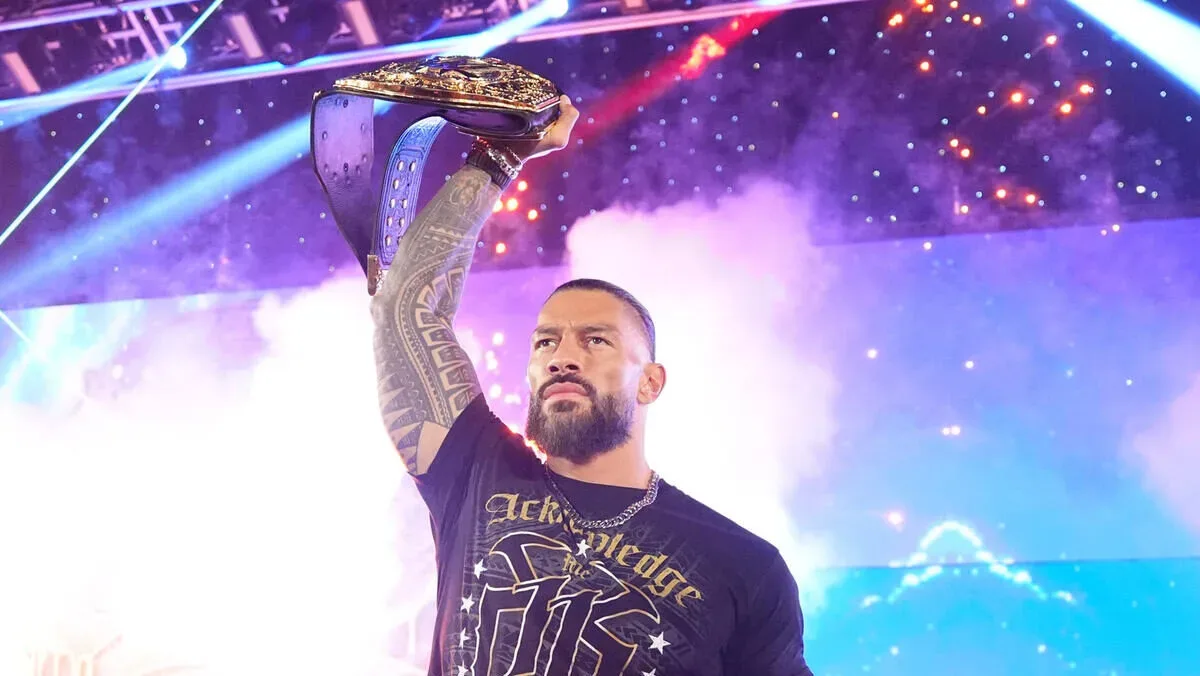
Roman Reigns says video games have become a major part of life in WWE locker rooms, offering modern wrestlers a more positive way to occupy their free time while traveling from city to city.
Speaking during a red-carpet interview connected to Street Fighter, Reigns was asked about gaming culture among WWE talent. While the former Undisputed WWE Champion was modest about his own current skill level, he made clear that gaming has become a significant social activity for the roster.
“I’m not very good at it nowadays. But yes, that has been a positive replacement for some of the other extracurricular activities wrestlers would do. The video games have definitely allowed the guys to stay in and not go and explore the towns too much. But yeah, it’s a huge thing in our locker room for sure.”
The comment offers a straightforward look at how the lifestyle of a touring wrestler has evolved. WWE performers still work an unusually demanding schedule, one that can involve constant travel, hotel stays, long arena days, media obligations, training, and the physical toll of competing in the ring. For generations, wrestlers found countless ways to fill the hours between appearances. Reigns’ point is that gaming has increasingly become one of the healthier and more controlled alternatives available to talent away from the building.
For more background on this topic, read Joe Hendry Won’t Choose Between a WWE World Title and Logan Paul’s Firing.
Gaming Has Become Part of Modern Wrestling Culture
Video games are hardly a new pastime in professional wrestling, but their visibility has grown substantially in the current era. Many performers openly discuss the games they play, interact with fellow wrestlers online, or bring their gaming interests into their public personas. Streaming has also created another avenue for talent to connect with fans outside the usual WWE programming environment.
That shift reflects a wider change in entertainment and sports culture. Gaming is no longer viewed as a niche hobby limited to private downtime. It is a mainstream social space, a competitive outlet, and for some performers, an extension of their creative identity. Within a traveling locker room, it can also provide an easy way for people with different backgrounds and experience levels to spend time together.
Reigns framed the trend less as a matter of competition and more as a benefit of routine. Wrestlers often find themselves in unfamiliar cities with only a limited amount of personal time before the next flight, drive, or call time. Staying in a hotel, playing games, and spending time with colleagues can be a simple way to decompress without adding unnecessary strain to an already demanding life.
His observation that gaming keeps people from “explor[ing] the towns too much” carries an important subtext. The wrestling business has long had a reputation for an intense road culture. With performers frequently away from home, nightlife and other distractions were historically common parts of the lifestyle for many talents. Reigns did not identify particular past activities or individuals, but he suggested that video games can help replace some of those choices with something more constructive.
A Different Version of the Road Life
The road remains central to WWE, even as technology has made it easier for performers to remain connected to family, friends, and entertainment from nearly anywhere. Phones, online gaming services, streaming platforms, video calls, and social media have all changed how talent handle travel. Gaming, in particular, provides both an individual escape and a group activity.
For a wrestler, that can matter after the physical and emotional intensity of a show. Matches require athletic preparation, coordination with opponents, awareness of production needs, and the pressure of performing in front of a live crowd and television audience. After that environment, an activity that is familiar, low-risk, and easily shared can offer a clear separation from the demands of the job.
It can also build camaraderie. A locker room is made up of performers at different stages of their careers, from established headliners to newer talent still learning the pace and expectations of WWE. Common interests can create bonds that are separate from storylines, rivalries, and professional hierarchy. Reigns’ comments indicate that gaming is one of the interests that has become especially prevalent among the current generation.
There is also a practical component. Wrestlers are often responsible for managing their bodies outside of ring time. Recovery, sleep, nutrition, travel, and preparation all carry added value in a profession built around physical performance. A quieter night in can be more compatible with that responsibility than a late night out, particularly during a busy run of events.
Reigns Balances a Major WWE Return With Everyday Locker Room Perspective
Reigns’ remarks arrive as he is scheduled to return to Monday Night RAW on next week’s episode. His presence remains one of the most consequential elements in WWE, given his status as one of the company’s defining stars and a central figure in its biggest stories of recent years.
That makes the relaxed nature of his gaming comments notable. Reigns is frequently discussed in the context of championship-level stakes, major rivalries, headline matches, and the continuing influence of The Bloodline. Yet his answer focused on a much more everyday aspect of the wrestling environment: how talent pass the time when the cameras are off.
The contrast also highlights why locker-room culture matters. WWE’s on-screen presentation is built around conflict, but the performers behind those characters are colleagues navigating the same travel, training, and time-management challenges. Shared activities such as gaming can offer a sense of normalcy in a profession where the schedule is anything but normal.
Reigns did not present himself as one of the locker room’s elite gamers. Instead, his response was broad and appreciative of the role games play for others. That distinction reinforces the larger point: the importance is not necessarily who is best at a particular game. It is that gaming has become a readily available outlet for WWE talent as a whole.
Why the Change Matters
Professional wrestling has always adapted alongside the culture surrounding it. The way performers train, travel, promote themselves, communicate with fans, and spend their personal time has changed considerably across different eras. The current generation operates in a more connected world, where entertainment can be accessed from a hotel room, a bus, an airport lounge, or nearly any other stop on the schedule.
Reigns’ comments do not suggest that video games solve every challenge associated with the wrestling lifestyle. The demands of travel and in-ring performance remain substantial, and every wrestler has different interests and routines. But he did identify gaming as a meaningful positive development in the modern locker room.
For WWE talent, games can provide a competitive release without the physical consequences of another athletic activity. They can create shared experiences between coworkers. They can help make a hotel room feel less isolated. And, as Reigns noted, they can encourage wrestlers to remain in rather than seek out potentially less productive forms of entertainment while on the road.
As WWE continues to feature a roster shaped by a newer generation of performers and changing fan expectations, gaming is likely to remain visible both inside and outside the locker room. Reigns’ assessment is simple: it is already a “huge thing” among the talent, and he sees its influence as a welcome one.
With Reigns now set for his next appearance on Monday Night RAW, attention will quickly return to his on-screen future. Still, his comments provide a small but revealing snapshot of the environment surrounding WWE’s biggest stars when the ring gear is packed away and the next show is still ahead.

Darryl Polo
Darryl Polo is a passionate wrestling fan covering WWE, AEW, TNA and beyond. He loves great rivalries, breakout stars and the moments that keep fans talking long after the bell. How we work.