
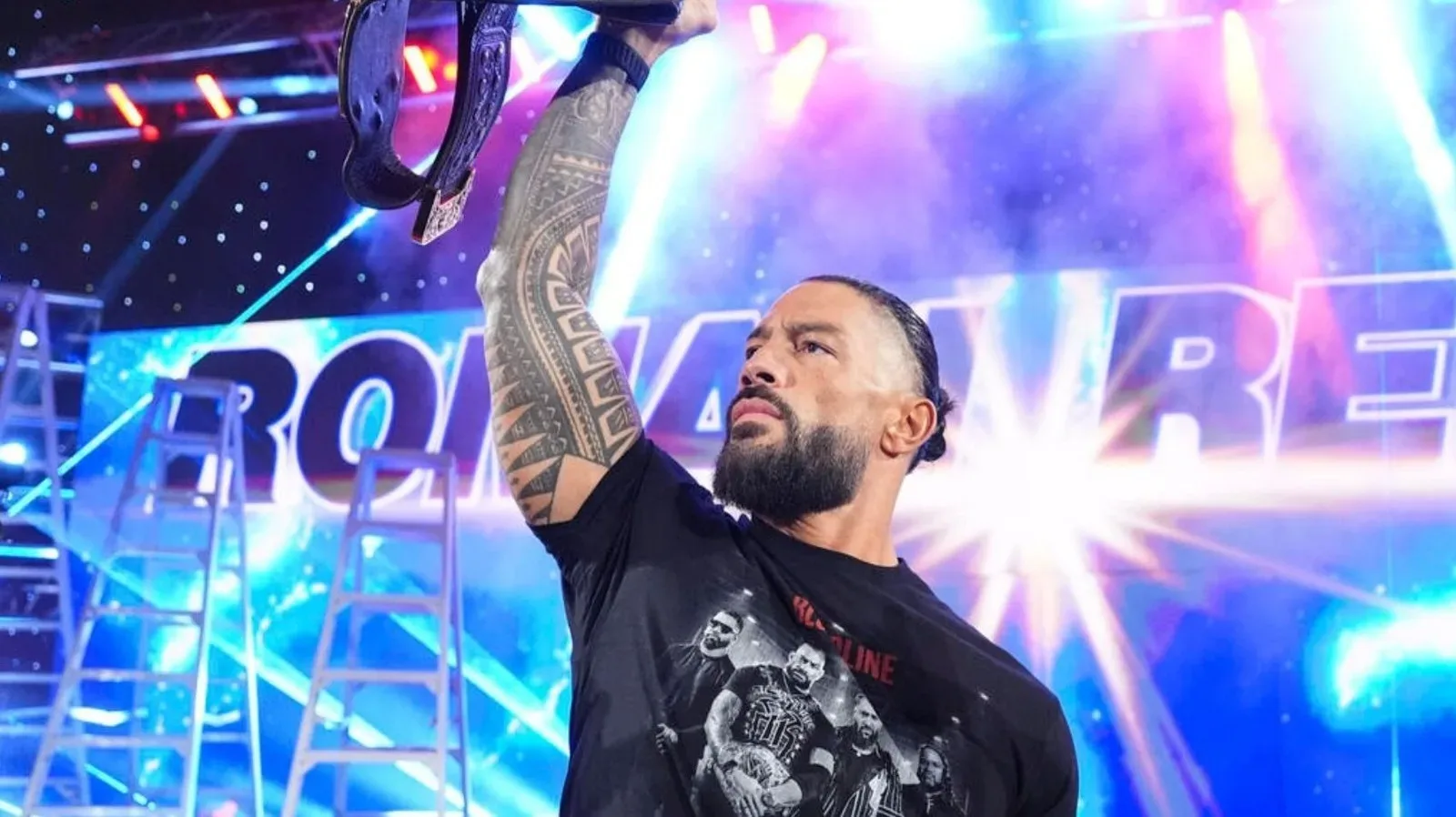
Roman Reigns has spent more than a decade and a half learning what turns a WWE performer from a talented athlete into a true attraction. The current World Heavyweight Champion has held championships, headlined WrestleManias, evolved through radically different character presentations and become one of the defining figures of his era. That experience has given Reigns a clear perspective on one lesson he believes younger WWE talent must understand: audiences need memorable signature moments they can anticipate and recognize immediately.
Speaking on THE MORNING SHIFT while promoting the upcoming Street Fighter film, Reigns connected the fundamentals of wrestling presentation with the challenge of bringing famous fighting-game characters to life. For Reigns, the same principle applies in both settings. A performer has to identify the elements fans most want to see, then make those elements a dependable part of the experience.
“With WWE, your signature moves become a part of the show, and we preach that to the younger guys, like ‘Make sure you find out these signatures and make them a part of our program, so people want to see them,’” Reigns said on THE MORNING SHIFT. “I think that’s what’s happening in real time for us for Street Fighter. We’re able to depict that and illustrate that and that’s what people are going to want to see.”
Why signature moments matter in WWE
The advice speaks to a foundational part of WWE’s presentation. In-ring ability remains vital, but the biggest stars often have instantly identifiable pieces of their act that give a crowd an active role in the performance. It can be a finishing move, a taunt, a gesture, a catchphrase, an entrance beat or a sequence that signals the climax of a match is approaching.
For more background on this topic, read Chelsea Green vs. Roxanne Perez Set for WWE Women’s Championship on October 23 SmackDown.
Those moments create anticipation. Fans know what they want to see, wrestlers know when to build toward it, and the eventual payoff can turn into the loudest reaction of the night. The result is more than a move being executed cleanly. It becomes a familiar ritual between the performer and the audience.
Reigns has experienced that process at several stages of his career. Early on, he developed a powerhouse identity that emphasized explosive offense and physical presence. As his character changed, especially during his rise as “The Tribal Chief” and later as the “OTC,” the presentation expanded far beyond individual moves. His entrance, his measured pace, his facial expressions, his verbal confrontations and the audience response to every major gesture all became part of the overall Reigns experience.
That is the distinction at the heart of his message. A signature does not simply need to look impressive. It needs to feel like something the fans are waiting for. The more clearly a wrestler establishes that association, the easier it becomes for a match to generate drama and for a character to develop a lasting identity.
From FCW prospect to WWE standard-bearer
Reigns is well-positioned to offer that kind of guidance. He signed with WWE in 2010 and reported to Florida Championship Wrestling, beginning a journey that has now spanned 16 years inside WWE rings. His career has included four reigns with the Undisputed WWE Championship, a lengthy run at the top of the company, and a sustained position as one of WWE’s most heavily featured main-event stars.
The path was not simply a straight line from developmental to superstardom. Reigns has navigated changing creative directions, the intense scrutiny that follows a top-card position, faction success with The Shield, and the personal adversity that has shaped how many fans view his story. The evolution into “The Tribal Chief” became the defining reinvention of his career, allowing Reigns to pair his physical credibility with a more controlled, authoritative and layered character.
That history matters when Reigns talks about younger stars discovering their signatures. WWE performers are often tasked with finding what makes them distinct in a deep roster filled with elite athletes. A move alone will not establish a career, but a consistent signature can be a useful building block. It gives audiences a shortcut to understanding a wrestler’s style and personality while offering the performer a reliable way to build a match.
For established stars, those signatures become inseparable from their legacy. For newer names, they can provide a key early opportunity to establish familiarity. Reigns’ point is that talent should be intentional about identifying those traits rather than assuming they will emerge on their own.
Reigns brings that perspective to Street Fighter
The comparison to Street Fighter is a natural one. The franchise is built around recognizable characters and instantly familiar visual and physical cues. Fans of the games do not just know the roster by name; they associate individual fighters with specific techniques, poses, rivalries and styles. Translating that material into a film requires the cast and creative team to capture the qualities that made those characters resonate in the first place.
Reigns suggested that the cast is working through that same dynamic in real time. In professional wrestling, the signature is cultivated over repeated appearances, with crowd reactions helping determine which moments gain the greatest importance. A film has a different format and a different set of expectations, but the goal of satisfying an audience’s desire to see defining character traits remains familiar.
That crossover also reflects the broader nature of Reigns’ current profile. His WWE success has made him one of the promotion’s most recognizable crossover figures, and Street Fighter gives him a major opportunity to apply the performance skills he has sharpened in front of live crowds to a new medium. Wrestling demands physicality, timing and character clarity, all of which can be valuable when portraying material that relies heavily on iconic personalities.
Reigns’ comments indicate that he understands the responsibility that comes with adapting a property whose fan base has its own expectations. Just as WWE fans expect a wrestler’s signature moment at the right time, Street Fighter fans will be looking for visual and character touchstones that make the adaptation feel connected to the franchise they know.
A successful 2026 continues for the World Heavyweight Champion
The movie promotion comes during what has already been a major year for Reigns in WWE. He won the 2026 Royal Rumble, earning a route to the biggest stage on the calendar. At WrestleMania 42, Reigns defeated CM Punk to capture the World Heavyweight Championship.
Since winning the title, Reigns has successfully defended against a wide range of challengers: Jacob Fatu, LA Knight, Penta and his former Shield stablemate Seth Rollins at SummerSlam. The list reflects the varied demands of a modern WWE championship reign. Fatu brings intensity and family history into any confrontation with Reigns. LA Knight’s crowd connection makes him a distinct kind of challenger. Penta presents an unpredictable in-ring threat, while Rollins carries the deep history of their time together in The Shield and their many years as rivals.
Each defense also reinforces the value of the advice Reigns described. Champions are not only evaluated by victories and losses; they are judged by whether they can make title matches feel significant. Reigns has repeatedly built his biggest bouts around recognizable aspects of his presentation, turning familiar character beats and major sequences into moments viewers expect to see.
That does not mean every wrestler should imitate Reigns’ exact approach. His advice is broader than one particular move set or persona. The task for younger talent is to find the details that feel authentic to them, then develop those details until audiences recognize their importance. A high-flying wrestler, a technical specialist, a powerhouse or a character-driven entertainer can all create signatures, but those signatures have to fit the person using them.
The long-term lesson for WWE talent
For emerging WWE names, Reigns’ message is ultimately about building an identity that fans can invest in over time. Spectacular athleticism can draw immediate attention, but recognizable signatures help transform attention into attachment. When fans know what to chant for, what to react to and what they hope will happen before a match ends, the performer has established a stronger relationship with the crowd.
Reigns has reached a stage where that relationship is evident every time he appears. His presence alone carries meaning because he has spent years creating and refining the elements of his act. As World Heavyweight Champion, he remains in a position to demonstrate those lessons at the highest level while also passing them to WWE’s next generation.
With Street Fighter on the horizon, Reigns is applying the same philosophy beyond the ring. Whether the setting is a WWE main event or a major film adaptation, his view is straightforward: identify the moments people came to see, make them matter, and give the audience a reason to want them again.
In pictures

Darryl Polo
Darryl Polo is a passionate wrestling fan covering WWE, AEW, TNA and beyond. He loves great rivalries, breakout stars and the moments that keep fans talking long after the bell. How we work.