
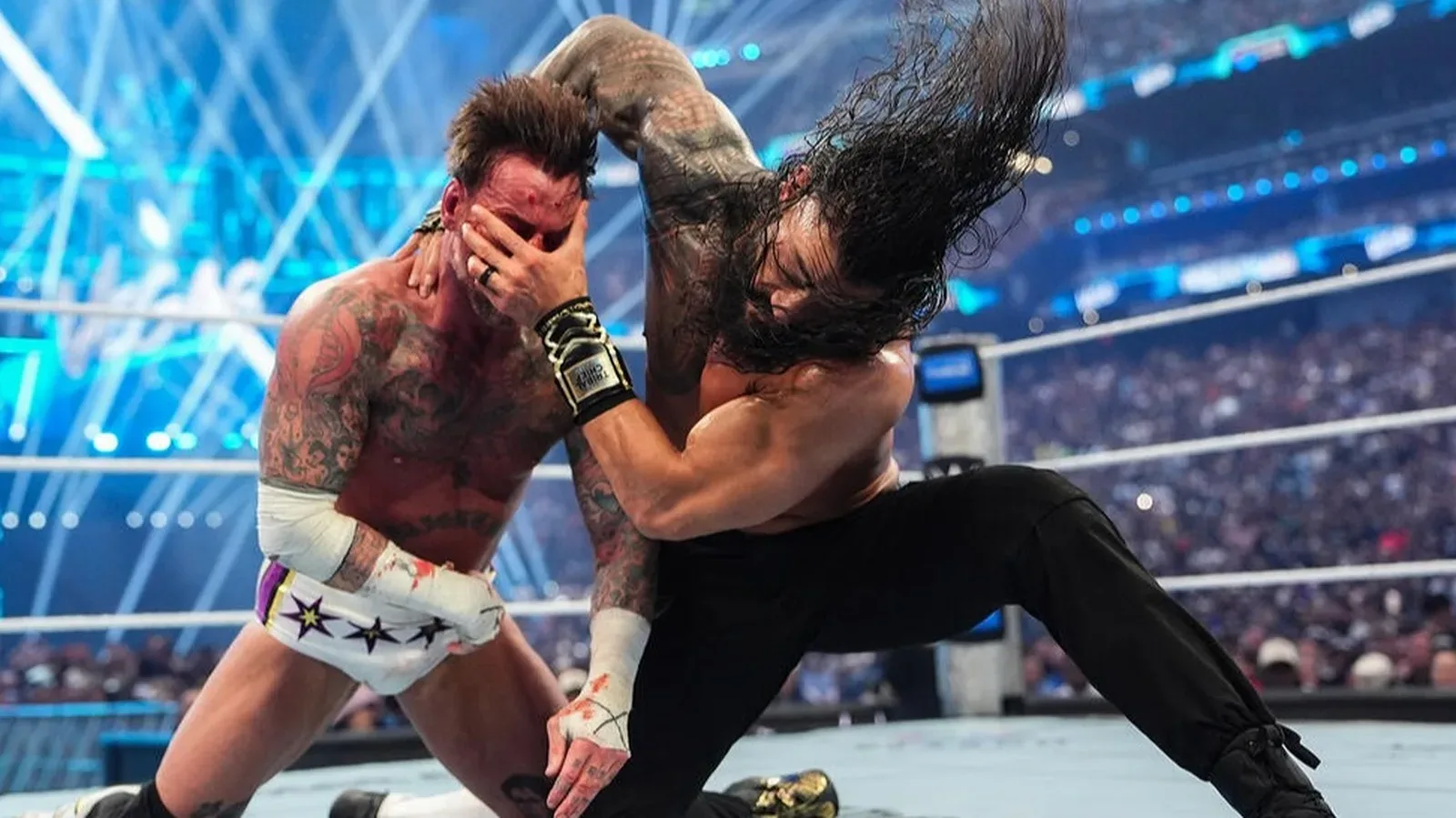
Roman Reigns has spent much of his WWE career presenting himself as an imposing, controlled force, a performer whose presence often speaks before he ever needs to raise his voice. That quality has also made him a natural fit for Akuma, the fearsome Street Fighter character Reigns will portray in the upcoming live-action film.
With Street Fighter set to arrive in theaters on Friday, October 16, Reigns has offered a closer look at the work behind the transformation. The WWE World Heavyweight Champion explained that Akuma’s powerful build allowed him to maintain elements of his established training routine, but the role also demanded an entirely different kind of physical preparation once martial arts movement entered the picture.
Speaking with Men’s Health, Reigns said Akuma’s design provided a helpful foundation for him physically. The character is famously muscular and carries the intimidating presence of a veteran fighter, qualities that overlap with Reigns’ own presentation in WWE. Still, matching a character’s physique was only one part of the challenge.
“I got lucky because Akuma...his physique is kind of bodybuilder-esque. He’s a big brother, so he’s very muscular. That helped me out, to kind of stay in my regimen,” Reigns said.
For more background on this topic, read Story Of The Year Recall Recording Christian’s WWE Theme For $1,000.
For Reigns, the larger adjustment came from learning how to move in ways that served the character and the fight-oriented world of Street Fighter. Professional wrestling requires immense athleticism, timing and body awareness, but the demands of martial arts stances and controlled fight choreography brought new details into focus. Reigns described the lower-body strength, balance and precision that were necessary to make the movements believable on screen.
“But when you add in the martial arts, the fighting disciplines...you have to be able to have your legs in a sumo squat. But then, you can pop up on your toes and also hit a unique pose with your arms. There’s so much isometric work in that. There’s so much to that body control, almost like a ballerina type of work. And the footwork was pretty extensive.”
The description highlights an important distinction in Reigns’ preparation. Strength alone is not enough for a role such as Akuma. The character’s recognizable stance, posture and explosive fighting style require an actor to hold tension through the legs and core, shift quickly through different positions and maintain a specific visual identity. Reigns’ reference to isometric work underscores the physical control involved in sustaining difficult positions, while his comparison to ballet points to the precision needed beneath the character’s brute-force exterior.
That blend of power and discipline makes Akuma a particularly notable role for Reigns. The character is traditionally portrayed as a stoic and relentless combatant who seeks out formidable opponents. Reigns has built his WWE persona around similar traits, whether he has stood as “The Head of the Table,” “The OTC,” or as a champion demanding acknowledgement from everyone in his orbit. The overlap does not mean the two roles are identical, but it gives Reigns an understandable connection point when approaching the character.
Akuma’s appeal has long rested in that intensity. He is not simply a physically dominant fighter; he is defined by his pursuit of stronger competition and his willingness to push himself through combat. Reigns’ wrestling career has frequently revolved around high-pressure championship environments, where every challenger has represented a threat to his standing. The move into a major video-game adaptation gives him the opportunity to channel some familiar qualities through a different performance medium.
At the same time, Reigns’ comments make clear that the role offered more than a chance to play on his established aura. It exposed him to an appreciation for martial arts and the details that go into making disciplined movement appear natural. Wrestling fans are accustomed to seeing Reigns operate in long, dramatic championship matches, where pacing and storytelling are essential. His work as Akuma required another form of timing: the ability to execute specific positioning, footwork and physical expression for the camera.
A Major Week for the World Heavyweight Champion
Reigns’ film promotion arrives as he heads into another major WWE assignment. This Saturday at Money in the Bank in New Orleans, Reigns will defend the World Heavyweight Championship against LA Knight. The championship bout gives Reigns a chance to continue a title reign that began when he defeated CM Punk at WrestleMania 42.
The Money in the Bank defense will be Reigns’ fifth since winning the championship at WrestleMania. His most recent successful defense took place on the September 14 edition of WWE Raw, where he defeated Penta in Mexico, Penta’s home country. That match placed Reigns in a particularly charged atmosphere, with Penta challenging for one of WWE’s top prizes in front of a crowd expected to strongly support him.
Reigns emerged from that encounter still holding the title, and he now faces a very different challenge in LA Knight. Knight has established himself as one of WWE’s most vocal and popular competitors, carrying the confidence and momentum of a wrestler who believes he belongs at the top of the company. A championship match at Money in the Bank offers him a significant opportunity to turn that belief into his biggest career accomplishment.
For Reigns, the title defense will also be a test of focus during a period in which his profile is extending beyond WWE. Film commitments, promotional appearances and championship responsibilities can all demand attention, but Reigns’ public comments about his Akuma training suggest he has approached the acting role with the same seriousness he has brought to his in-ring work. The preparation was not limited to looking the part. It involved learning unfamiliar physical disciplines and adapting to a new performance environment.
From WWE Main Events to the Big Screen
Reigns’ casting as Akuma is another major step in a career that has already placed him among the most recognizable names in modern professional wrestling. He enters the role with a background that naturally lends itself to action performance: years of live television, stadium-scale matches, elaborate entrances and the challenge of communicating character through physicality.
However, live wrestling and film acting ask for different kinds of execution. In a WWE ring, Reigns must respond to the energy of an audience while working with an opponent to tell a story in real time. On a film set, movement can be broken into individual shots and repeated from multiple angles, with camera placement and choreography shaping how each moment is ultimately presented. The control Reigns described—particularly the stances, poses and footwork—would be central to ensuring Akuma feels authentic within that process.
The role may be especially intriguing for audiences familiar with both WWE and Street Fighter because Akuma is such a physically expressive character. His silhouette, musculature, stance and calm menace are all central to his identity. Reigns’ comments indicate that he understood those visual demands and worked to honor them rather than treating the assignment as a simple extension of his wrestling persona.
Whether the martial arts training has any direct impact on Reigns’ WWE offense remains to be seen. There is no indication that he plans to alter his in-ring style, but the experience has evidently broadened his respect for the physical craft behind martial arts performance. That knowledge comes at an appropriate time, with Reigns preparing to meet another determined challenger under the bright lights of a premium live event.
Money in the Bank in New Orleans will determine whether Reigns can keep his World Heavyweight Championship through a fifth defense. Before then, Street Fighter will offer fans a different view of the champion: not as the man at the head of WWE’s table, but as Akuma, a legendary combatant whose power is matched by intense control. For Reigns, the transition has required strength, balance, discipline and extensive footwork—attributes that should sound familiar to anyone who has watched him perform at WWE’s highest level.
In pictures

Darryl Polo
Darryl Polo is a passionate wrestling fan covering WWE, AEW, TNA and beyond. He loves great rivalries, breakout stars and the moments that keep fans talking long after the bell. How we work.