
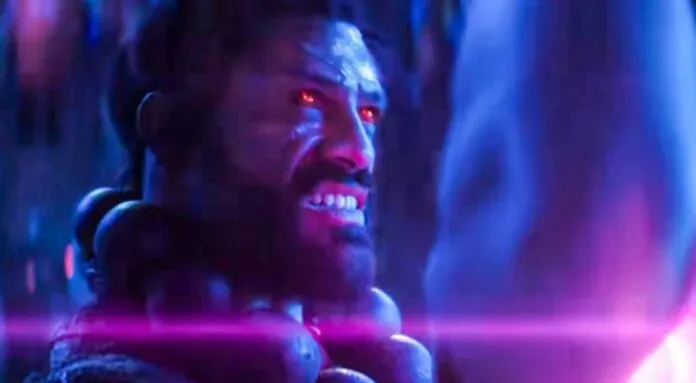
Roman Reigns has spent much of his WWE career performing in an environment where every impact is felt, every fall has to be timed precisely, and every major match asks performers to put their bodies on the line in front of a live audience. That background made one aspect of his work on the upcoming Street Fighter movie especially enjoyable: he did not have to take the falls himself.
Reigns plays Akuma in the new film, which is scheduled to arrive in theaters on Friday, October 16. During a promotional interview with HeyUGuys alongside Eric Andre and David Dastmalchian, the WWE star was asked about the difference between screen combat and the physicality involved in professional wrestling. Reigns gave a humorous, candid answer that highlighted the value of the stunt team working behind the scenes.
“I didn’t fall down once,” Reigns said with a laugh. “Every time it was time to fall down, Niko, get up [in there]. I’m going over there with Langston and we’re gonna go up on the perch. You know, being live live in WWE, having to fall down and throw your body all over the ring, I love it when we’re in the moment but it’s grueling. So, to be able to have that as a blessing, beautiful.”
Reigns Sees the Difference Between a WWE Ring and a Movie Set
The comment reflects a key distinction between WWE and action filmmaking. Both worlds depend on choreography, timing, athleticism, trust and performers who understand how to make combat look convincing. However, a WWE match unfolds live and cannot simply stop for another attempt if something does not look right. Wrestlers must execute in real time while reacting to opponents, referees, the audience, television cameras and the shifting demands of the match itself.
For more background on this topic, read Laynie Luck Expects WWE EVOLVE Matches To Air Through The Rest Of 2026.
That live setting also means the physical strain accumulates quickly. A wrestler may spend several minutes being knocked down, landing on the canvas, running the ropes, lifting another athlete, absorbing strikes and producing the kind of high-impact sequences that are central to WWE’s presentation. Even when performed by trained professionals, the ring is not a soft landing surface in the way audiences may assume.
Film productions can approach action from a different angle. A fight scene can be built in individual pieces, with specific shots designed around performers, stunt doubles, camera placement and editing. A stunt performer can step in for the most demanding falls or dangerous movements, allowing the actor to focus on the close-up material and character work. Reigns’ remarks made clear that he appreciated that division of labor, particularly after years in a profession where there is no substitute available once the bell rings.
His reference to “being live live” in WWE is especially telling. The spontaneity and immediacy of wrestling are major parts of its appeal, but they are also why its physical workload is so different from filming a sequence that can be reset. Reigns did not diminish the work involved in movie combat; instead, he celebrated the opportunity to let specialists handle impacts that WWE performers routinely take on themselves.
Akuma Brings Reigns Into a Major Video Game Adaptation
Reigns’ role as Akuma places him in one of the most recognizable fighting-game properties in the world. Akuma has long been presented as an imposing and dangerous presence within the Street Fighter universe, making the role a natural fit for a performer whose WWE identity has been built around dominance, intensity and championship-level confidence.
For Reigns, the casting provides an opportunity to bring a character to life outside the WWE arena while still drawing on traits that have made him a central figure in sports-entertainment. His on-screen WWE persona is defined by poise, authority and an ability to command attention before any physical confrontation begins. Those qualities can translate effectively to a character such as Akuma, particularly in a film where larger-than-life fighters are expected to have a distinct visual and emotional presence.
The movie also includes other familiar names from the wrestling world. Cody Rhodes appears as Guile, while New Japan Pro-Wrestling’s Hirooki Goto is set to portray E. Honda. The casting gives the film a notable professional-wrestling footprint, with talent from WWE and NJPW taking on characters from the game’s expansive roster.
Rhodes and Reigns, of course, share considerable history in WWE. Their involvement in the same film is another crossover moment for two stars whose paths have been closely connected on WWE programming. Goto’s inclusion adds another dimension, bringing a respected NJPW veteran into the project as E. Honda.
A Different Type of Teamwork
Wrestling and filmmaking both rely heavily on trust, though that trust is applied in different ways. In WWE, competitors trust each other to execute moves safely while preserving the urgency of a fight. The audience sees the complete exchange as it happens, and performers have to make rapid adjustments based on positioning, timing or the flow of the crowd.
On an action-film set, actors and stunt professionals work through a more segmented process. Reigns’ mention of Niko and Langston underscored the collaboration involved in creating the movie’s action. While he moved to another part of the sequence, stunt performers could take responsibility for the falls. That is not merely a matter of convenience; it is a specialized craft that allows productions to create ambitious action while managing the physical demands placed on their cast.
Reigns’ appreciation for that process comes from knowing exactly what falling repeatedly requires. In WWE, taking a bump is a fundamental part of the job. The most experienced stars make it look effortless, but the repetition can be punishing. Reigns described WWE’s physicality as something he loves while acknowledging that it is “grueling,” a balanced assessment from someone who has competed at the highest level for years.
His comments also offer an interesting look at how wrestlers can adapt their skills to other forms of entertainment. The presence, athletic coordination and camera awareness developed in WWE can be valuable on a film set. At the same time, the movie environment asks performers to understand a different system, one where the final action scene is assembled through multiple takes and perspectives rather than delivered from beginning to end in one live performance.
Reigns Remains Active Following Money In The Bank
While Street Fighter gives Reigns a major project outside the ring, his WWE accomplishments remain central to his standing. Reigns recently defeated LA Knight at the Money In The Bank premium live event, adding another significant victory to his record.
The match with Knight put Reigns in the ring with one of WWE’s most prominent personalities, and the result reinforced Reigns’ ability to remain a decisive force when he competes. Whether he is delivering an intense promo, stepping into a high-profile match or moving into a new medium such as film, Reigns continues to carry the aura of a performer accustomed to major stages.
There is also a contrast between the two sides of his current workload. In WWE, Reigns is expected to deliver live drama with the inherent physical risks that come with the ring. In Street Fighter, he is taking on a character-driven action role supported by the controlled structure of a movie production and the expertise of stunt doubles. His lighthearted reaction to avoiding the falls does not suggest he has lost appreciation for wrestling. Rather, it shows why a different approach can feel like a welcome luxury.
A Well-Earned Break From the Bumps
Roman Reigns’ description of the experience was simple and memorable: when it was time for someone to hit the ground, he could let the stunt team take over. For a WWE performer whose job has regularly involved throwing his body into the ring and absorbing the consequences in front of a live crowd, that is easy to understand.
Reigns still emphasized that he loves the feeling of being in the moment in WWE. Yet he was equally open about the toll of that work and why the production’s stunt setup felt like a “blessing.” It is a reminder that the physical credibility wrestlers bring to the screen is earned through a demanding profession, even when a movie allows them to step aside for the most punishing part of the action.
With Reigns as Akuma, Rhodes as Guile and Goto as E. Honda, Street Fighter will give wrestling fans several familiar faces to watch when it reaches theaters on October 16. For Reigns, it will also mark a role where the fight scenes may be intense, but at least the repeated falls belong to someone else.

Darryl Polo
Darryl Polo is a passionate wrestling fan covering WWE, AEW, TNA and beyond. He loves great rivalries, breakout stars and the moments that keep fans talking long after the bell. How we work.